Coordinating Same-Day Turnovers Guide for Hosts
Master the art of coordinating same-day turnovers with our comprehensive guide, ensuring timely cleanings and satisfied guests every time.
Coordinating Same-Day Turnovers Guide for Hosts
Running a reliable same-day turnover comes down to one system, not a stack of last-minute texts: a time-bound cleaning SOP, automation that turns bookings into verified tasks the moment they land, and a staffed backup layer that catches what the SOP alone cannot. Build all three and missed cleans stop being a recurring emergency.
Here’s what that looks like in practice:
- A standardized, timed checklist that tells every cleaner exactly what happens minute by minute, not “clean the unit.”
- Booking-to-task automation with scheduling rules that block same-day requests you can’t actually staff.
- Backup staffing plus photo verification so a no-show or a late checkout never turns into a bad review.
Hosts who run this framework typically see fewer late starts, faster turnarounds, and far fewer cleanliness complaints from guests. Airbnb’s timing controls and NAA turnaround benchmarks back the operational side of this; a platform like RealtevoOS handles the automation layer that ties it together.
Key Takeaways
Reliable same-day turnovers depend on a timed cleaning SOP, booking-to-task automation, and a staffed backup layer working together, not any single fix alone.
| Point | Details |
|---|---|
| Standardize the SOP | Give cleaners a timed, laundry-first checklist so pacing never depends on guesswork. |
| Automate booking to task | Auto-generate cleaning jobs at booking confirmation with the right checklist attached. |
| Set capacity-based scheduling rules | Use advance notice and preparation time to block same-day bookings you can’t staff. |
| Build a real backup layer | Confirmation windows and auto-offer to backups prevent single-cleaner dependency. |
| Consolidate with RealtevoOS | RealtevoOS automates task creation, photo verification, and backup dispatch in one dashboard. |
Table of Contents
- Why Do Same-Day Turnovers Fail?
- What Does a Same-Day Turnover Workflow Look Like Step by Step?
- How Do You Standardize Checklists for Different Turnover Types?
- How Can You Automate Bookings Into Verified Cleaning Tasks?
- How Do You Centralize Cleaner Communication and Verification?
- What Staffing Model Prevents a Single Point of Failure?
- Which Platform Settings Reduce Impossible Same-Day Bookings?
- What KPIs Should You Track for Turnover Reliability?
- How RealtevoOS Improved One Operator’s Turnover Reliability
- What Hosts Get Wrong About Same-Day Turnovers
- Ready to Run Same-Day Turnovers Without the Chaos
- Frequently Asked Questions About Same-Day Turnovers
- Sources
Why Do Same-Day Turnovers Fail?
Most same-day turnover failures trace back to the same handful of gaps, and they compound fast during a busy weekend.
- No clear timeline — cleaners guess at pacing instead of working against a set clock.
- Inconsistent checklists — every cleaner interprets “ready” differently.
- Single-person dependency — one cleaner cancels and there’s no plan B.
- Linen shortages — no par level means a scramble mid-shift.
- Late checkouts — guests linger past 11 a.m. and the whole schedule shifts.
- No photo verification — you find out about a missed spot from the next guest, not your team.
- Communication gaps — a text sent to the wrong group chat gets missed entirely.
The NAA’s apartment turnover guidance notes that even standard make-ready work runs 3 to 7 business days when it’s planned. Compress that into a same-day window with a group text and a shared spreadsheet, and small delays cascade into a guest standing outside a locked door later in the afternoon.
What Does a Same-Day Turnover Workflow Look Like Step by Step?
A same-day turn works when every step has an owner and a clock. Here’s the sequence that holds up under pressure:
- Booking triggers task creation — the reservation system auto-generates a cleaning job the moment checkout is confirmed.
- Cleaner arrival and walkthrough audit — a quick scan for obvious damage or missing items before work starts.
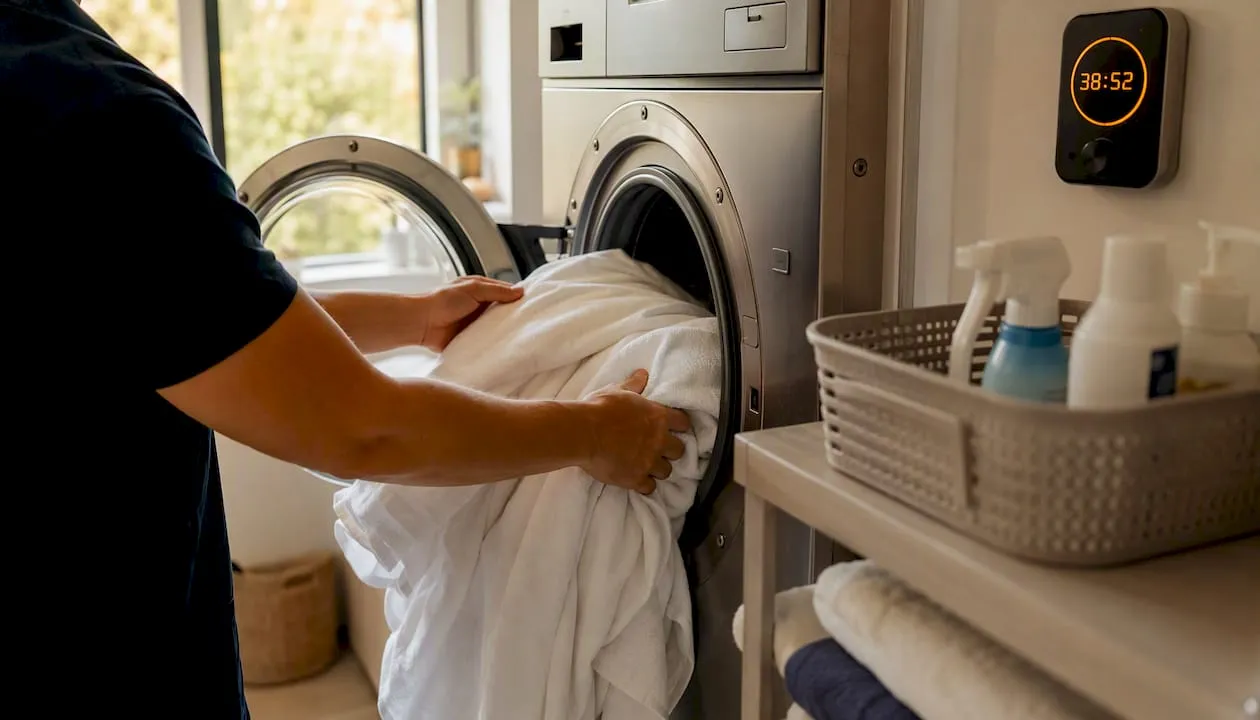
- Laundry launch — sheets and towels go in first, since the wash cycle is the one task you can’t rush.
- Wet-area cleaning — bathrooms and kitchens get tackled while laundry runs.
- Bedrooms and living spaces — beds, surfaces, and floors in the dry rooms.
- Floors and staging — final vacuum, staged decor, welcome touches.
- Photo verification — timestamped shots of key checkpoints uploaded to the job record.
- Guest access released — the smart lock code or check-in message goes out only after verification clears.
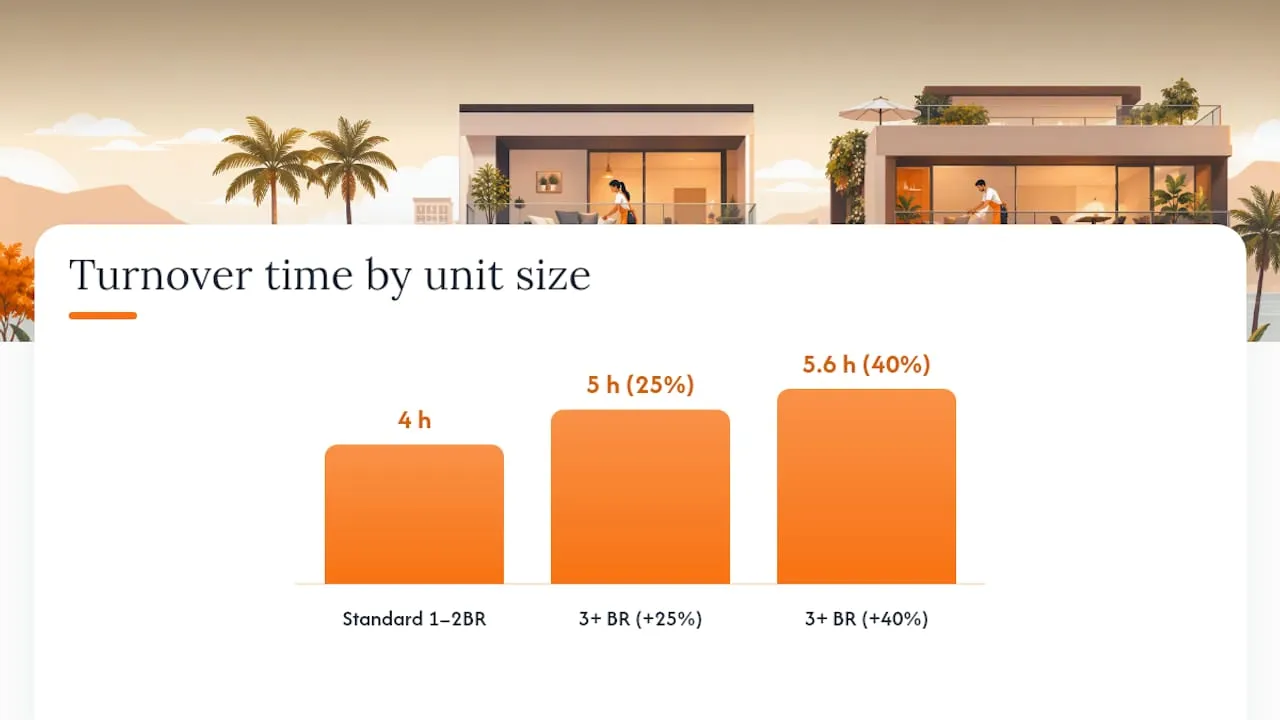
Timing depends on unit size, but the cleaner SOP that consistently avoids drama is built around a roughly four-hour flip for a standard one- or two-bedroom unit.
Larger units with three or more bedrooms scale most of these numbers up by 25 to 40 percent, and laundry becomes the real bottleneck since one machine can’t keep pace with multiple bedroom sets.
Pro Tip: Start laundry the second the cleaner walks in, before anything else. If a cleaner isn’t on-site within 30 minutes of checkout, trigger an automatic alert to your backup crew rather than waiting to see if they show up late.
How Do You Standardize Checklists for Different Turnover Types?
Not every changeover needs the same level of work, and treating them all the same either wastes labor hours or leaves gaps.
- Quick same-day turn — standard clean between back-to-back bookings, tight timeline, no deep-clean tasks.
- Standard turnover — normal gap of a day or more, allows for a full reset and minor maintenance checks.
- Deep clean — quarterly or after longer stays, covers baseboards, appliances, upholstery, and grout.
A copy-ready checklist template should list each task with an estimated time and a photo checkpoint: strip and remake beds (8 min, photo of made bed), sanitize bathroom surfaces (10 min, photo of counter and toilet), restock supplies (5 min, photo of stocked shelf), final staging (5 min, photo of living room). Keep linen par levels at three full sets per bedroom so a slow laundry day never stalls a turn, and store backup sets in a labeled bin the cleaner can access without a host phone call.
Pro Tip: Print your checklist categories directly into your owner reporting checklist so quality tracking and cleaning verification live in the same document owners already see.
How Can You Automate Bookings Into Verified Cleaning Tasks?
Automation is what turns a good checklist into a system that runs without your phone buzzing all day.
- Auto-create a job at booking confirmation, with the correct checklist template attached automatically based on unit type.
- Assign a primary cleaner and a backup in the same step, not after something goes wrong.
- Set a confirmation window — typically two hours — so unconfirmed jobs auto-route to the backup before it’s too late to matter.
- Apply scheduling rules that block same-day bookings when your available cleaning capacity is already at zero.
Airbnb’s own availability settings let hosts configure advance notice and preparation time, and preparation time defaults to blocking one hour before and after each booking. Treat these less like calendar preferences and more like capacity controls: they’re the platform’s built-in way of refusing a booking you can’t actually service.
Pro Tip: Set preparation time to match your realistic turnover window, not your best-case scenario. A one-hour buffer looks flexible on paper but leaves zero room for a late checkout during your busiest weeks.
How Do You Centralize Cleaner Communication and Verification?
Group texts and scattered spreadsheets are the single biggest source of missed same-day cleans, because nothing forces confirmation and nothing gets logged.
- Run every job through one dispatch board where task status, confirmations, and photos live in a single place, not six different chat threads.
- Standardize photo checkpoints — kitchen counter, bathroom, bedroom, and full-room wide shot, each timestamped automatically on upload.
- Use short status templates for cleaners (“Arrived 1:05 PM, laundry started”) and for guests (“Your unit passed final inspection, check-in code active”).
This kind of centralized model is exactly what coordinating cleaning teams across multiple properties requires once you’re managing more than a couple of units, since ad-hoc texting simply can’t scale past that point.
Pro Tip: Auto-name photo files by property address and timestamp (e.g., “Oak_St_204_1442.jpg”) so a disputed cleanliness claim takes seconds to resolve instead of a day of digging through camera rolls.
What Staffing Model Prevents a Single Point of Failure?
Every same-day turnover system eventually gets tested by a cleaner who cancels an hour before checkout, and your staffing shape determines whether that’s a non-event or a crisis.
- In-house teams work best for hosts with five or more units in one area, since you control training and standards directly.
- Local contractor pools give flexibility for smaller portfolios but need a written rate sheet and onboarding process, covered in more detail in hiring a cleaning service for your vacation rental.
- On-call backup squads exist purely for contingency: they don’t get regular shifts, but they’re pre-vetted and ready when someone bails.
Automated dispatch with a strict confirmation window and auto-offer to backups when a cleaner doesn’t respond in time is one of the most effective ways to cut no-shows and speed up replacement response.
Pro Tip: Charge a same-day priority fee, typically 20 to 30 percent above your standard cleaning rate, and be upfront about it with backup cleaners. That premium is what keeps a backup crew willing to drop everything on short notice.
Which Platform Settings Reduce Impossible Same-Day Bookings?
Some same-day turns fail before the booking even confirms, because the listing settings allowed a reservation the operation could never service.
- Advance notice settings control how much lead time you require before check-in, which directly limits last-minute same-day requests.
- Preparation time blocks a set window around every checkout, and Airbnb allows custom windows from 15 minutes up to six hours or more.
- Check-in and check-out windows should be aligned with your realistic turnover speed, not squeezed to maximize booking flexibility.
A simple house-rules line covers most guest expectations: “Same-day check-ins are subject to availability confirmation and may require a later check-in time to ensure the unit is guest-ready.” These settings function as genuine operational safeguards, not just calendar housekeeping, according to Airbnb’s own availability documentation.
What KPIs Should You Track for Turnover Reliability?
Six numbers tell you whether your same-day turnover system is holding up or quietly breaking down.
- Same-day clean success rate
- Average turnover time
- Late-start incidents
- Rework rate (guest-flagged issues after cleaning)
- Guest cleanliness complaints per stay
- Cleaner confirmation rate
Watch the critical dashboard daily; roll up a weekly summary for owners and staff reviews.
How RealtevoOS Improved One Operator’s Turnover Reliability
One multi-property operator running manual coordination through texts and spreadsheets struggled with missed cleans whenever back-to-back bookings landed on the same day. After adopting RealtevoOS to automate booking-to-task conversion, enforce photo verification, and trigger backup assignment on missed confirmations, the operator reported meaningfully fewer missed same-day turns and hours saved weekly on manual dispatch.
A 30-day pilot checklist looks like this:
- Configure booking-to-task automation rules and confirmation windows.
- Import your standardized checklist templates by unit type.
- Train two cleaners on the photo verification workflow before scaling further.
- Run daily QA reviews on every completed job for the first two weeks.
Pro Tip: Track confirmation rate and late-start incidents weekly during weeks 1 and 2, then shift to same-day success rate as your primary metric by week 3 once the basics are dialed in.
What Hosts Get Wrong About Same-Day Turnovers
Most advice on this topic treats same-day turnovers as a cleaning problem. It isn’t. It’s a scheduling and communication problem that happens to end with a mop. The cleaning itself is almost never what fails; a competent cleaner can flip a one-bedroom in four hours without much drama. What fails is everything around the clean: nobody confirmed the cleaner was actually coming, nobody blocked the booking that made the turn physically impossible, and nobody checked the work before the next guest walked in.
The conventional fix, hiring more cleaners, misses the real lever. More staff without a confirmation system just means more people you’re chasing down by text. What actually moves the needle is treating your booking settings as capacity controls, not calendar preferences, and treating photo verification as non-negotiable rather than optional.
If you take one thing from this guide, prioritize the automation layer before the staffing layer. A great backup crew can’t save a turnover that was never scheduled correctly in the first place.
Ready to Run Same-Day Turnovers Without the Chaos
Spreadsheets and group texts get you through a slow month, but they fall apart the moment three checkouts land on the same Saturday. Realtevoos is built specifically for that pressure point: it converts each booking into a verified cleaning task automatically, routes unconfirmed jobs to backup cleaners before a gap turns into a missed clean, and keeps every timestamped photo in one dashboard instead of scattered across phones.

That means less time spent chasing confirmation texts and more certainty that every unit passes inspection before a guest arrives. If you’re managing more than a handful of properties, the management deck gives you a single view of every turnover in progress, who’s assigned, and what’s still pending verification. Start a free trial at RealtevoOS and configure your first automated turnover rule today.
Frequently Asked Questions About Same-Day Turnovers
What is the best way to start coordinating same-day turnovers for the first time? Begin with a written, timed checklist and a confirmed backup cleaner before adding any automation software. Get the process right manually first, then automate it.
How much extra should a same-day turnover cost compared to a standard clean? Most operators charge a priority fee of roughly 20 to 30 percent above the standard rate to compensate cleaners for the tighter, higher-pressure window.
Can automation fully replace texting cleaners directly? Automation should replace ad-hoc texting for dispatch and confirmation, but a direct message channel still matters for genuine emergencies like property damage or a locked-out cleaner.
What happens if a same-day booking arrives after preparation time has already blocked the slot? The booking simply won’t be available to guests, which is exactly what preparation time settings on platforms like Airbnb are designed to do.
How many backup cleaners does a small host actually need? One reliable backup per two to three active cleaners is a reasonable starting ratio, scaling up as your same-day booking volume increases.