The Real Role of SaaS in Vacation Rentals
Discover the true role of SaaS in vacation rentals—automate pricing, optimize guest communication, and boost your revenue effortlessly!

The Real Role of SaaS in Vacation Rentals
Most property managers still think of vacation rental software as digital paperwork. A calendar here, a booking confirmation there. That framing is costing them real money. The role of SaaS in vacation rentals has shifted dramatically. Today’s platforms do not just organize your tasks. They price your listings in real time, handle guest questions through AI, dispatch cleaning crews automatically, and generate financial reports without you touching a spreadsheet. The U.S. short-term rental market grew 21.51% year-over-year in 2025, and the operators winning that growth are not working harder. They are using smarter software.
Table of Contents
- Key Takeaways
- The Role of SaaS in Vacation Rentals Today
- How SaaS drives revenue and occupancy
- Automating operations and improving guest experience
- Choosing and implementing the right SaaS platform
- My honest take on SaaS in vacation rentals
- How Realtevoos powers your vacation rental operations
- FAQ
Key Takeaways
| Point | Details |
|---|---|
| SaaS goes beyond booking tools | Modern vacation rental SaaS platforms automate pricing, guest communications, reporting, and maintenance coordination. |
| Revenue impact is measurable | AI-driven dynamic pricing and guest support automation can increase revenue by 18% compared to market averages. |
| Automation reduces operational labor | Property managers report saving several hours each week by automating routine guest messages and task dispatching. |
| Choosing the right platform matters | Evaluate SaaS tools by feature depth, scalability across properties, and integration with Airbnb and Vrbo. |
| Human oversight stays critical | Automation without accountability produces blind spots. Regular auditing of SaaS performance keeps results improving. |
The Role of SaaS in Vacation Rentals Today
The vacation rental industry has a fragmentation problem. Listings live on Airbnb, Vrbo, and direct booking sites simultaneously. Guest messages come from multiple channels. Maintenance requests pile up in text threads. Financial data sits in disconnected spreadsheets. What SaaS solutions for rentals actually do is collapse all of that into a single operating layer.
At the core level, every serious vacation rental management software platform covers these capabilities:
- Unified calendar management that syncs availability across all distribution channels in real time, eliminating double bookings
- Centralized guest messaging that pulls conversations from every platform into one inbox
- Automated financial reporting that tracks revenue, expenses, and occupancy without manual data entry
- Task management tools that assign cleaning and maintenance jobs to the right person automatically after checkout
- Channel management that pushes rate and availability updates to every booking platform simultaneously
Beyond those fundamentals, cloud-based tools for vacation rentals have added a layer of intelligence that changes what is possible. AI-powered pricing tools now update rates daily based on local demand, competitor pricing, and seasonal patterns. AI chatbots handle routine guest questions around the clock without waking anyone up. Review management tools draft responses automatically and flag negative feedback before it becomes a reputation issue.
Pro Tip: When evaluating vacation rental management software, ask specifically how the platform handles cross-channel pricing updates. A tool that syncs rates every 24 hours is already behind one that updates in real time based on live demand signals.
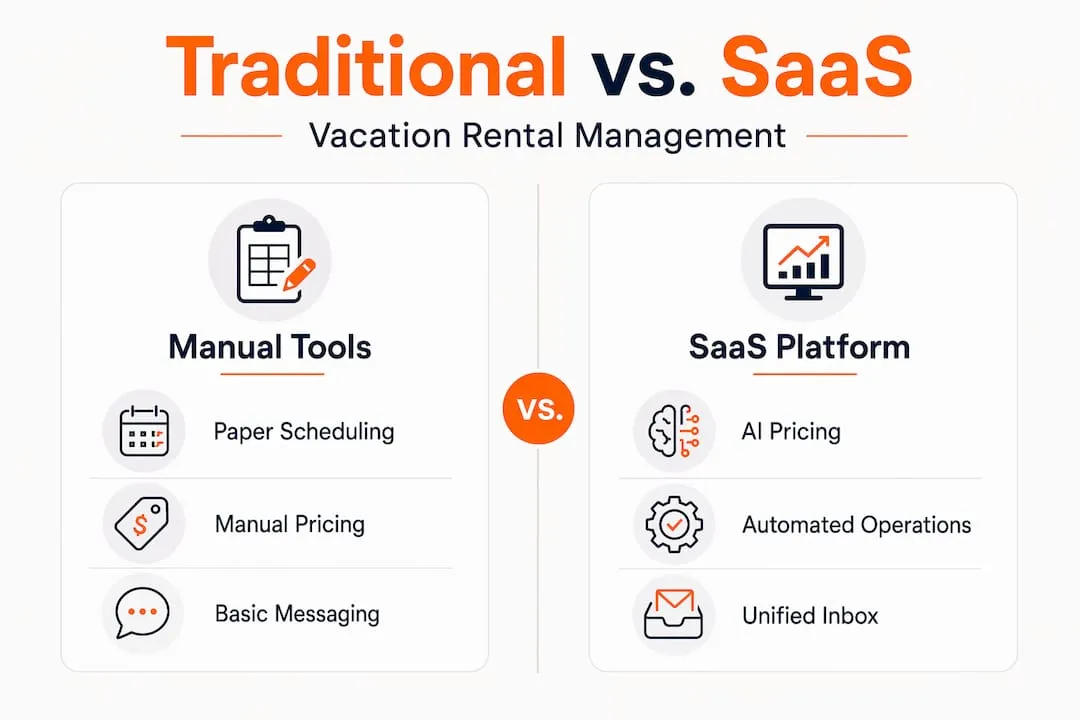
This is what makes SaaS fundamentally different from traditional property management tools. It is not software that waits for you to act. It acts on your behalf based on rules, data, and increasingly, AI judgment.
How SaaS drives revenue and occupancy
The most skeptical property managers usually come around when they see the revenue numbers. The SaaS impact on property management is not just about saving time. It shows up directly in occupancy rates and earnings per listing.
Here is a comparison of typical performance outcomes with and without AI-driven SaaS tools:
| Metric | Without AI-Driven SaaS | With AI-Driven SaaS |
|---|---|---|
| Pricing updates | Manual, weekly or less | Automated daily or real-time |
| Guest inquiry response time | Hours | Minutes or instant |
| Occupancy rate variance | Higher seasonal gaps | More consistent year-round |
| Revenue vs. market average | Baseline | Up to 18% above market |
| Search visibility | Standard OTA ranking | Up to 115% visibility increase via AI search |
The numbers behind these outcomes are real. Evolve, one of the largest vacation rental management companies in the U.S., deflects over 60% of routine guest inquiries using AI, and their properties show 18% more revenue and 9% more booked nights compared to market averages. That gap is not explained by location or property quality. It is explained by system design.
Dynamic pricing is where many operators first feel the difference. AI-driven pricing algorithms analyze supply and demand signals that no human could monitor manually at scale. A Friday night in a beach town during a local festival should not carry the same rate as a random Tuesday in February. SaaS platforms catch those differences automatically and adjust before you would even notice the opportunity.

For operators managing scaling rental portfolios, this is not a nice-to-have. It is the difference between running a business and leaving money sitting in your calendar.
Automating operations and improving guest experience
The operational case for SaaS is as strong as the revenue case. When you manage more than two or three properties, the coordination work multiplies faster than the income does. That is where cloud-based tools for vacation rentals stop being a convenience and start being a structural necessity.
Guest communication is the biggest time sink in most vacation rental operations. Guests ask about check-in codes, parking, early arrivals, and local restaurant recommendations, often at 11 PM. AI agents that handle guest messages across platforms like WhatsApp and iMessage mean those questions get answered instantly, without the host losing sleep. The guest gets a better experience. The host gets their evening back.
Beyond communication, automating vacation rental processes extends to the physical operation of properties:
- Automated checkout triggers that assign cleaning tasks to your team within minutes of a guest departure
- Predictive maintenance alerts that flag equipment wear before it becomes a guest-facing problem
- Damage report systems that collect photo evidence and documentation automatically
- Review response tools that draft replies using the context of the original guest feedback
- Micro-SaaS tools like automated SMS dispatchers and AI-powered review responders that target specific operational pain points
The mental load reduction is real and underappreciated. Software that proactively assists hosts rather than simply organizing their tasks represents a genuine shift in how property management works day-to-day. Operators report not just time savings but reduced anxiety about whether things are being handled.
Pro Tip: Automation works best when you set clear escalation rules. Decide upfront which guest situations require a human response and which ones your SaaS platform can handle independently. A guest asking for the wifi password is not the same as a guest reporting a broken furnace.
Choosing and implementing the right SaaS platform
Not every platform fits every operation. A solo host managing two properties in one city has different needs than a professional manager running 40 listings across three states. Matching the right vacation rental management software to your actual situation takes some honest evaluation.
Here is a framework for comparing your options:
| Evaluation Criteria | What to Look For |
|---|---|
| Feature depth | Does it cover pricing, messaging, reporting, and task management in one place? |
| Channel integrations | Does it connect natively with Airbnb, Vrbo, and your direct booking site? |
| Scalability | Can you add properties without rebuilding your workflows? |
| Reporting quality | Can you pull property management reports by property, date range, and revenue type? |
| AI capabilities | Does the platform use AI for pricing, guest messaging, and performance forecasting? |
| Pricing model | Does the cost scale reasonably as your portfolio grows? |
Once you have identified a shortlist, the implementation process matters as much as the selection. Follow these steps to avoid the common pitfalls that derail SaaS rollouts:
- Audit your current workflows before onboarding. Document what you do manually so you know exactly which tasks the platform needs to cover.
- Migrate one property first. Run it on the new platform for two to four weeks before adding the rest of your portfolio.
- Set up your automation rules carefully. Pre-written guest message templates and pricing guardrails need your input before they run unsupervised.
- Connect your channels last. Establish your internal workflows before syncing with external booking platforms to avoid rate or availability conflicts.
- Review performance monthly. SaaS platforms generate data. Use it. Look at which properties are underperforming and investigate whether the settings are optimized.
The biggest mistake operators make is treating SaaS onboarding as a one-time event. The platforms that deliver the most value are the ones that get actively managed, reviewed, and adjusted as your business evolves.
My honest take on SaaS in vacation rentals
I have spent years watching property managers adopt SaaS tools with great enthusiasm and middling results, not because the tools failed them, but because they treated automation as a destination rather than a practice.
In my experience, the operators who extract the most value from SaaS are not the ones with the most features turned on. They are the ones who know exactly what they want those tools to accomplish and check regularly whether that is happening. Effective AI and automation produce measurable results when they are tied to clear customer outcomes and profit metrics. Vague implementation produces vague results.
What I have also learned is that the conversation in this industry tends to oscillate between two extremes. Either SaaS is going to replace everything a property manager does, or it is overhyped software that cannot replace genuine hospitality. Both positions miss the point. Human accountability in SaaS management means oversight, auditing, and continuous evaluation. Automation handles the repeatable tasks reliably. Humans handle the exceptions, the judgment calls, and the strategy.
My honest advice: pick a platform that forces you to think about your business more clearly, not one that promises to run it without you. The best SaaS tools surface better questions, not just better answers.
— Jose
How Realtevoos powers your vacation rental operations
If you are managing multiple properties and still spending hours each week on reports, messages, and scheduling coordination, that time is coming directly out of your growth capacity. Realtevoos was built specifically to solve that problem.

Realtevoos consolidates your entire operation into one AI-powered command center. It pulls live data from Airbnb and Vrbo, automates guest communications, and generates financial reports without you building them manually. Property managers using Realtevoos report saving several hours each week while maintaining guest satisfaction scores across a growing portfolio. The platform scales with you, whether you are managing five properties or fifty, without requiring you to rebuild your workflows as you grow. If you are ready to stop managing your management software and start using it as a real growth tool, Realtevoos is worth a close look.
FAQ
What is SaaS for vacation rentals?
SaaS for vacation rentals refers to cloud-based software that property managers access via subscription to handle operations like booking management, guest messaging, dynamic pricing, and financial reporting without installing local software.
How does SaaS improve vacation rental revenue?
AI-driven SaaS tools use dynamic pricing algorithms that update rates based on real-time demand, helping operators earn more per booking. Properties using these tools have seen up to 18% more revenue compared to market averages.
Can SaaS handle guest communications automatically?
Yes. AI-powered guest support tools can deflect over 60% of routine inquiries automatically, responding via the platforms guests already use like WhatsApp and email, without host involvement.
What should I look for in vacation rental management software?
Prioritize platforms that offer native channel integration with Airbnb and Vrbo, AI-driven pricing, unified guest messaging, and reporting tools that cover individual property performance without manual data entry.
Is SaaS worth it for small vacation rental portfolios?
Even operators with two or three properties benefit from SaaS by eliminating double bookings, automating guest messages, and accessing pricing data they could not track manually. The time savings alone typically justify the cost within the first month.