The Role of Automation in Scaling Rentals in 2026
Discover the role of automation in scaling rentals by 2026. Unlock efficient workflows, enhance guest management, and scale without stress!

The Role of Automation in Scaling Rentals in 2026
Automation is the operational backbone that allows vacation rental managers to grow their portfolios without hiring a proportional number of new staff. The role of automation in scaling rentals is to convert repetitive, time-intensive tasks into reliable digital workflows that run 24 hours a day, 7 days a week. Tools like Hospitable, PriceLabs, and Turno have made it possible for solo operators to manage what once required entire teams. Without automation, operators scaling beyond 8 to 12 units hit a chaos ceiling where manual labor outpaces revenue gains. With it, the ceiling disappears.
What are the key operational areas where automation drives rental scaling?
Automation in property management touches every function that consumes a manager’s day. The four areas with the highest leverage are guest communications, dynamic pricing, cleaning coordination, and owner reporting.
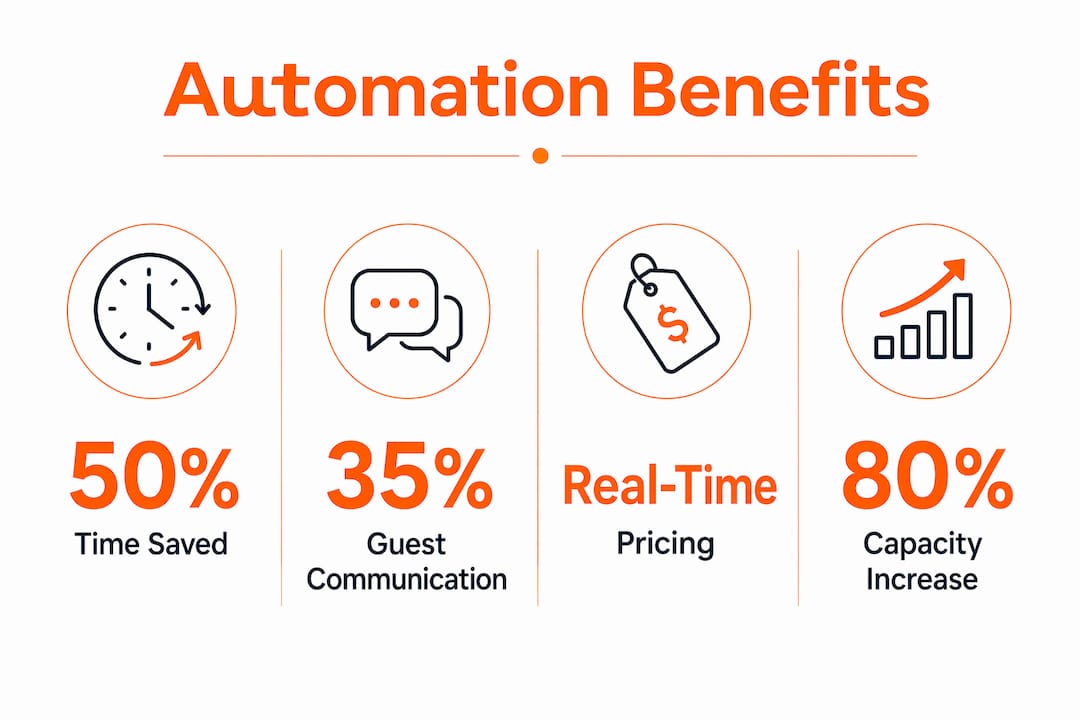
Guest communications represent the single largest time drain. Property managers spend 35% of their working hours on communication tasks that are partially or fully automatable. That is more than a third of every workday spent on messages that a well-configured tool can handle. Hospitable, for example, automates multi-channel messaging across Airbnb and Vrbo, sending pre-arrival instructions, check-in codes, and review requests without any manual input.
Dynamic pricing is the second major area. PriceLabs adjusts nightly rates in real time based on local demand, competitor data, and seasonal patterns. Managers who set pricing manually once a week leave revenue on the table every single day. Automated pricing tools respond to market shifts within hours, not weeks.

Cleaning and maintenance coordination is where operational bottlenecks form fastest at scale. Turno and Breezeway automate turnover scheduling, assign cleaners based on availability, and send photo-verified completion reports. Without this layer, a manager with 20 properties is manually texting cleaners after every checkout.
Owner reporting closes the loop. Automated reporting tools pull performance data from Airbnb and Vrbo and deliver formatted summaries to property owners on a set schedule. This builds trust without requiring the manager to spend hours assembling spreadsheets. For a deeper look at how automated reporting workflows improve owner relationships, the mechanics are worth understanding before you scale past 10 units.
Pro Tip: Automate guest messaging first. It is the fastest win and frees up mental bandwidth to tackle pricing and turnover systems next.
How does automation improve scalability metrics: ROI, time savings, and capacity?
The financial case for automation is not theoretical. Property management firms that reach advanced automation levels achieve an average ROI of 312% over three years, with a payback period of just 4 to 7 months for portfolios exceeding 50 units. That figure means every dollar invested in automation returns more than four dollars within three years. For a manager running 60 properties, that math changes the entire business model.
Time savings are equally dramatic. One solo manager handling 120 units cut communication overhead by 80% and reduced maintenance coordination time by 75%, increasing total capacity by 40% without a single new hire. That is not an outlier. It is what happens when automation replaces manual coordination at scale.
“At small scale, automation reclaims personal time. At 50+ units, the focus shifts to capacity management, enabling additional units without linear staff growth.” — Builts AI Case Study
The table below summarizes what automation delivers at different portfolio sizes.
| Portfolio size | Primary benefit | Key metric |
|---|---|---|
| 5 to 20 units | Time reclaimed for owners | Hours per week saved on messaging |
| 20 to 50 units | Operational consistency | Reduced errors, faster turnovers |
| 50+ units | Capacity and ROI | 312% ROI over 3 years, 40% capacity gain |
Tenant application processing shows a similar pattern. Automated screening reduces turnaround from 4 to 7 business days down to 24 to 48 hours. Faster approvals mean shorter vacancy windows, which directly improves annual revenue per unit.
What automation layers and technologies enable effective scaling?
Not all automation is equal. The most effective operators use a three-layer system that handles increasing levels of complexity.
-
Intelligent triage (Layer 1). This layer automatically sorts and responds to 40 to 50% of incoming inquiries using rule-based logic. Questions about check-in times, parking, and WiFi passwords never reach a human. The system answers them instantly, every time.
-
Context-aware AI (Layer 2). This layer handles more complex communications by pulling contextual data from the booking record, property details, and guest history. A Three-Layer Automation System combining these first two layers can automate up to 65% of total communication volume. That means two out of every three guest messages never require human attention.
-
Human-in-the-loop (Layer 3). This layer escalates genuinely complex situations to a human operator, but with full context already assembled. The manager sees the guest history, the booking details, and the prior automated responses before they type a single word. This design means human expertise handles complex cases with complete information rather than starting from scratch.
Leading operators treat AI not as a bolt-on feature but as foundational infrastructure embedded within their property management system. This approach creates consistency across distributed portfolios where a manager in one city maintains the same service standards across properties in three others.
Pro Tip: Build your automation stack in layers. Get Layer 1 working reliably before adding Layer 2. Skipping ahead creates gaps that frustrate guests and undermine the whole system.
Which automation tools and platforms lead in supporting scalable rentals?
The right tools depend on portfolio size and operational priorities. Here is how the leading platforms compare across the core functions.
| Function | Tool | Best for |
|---|---|---|
| Guest messaging | Hospitable | Multi-channel automation across Airbnb and Vrbo |
| Dynamic pricing | PriceLabs | Data-driven rate adjustments at any portfolio size |
| Cleaning coordination | Turno | Automated turnover scheduling and cleaner management |
| Maintenance workflows | Breezeway | Task tracking and property care checklists |
| Full PMS with AI | Realtevoos | Centralized operations, reporting, and AI-driven insights |
A few points worth noting about each category:
- Hospitable is the preferred choice for messaging automation because it handles multi-channel communication natively. Automated guest messaging tools like Hospitable reduce active management time per unit by 60 to 70%, which is the single largest time savings available to a growing operator.
- PriceLabs connects directly to most major property management systems and updates pricing daily based on real market data. Manual pricing at scale is simply not competitive.
- Turno and Breezeway solve different problems. Turno focuses on cleaner coordination and marketplace access. Breezeway focuses on property care workflows and maintenance checklists.
- For operators who want a single platform that consolidates all of these functions, a purpose-built PMS with integrated AI handles the full stack. Understanding how rental management intelligence systems work helps clarify why centralization matters more as portfolio size grows.
How can property managers implement automation strategically to scale successfully?
Implementation order matters as much as tool selection. The managers who scale without chaos follow a consistent sequence.
- Start with guest messaging automation before adding units. Getting Hospitable or a comparable tool configured correctly takes time. Do it at 5 units, not 25.
- Add dynamic pricing within the first month of any new property. PriceLabs or a similar tool pays for itself within weeks at most occupancy levels. Manual pricing is a revenue leak from day one.
- Automate cleaning coordination before turnover volume becomes unmanageable. At 10 or more units with frequent turnover, manual cleaner scheduling creates the first major bottleneck. Turno or Breezeway eliminates it.
- Audit your technology stack at every major growth milestone. What works at 10 units often breaks at 30. Review your tools, your standard operating procedures, and your communication templates every time you add a significant block of new properties.
- Use virtual assistants and AI to absorb volume before hiring local staff. Local staff are expensive, hard to train consistently, and difficult to scale quickly. AI handles volume. Humans handle judgment calls. Hire local staff only for tasks that genuinely require physical presence.
The rental operations scaling process follows a predictable pattern for operators who get this sequence right. Those who skip steps and add units before automating foundational workflows consistently hit the chaos ceiling described earlier.
Pro Tip: Document every automated workflow as a written SOP before you rely on it. When a tool fails or a configuration breaks, the SOP tells you exactly what the automation was supposed to do so you can fix it fast.
Key takeaways
Automation is the single most important lever for scaling vacation rental portfolios because it increases capacity, reduces errors, and delivers measurable ROI without requiring proportional staff growth.
| Point | Details |
|---|---|
| Automate messaging first | Guest communications consume 35% of manager time and are the fastest win at any portfolio size. |
| Layer your automation | A three-layer system automates up to 65% of communication volume while keeping humans on complex cases. |
| ROI is proven at scale | Portfolios above 50 units achieve 312% ROI over three years with a 4 to 7 month payback period. |
| Sequence matters | Implement messaging, pricing, and cleaning automation before adding units to avoid operational chaos. |
| Centralize as you grow | A unified PMS with integrated AI maintains consistency across distributed portfolios at any size. |
What I have learned after watching operators scale with and without automation
The operators who struggle most are not the ones with bad properties or weak markets. They are the ones who treat scaling as a volume problem when it is actually a systems problem. They add listings, then scramble to build the infrastructure that should have been in place first.
I have seen managers with 8 properties working 70-hour weeks and managers with 40 properties working 30-hour weeks. The difference is not talent. It is whether they automated messaging, pricing, and turnover before they grew, or after. The ones who automated first built a machine. The ones who automated after built a fire they were always fighting.
The human-in-the-loop principle is also widely misunderstood. Operators sometimes resist automation because they fear losing the personal touch that earns five-star reviews. That fear is backwards. When automation handles the routine, humans have more time and mental energy for the moments that actually matter: the guest with a genuine problem at 11pm, the owner who needs a real conversation about performance, the property that needs a judgment call no algorithm can make.
The operators consistently outperforming their markets in 2026 are not the ones with the most properties. They are the ones who built their automation stack deliberately, audited it regularly, and used the time it freed up to make better decisions rather than just handle more volume.
Scale your portfolio with Realtevoos
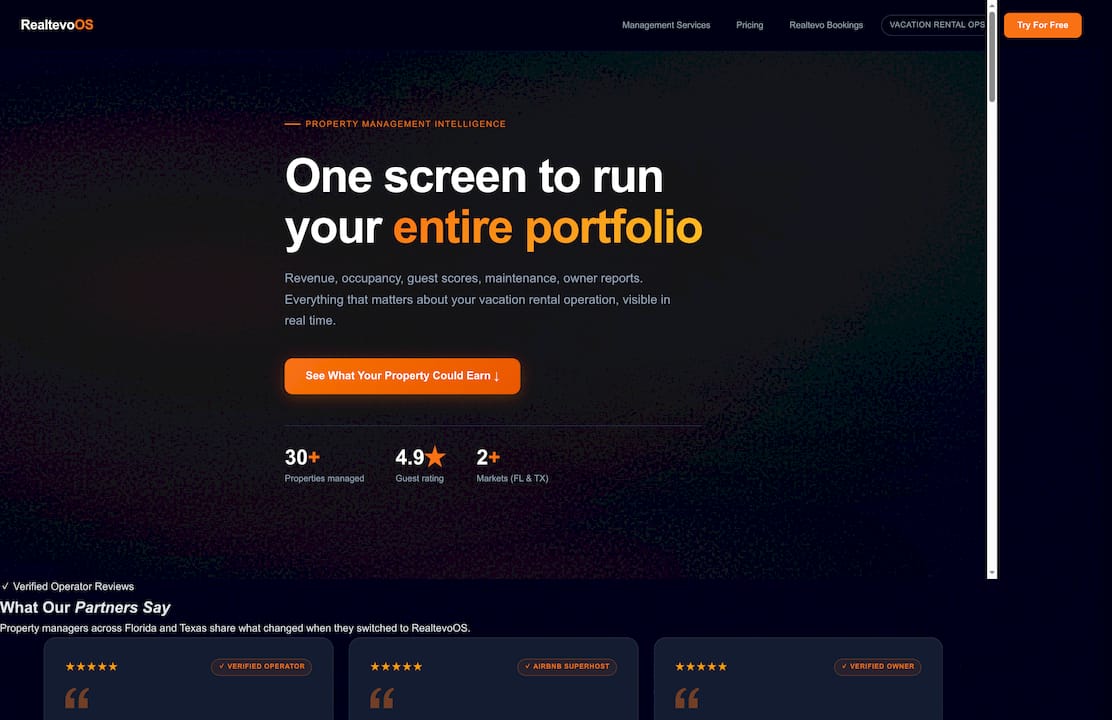
Realtevoos is built specifically for vacation rental managers who are serious about scaling without losing operational control. The platform centralizes guest communications, dynamic pricing, turnover coordination, and owner reporting in a single dashboard that pulls live data from Airbnb and Vrbo. AI-driven insights surface the decisions that matter most, from occupancy gaps to maintenance patterns, so you spend your time acting on information rather than hunting for it. Property managers using Realtevoos report saving several hours per week on manual tasks while maintaining higher guest satisfaction scores. If you are ready to build the operational foundation that makes growth sustainable, explore Realtevoos and see how the platform fits your current portfolio size and goals.
FAQ
What is the role of automation in scaling rental portfolios?
Automation converts repetitive manual tasks like guest messaging, pricing updates, and cleaning coordination into reliable digital workflows. This allows property managers to add units without proportional increases in workload or staffing.
When does automation start delivering ROI for rental operators?
At 20 to 30 units, automation primarily reclaims personal time. Above 50 units, the focus shifts to capacity management, with advanced automation delivering an average ROI of 312% over three years and a payback period of 4 to 7 months.
What happens if you scale without automation in place?
Operators scaling beyond 8 to 12 units without automation hit a chaos ceiling where manual labor increases faster than revenue. Quality declines, response times slow, and the business becomes harder to run with each new property added.
Which automation tool should vacation rental managers implement first?
Guest messaging automation, using tools like Hospitable, delivers the fastest return because it addresses the 35% of manager time spent on automatable communication tasks. It also frees up capacity to implement pricing and turnover systems next.
How does AI fit into vacation rental automation in 2026?
Leading operators treat AI as infrastructure embedded within their property management system rather than a standalone add-on. A three-layer AI system handles up to 65% of communication volume automatically while escalating complex cases to humans with full context already assembled.