Vacation Rental Marketing List: Your 2026 Growth Guide
Unlock growth with our vacation rental marketing list for 2026. Discover effective strategies to boost bookings and maximize revenue today!

Vacation Rental Marketing List: Your 2026 Growth Guide
Building a vacation rental marketing list that actually drives bookings is harder than most property owners expect. With millions of listings competing for the same guests on the same platforms, relying on a single tactic no longer moves the needle. What works in 2026 is a structured, multi-channel approach organized around the three stages every guest moves through: discovery, conversion, and retention. This guide gives you a practical, prioritized marketing channel list, a side-by-side comparison of costs and benefits, and a framework for deciding which strategies fit your property right now.
Table of Contents
- Key takeaways
- What makes a strong vacation rental marketing list
- 1. OTA listing optimization
- 2. Direct booking website
- 3. Professional photography and video
- 4. Search engine optimization for your property website
- 5. Email marketing to past guests
- 6. Social media organic content
- 7. Paid advertising on Google and Meta
- 8. Metasearch listings
- 9. Reviews management
- 10. Channel integration and automation technology
- Comparing channels: costs, roles, and where they fit
- How to decide what to prioritize
- My honest take on building a marketing system that works
- Put your marketing list into action with Realtevoos
- FAQ
Key takeaways
| Point | Details |
|---|---|
| Map channels to the guest journey | Organize your marketing by discovery, conversion, and retention to avoid wasted spend. |
| Budget 3–5% of gross revenue | A $60,000 property should allocate roughly $1,200–$3,000 annually across photography, ads, and tools. |
| Direct bookings save real money | Owners who capture direct reservations save 3%–16% in platform fees and build lasting guest loyalty. |
| Email requires data you own | OTAs block guest contact info, so email marketing only works if you capture data through your own channels. |
| Adjust strategy based on occupancy | When occupancy falls below 50%, prioritize OTA optimization. Above 75%, shift focus to direct bookings. |
What makes a strong vacation rental marketing list
A marketing channel list is only useful if you know why each item belongs. The industry term for this structured approach is a multi-channel distribution and retention strategy, and it works because different channels serve completely different purposes in the guest’s decision process.
The guest journey framework used by experienced operators breaks everything into three phases. Discovery is where strangers find you. Conversion is where browsers become bookers. Retention is where one-time guests become repeat revenue.

Budget is the second filter. Most property managers invest 3–5% of gross revenue on marketing, which means a $60,000 property has roughly $1,200 to $3,000 to allocate across channels each year. That money needs a plan, not scattered experiments.
Operational presentation also belongs on this list. Professional photos, clear listing copy, and responsiveness directly affect whether a potential guest clicks “book” or moves on. These are marketing assets, not operational afterthoughts.
Pro Tip: Before adding any new channel to your mix, ask yourself which guest journey stage it serves. If it doesn’t fit discovery, conversion, or retention, it probably isn’t worth the investment.
1. OTA listing optimization
Online travel agencies like Airbnb, Vrbo, and Booking.com are still the single most powerful discovery tool available to vacation rental owners. They bring enormous organic traffic you could not replicate independently, especially for new listings. Optimization here means filling out every available field, using high-resolution photos in the first three slots, and maintaining response times under an hour.
OTA algorithms reward listings with high engagement and fast responses. A fully optimized listing doesn’t just rank higher; it converts at a better rate because guests feel they’re getting complete, trustworthy information upfront.
2. Direct booking website
A direct booking site is where your short-term rental marketing strategies become a complete system. Without it, you cannot collect guest emails, offer exclusive discounts, or reduce your dependence on OTA fees.
Direct-booking incentives like 5–10% discounts, early check-in priority, or complimentary add-ons give guests a concrete reason to book with you directly. Pair those incentives with a booking-enabled website and a payment processor, and you have the infrastructure needed to capture direct reservations without relying entirely on third-party platforms.
3. Professional photography and video
This is the highest-ROI line item in most vacation rental marketing budgets. Listing optimization factors like professional photos and clear value propositions significantly boost conversions, and the effect on nightly rate is equally significant. Properties with professional photography consistently command higher prices and get more clicks at the same price point.
Video content takes this further. Short walkthroughs posted to Instagram Reels or YouTube Shorts let prospective guests visualize the experience before they book, which reduces hesitation and increases booking confidence.
4. Search engine optimization for your property website
SEO turns your direct booking site into a discovery channel on top of being a conversion tool. Targeting location-specific search terms like “beachfront cabin rental in [destination]” or “pet-friendly vacation home near [landmark]” attracts guests who are already researching but haven’t committed to an OTA listing yet.
The best approach combines on-page SEO with a small content strategy: destination guides, local activity posts, and seasonal travel tips. These pages build authority over time and draw traffic without ongoing ad spend.
5. Email marketing to past guests
Email is the highest-margin retention channel available to you. The catch is that OTA platforms do not provide guest contact info for remarketing purposes. Every email address you want for future campaigns must be captured through your own touchpoints.
A QR-based digital guestbook, a local experience guide PDF, or a post-stay feedback form can all serve as email capture tools on your property. Once you have that list, a simple quarterly newsletter with seasonal availability and a loyalty discount pays for itself with one rebooking.
6. Social media organic content
Instagram, Facebook, and TikTok work best as trust-building channels rather than direct conversion tools. Guests who discover your property through a piece of content and then check your feed before booking are looking for proof that your listing matches reality.
Storytelling across guest touchpoints consistently outperforms amenity-only posts. Instead of “fully equipped kitchen,” show a photo of the morning coffee setup with a caption about the nearby farmer’s market. That kind of content creates an emotional connection that a feature list cannot replicate.
7. Paid advertising on Google and Meta
Paid ads belong in the vacation rental promotion toolkit once your organic channels are working. Google Ads lets you appear for high-intent searches like “vacation rentals in [destination] this summer.” Meta ads on Facebook and Instagram let you retarget people who visited your direct booking site but didn’t complete a reservation.
The key is setting a defined budget and testing before scaling. A $200 to $300 monthly test on Google Ads can tell you whether paid search is viable for your market before you commit significant dollars.
8. Metasearch listings
Metasearch platforms like Google Vacation Rentals, Tripadvisor, and Kayak aggregate listings from multiple sources and show price comparisons side by side. Getting your property into these results requires either a channel manager that feeds your direct booking site data into the metasearch feed or a direct partnership with a distribution platform.
The margin advantage here is meaningful. Bookings that come through metasearch and land on your direct site carry the same 3%–16% fee savings as any other direct booking, but the guest found you through a high-traffic aggregator rather than a purely organic search.
9. Reviews management
Reviews are a conversion channel disguised as feedback. A consistent stream of recent, detailed positive reviews is one of the strongest signals to a hesitant guest that your property is worth booking. The operational behavior that generates great reviews, like stocking the kitchen well and responding to messages fast, is marketing behavior.
Actively requesting reviews post-stay and responding to every review, positive or negative, signals attentiveness to future guests browsing your listing. It also feeds the OTA algorithm since platforms weight review recency and volume.
10. Channel integration and automation technology
Calendar and booking syncing across 20+ platforms eliminates the double-booking risk that makes multi-channel marketing feel too risky for many owners. When availability is always accurate everywhere, you can list on more platforms without the operational anxiety.
Automation tools also handle guest messaging sequences, which are a marketing function. A well-timed pre-arrival message with local tips and a post-stay message requesting a review are both touchpoints that build the kind of guest experience that drives word-of-mouth referrals. For operators looking at rental operations scaling, this kind of automation is what makes adding properties feel manageable rather than overwhelming.
Comparing channels: costs, roles, and where they fit
Here is a practical side-by-side look at how the main channels stack up for a typical vacation rental property.
| Channel | Guest journey role | Typical cost | Best use case |
|---|---|---|---|
| OTA (Airbnb, Vrbo) | Discovery | 3%–15% commission per booking | New listings and high-traffic markets |
| Direct booking site | Conversion and retention | $50–$200/month (tools + hosting) | Repeat guests and margin protection |
| Professional photography | Conversion | $200–$500 one-time | Every property, no exceptions |
| Email marketing | Retention | $10–$50/month (email platform) | Properties with 12+ months of guests |
| Paid ads (Google, Meta) | Discovery and remarketing | $200–$1,000+/month | Properties with proven conversion rates |
| Social media organic | Trust building | Time investment only | Lifestyle-oriented properties |
| SEO/content | Discovery (long-term) | $0–$500/month depending on DIY vs. agency | Direct booking focused owners |
| Metasearch | Discovery with direct margin | Variable (CPC or commission) | Owners with a direct booking site ready |
Pro Tip: When allocating budget, prioritize photography and OTA optimization before paid ads. You can have the best ad in the world, but if the listing it sends guests to doesn’t convert, you’ve spent money twice for the same failure.
How to decide what to prioritize
The right vacation rental marketing strategy depends on where you are right now, not where you want to be eventually.
Here is a practical decision framework based on occupancy thresholds and growth goals:
- If occupancy is below 50%, your problem is discovery. Double down on OTA profile completeness, add a second or third platform, and invest in photography. Everything else is secondary.
- If occupancy is between 50% and 75%, your marketing timing should shift toward building a direct booking presence while maintaining OTA visibility. This is the stage to launch your direct booking site and start capturing guest emails.
- If occupancy exceeds 75%, the focus moves to margin. Paid ads driving traffic to your direct site, email campaigns to past guests, and review management become the core of your marketing system.
- If your property is brand new, treat OTA optimization and content creation as your full-time marketing job for the first 90 days. Data-driven reporting on early bookings will tell you which channels are generating traction before you spend more broadly.
- If you manage multiple properties, centralized channel management and automated guest communication are not optional extras. They are the infrastructure that makes vacation rental scaling strategies work without burning out your team.
Track two or three KPIs per channel: cost per booking, conversion rate from clicks to reservations, and repeat booking rate. Review them quarterly and be willing to cut channels that don’t perform after a fair test period.
My honest take on building a marketing system that works
I’ve reviewed dozens of marketing plans from vacation rental owners, and the most common mistake I see is treating marketing as a checklist rather than a system. They tick the boxes: listed on Airbnb, have Instagram, sent one email. But none of it is connected.
The owners who see real growth build marketing that touches every guest interaction. Pre-arrival messages are marketing. A thoughtfully stocked kitchen is marketing. A post-stay email with a loyalty discount is marketing. Every single touchpoint is an opportunity to earn a repeat booking or a referral, and most owners leave those moments completely unplanned.
The second mistake I see constantly is investing in discovery channels before the conversion layer is ready. Spending $500 on Google Ads that lead to an incomplete listing or a site with no booking engine is money with no return. Without an effective conversion mechanism, even a great discovery channel becomes irrelevant.
What I’ve found works in practice is building the foundation first: perfect the listing, get professional photos, set up a direct booking site with email capture. Then layer on paid promotion and social content once those pieces convert reliably. That sequence is less exciting than running ads immediately, but it actually works.
The operators who scale most effectively are also the ones who build their marketing decisions on data, not instinct. Data in property management has become genuinely accessible even for small portfolios. Use it.
— Jose
Put your marketing list into action with Realtevoos
Managing a multi-channel marketing setup manually gets complicated fast, especially once you’re running more than two or three properties. Realtevoos is built specifically for this challenge.
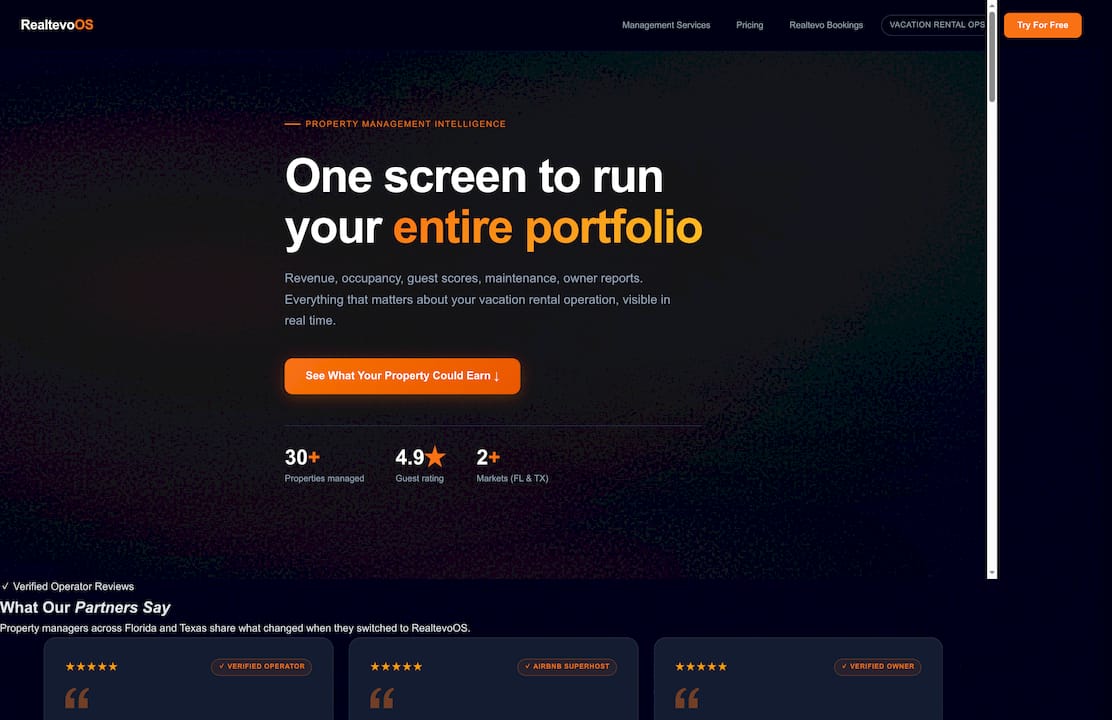
The platform connects your booking platforms, syncs availability across channels in real time, and automates guest communications so no touchpoint gets missed. Its centralized dashboard pulls performance data from Airbnb, Vrbo, and your direct booking site into one view, so you can see exactly which channels are driving revenue and where to adjust. For property managers focused on scaling vacation rental operations without adding proportional overhead, Realtevoos handles the operational complexity that would otherwise slow you down. Explore how it can support your full marketing and operations workflow.
FAQ
What is a vacation rental marketing list?
A vacation rental marketing list is a structured set of channels and tactics organized by guest journey stage, covering discovery, conversion, and retention. It typically includes OTA optimization, a direct booking site, email marketing, and paid advertising.
How much should I spend on vacation rental marketing?
Most property managers allocate 3–5% of gross revenue to marketing. For a property earning $60,000 annually, that’s roughly $1,200 to $3,000 spread across photography, ads, and software tools.
Which platforms are best for vacation rentals?
Airbnb, Vrbo, and Booking.com dominate discovery, but the highest-margin bookings come through a direct booking website. The best strategy uses OTAs for reach and your own site for repeat guests and margin protection.
How do I collect guest emails for marketing?
Since OTAs block guest contact data, you need to capture emails through your own touchpoints. A digital guestbook, a local experience guide PDF, or a post-stay feedback form on your direct booking site all work well.
When should I prioritize direct bookings over OTAs?
Once your occupancy consistently exceeds 75%, shifting focus toward direct booking channels protects your margins and builds a guest list you own. Below that threshold, OTA optimization usually drives better results per dollar spent.