Vacation Rental Revenue Tips That Actually Work
Unlock your property's potential with effective vacation rental revenue tips. Learn proven strategies to boost your rental income today!

Vacation Rental Revenue Tips That Actually Work
Vacation rental revenue tips are proven strategies that increase short-term rental income through pricing precision, listing quality, and operational efficiency. Property managers who treat these as a unified system rather than isolated tactics consistently outperform those who rely on price adjustments alone. Tools like PriceLabs, Wheelhouse, and AirDNA give owners the data to make smarter decisions across every revenue lever. This article covers the most impactful strategies, from dynamic pricing guardrails to cleaning fee structure and AI-driven guest communication, so you can apply them immediately.
1. Set dynamic pricing with floor and ceiling guardrails
Dynamic pricing is the practice of adjusting nightly rates in real time based on local demand, events, seasonality, and competitor behavior. Properties using it correctly see 36% more revenue than those on static rates. That gap exists because static pricing leaves money on the table during peak demand and fails to attract bookings during slow periods.

The guardrails are what separate profitable dynamic pricing from reckless automation. A floor price is the minimum rate you will accept per night. Calculate it by adding your per-night cleaning cost (amortized over the stay length), platform fees, supplies, and a target margin. A ceiling price prevents algorithms from pricing you out of the market during high-demand periods when a slightly lower rate fills the calendar faster.
Dynamic pricing also improves occupancy by 2 to 3% and average daily rate by 5 to 15%, which compounds into meaningful annual gains. Tools like PriceLabs and Wheelhouse automate these adjustments, but they only perform well when you set the boundaries correctly.
- Calculate your floor using: cleaning cost divided by stay length, plus platform fee percentage, plus supplies per stay, plus your minimum margin
- Set your ceiling at a level where you would still expect to fill at least 60% of available nights during peak periods
- Review your floor and ceiling monthly as costs change
Pro Tip: Never let a pricing tool run without a floor price. One slow weekend with an algorithm-set rate below your variable costs can erase a week of profit.
2. Fill orphan nights with targeted discounts
Orphan nights are single or double-night gaps between existing bookings that standard minimum stay requirements leave unbookable. Targeted discounts and temporary minimum stay relaxations convert these gaps into revenue that would otherwise be zero. A night booked at 60% of your normal rate is always better than an empty night.
The practical approach is to set automated rules in your pricing tool that trigger a discount when a gap of one or two nights appears within a 14-day window. Combine this with a temporary minimum stay reduction to one night for that specific gap. Most dynamic pricing platforms, including PriceLabs, support gap-filling rules natively.
Orphan night strategy requires discipline. Do not apply blanket discounts to your entire calendar. Apply them only to the specific gap dates, and set an expiration so the discount disappears once the gap is filled or the window passes.
3. Optimize your listing for Airbnb’s conversion algorithm
Conversion rate is Airbnb’s primary ranking factor, meaning the percentage of guests who book after viewing your listing determines how often Airbnb shows it. A listing with a 4% conversion rate ranks above a listing with a 2% rate, regardless of reviews. This single fact changes how you should think about listing optimization.
The highest-impact conversion levers are your cover photo, Instant Book status, and total checkout price. Professional photography increases click-through rates significantly, and your cover photo must show the most visually compelling feature of your property. Instant Book removes friction from the booking process and signals to Airbnb’s algorithm that you are an active, responsive host.
Pricing within 10 to 15% of comparable listings in your market keeps you competitive without racing to the bottom. Listing and pricing optimization can yield 20 to 40% booking rate increases when applied together. Update your calendar at least once per week, even if nothing changes, because calendar activity signals to Airbnb that your listing is actively managed.
Pro Tip: Search your own market on Airbnb as a guest would. If your listing does not appear in the first two pages for your target dates, your conversion rate or pricing is the problem, not your reviews.
4. Fix your cleaning fee structure
95% of vacation rental managers use flat cleaning fees, and most of them are leaving money on the table or losing bookings because of it. A flat $150 cleaning fee on a one-night stay makes your total checkout price look absurd compared to a hotel. That same fee on a seven-night stay is barely noticeable per night.
Variable cleaning fees solve this problem. Charge a lower fee for short stays and off-season bookings where you need to compete aggressively on total price. Charge a higher fee during peak season when demand is strong and guests are less price-sensitive. Variable fees tied to seasonality and stay length protect your margins without hurting your search visibility.
- Short stays (1 to 2 nights): lower cleaning fee to keep total checkout price competitive
- Standard stays (3 to 6 nights): standard cleaning fee that covers your actual cost plus margin
- Peak season: higher cleaning fee that reflects increased turnover demand and supply costs
- Off-season orphan stays: reduced fee to incentivize bookings that would otherwise not happen
Model your breakeven before setting any fee. Know exactly what a turnover costs you in labor, supplies, and time, then price your cleaning fee to cover that cost at your most common stay length.
5. Automate guest communication without losing the personal touch
AI-driven messaging tools handle 70 to 85% of guest messages without human intervention, reducing monthly messaging time from roughly 15 hours to under one hour per property. For managers running five or more properties, that time savings directly translates to capacity for growth rather than additional labor costs.
The revenue connection is direct. Faster response times improve your Airbnb response rate score, which affects search ranking. Consistent, accurate pre-arrival communication reduces guest confusion and negative reviews. Guests who feel well-informed before arrival leave better reviews, and better reviews drive more bookings at higher rates.
Automated messaging works best when you build templates for the highest-frequency scenarios: booking confirmation, check-in instructions, mid-stay check-in, and checkout reminders. Layer in AI tools that can answer property-specific questions using a knowledge base you build once. Platforms like Realtevoos integrate automated communications directly with your property data, so responses stay accurate as your operations change.
Pro Tip: Automate the routine, but flag any message containing the words “cancel,” “refund,” or “damage” for immediate human review. These are the conversations where a personal response protects your revenue and your reputation.
6. Build accurate income projections before setting your strategy
Income projection is the foundation of every pricing decision you make. The formula is straightforward: average daily rate multiplied by occupied nights, minus operating expenses. Typical operating expense ratios run 55 to 70% of gross revenue, covering management fees, cleaning, platform fees, maintenance, utilities, and insurance. That means a property generating $60,000 gross may net only $18,000 to $27,000 after expenses.
Tools like AirDNA and Airbtics provide market-level data on average daily rates and occupancy for comparable properties in your area. Use these as benchmarks, not guarantees. Your actual performance depends on listing quality, pricing strategy, and operational execution.
The table below shows how small changes in ADR and occupancy compound into significant revenue differences:
| Scenario | ADR | Occupied nights/year | Gross revenue |
|---|---|---|---|
| Conservative | $150 | 180 | $27,000 |
| Moderate | $175 | 210 | $36,750 |
| Optimized | $200 | 240 | $48,000 |
Stress-test your projections by modeling a 20% drop in occupancy. If that scenario makes your property cash-flow negative, your cost structure needs adjustment before your pricing strategy can work. Explore data-driven property management approaches to build projections that account for real operational variables.
7. Treat distribution and listing quality as revenue levers
Distribution, listing quality, and pricing function as a unified system, not independent variables. A pricing tool cannot fix low visibility caused by weak photos or a poorly written description. Conversely, a beautiful listing with misaligned pricing will still underperform. Both must be managed together.
Effective distribution means being present on Airbnb, Vrbo, and Booking.com, with a direct booking channel supported by SEO and paid search. A direct booking strategy combining SEO with paid ads and listing conversion improvements drives long-term revenue growth by reducing platform fee dependency. Direct bookings typically save 3 to 15% in platform fees per reservation.
Listing quality means professional photos, a headline that leads with your property’s strongest feature, and a description that answers the questions guests actually ask before booking. Update your listing content seasonally to reflect current amenities, local events, and seasonal appeal. A listing that reads the same in January as it does in July is missing conversion opportunities.
Key takeaways
Maximizing vacation rental revenue requires dynamic pricing with guardrails, variable cleaning fees, optimized listings, and automated operations working together as one system.
| Point | Details |
|---|---|
| Dynamic pricing with guardrails | Set floor and ceiling prices based on real costs; dynamic pricing adds 36% more revenue than static rates. |
| Variable cleaning fees | Tie fees to season and stay length to protect margins without hurting search visibility. |
| Conversion-first listing | Keep pricing within 10 to 15% of market and enable Instant Book to improve Airbnb ranking. |
| Automate guest messaging | AI tools reduce messaging time by up to 85%, freeing capacity and improving review scores. |
| Project income realistically | Model ADR, occupancy, and a 55 to 70% expense ratio before committing to any pricing strategy. |
Why fragmented revenue management is the real profit killer
I have reviewed the operations of dozens of vacation rental portfolios, and the pattern is consistent. Owners who struggle with revenue are almost never failing at one thing. They are failing at the connection between things. Their pricing tool is set up correctly, but their listing photos are two years old. Their cleaning fees are competitive in summer but absurd in January. Their guest messaging is fast, but their calendar goes untouched for weeks.
The uncomfortable truth is that revenue management for short-term rentals is not a set-it-and-forget-it function. It requires weekly attention across pricing, listing content, and operational costs. Most owners underestimate this. Self-managing a vacation rental requires 15 to 25 hours per week during peak season. That is a part-time job, and treating it as anything less produces part-time results.
What I have seen work consistently is treating your property like a small business with a revenue manager, an operations manager, and a marketing manager. For most owners, those are all the same person. That means building systems, using rental management intelligence tools that connect your data, and reviewing performance weekly rather than monthly. The owners who scale successfully are not necessarily the ones with the best properties. They are the ones who built the best operating systems around their properties.
— Jose
How Realtevoos helps you apply every one of these tips
Managing pricing, guest communication, listing quality, and income reporting across multiple properties is where most operators hit a ceiling. Realtevoos is built specifically for that moment.
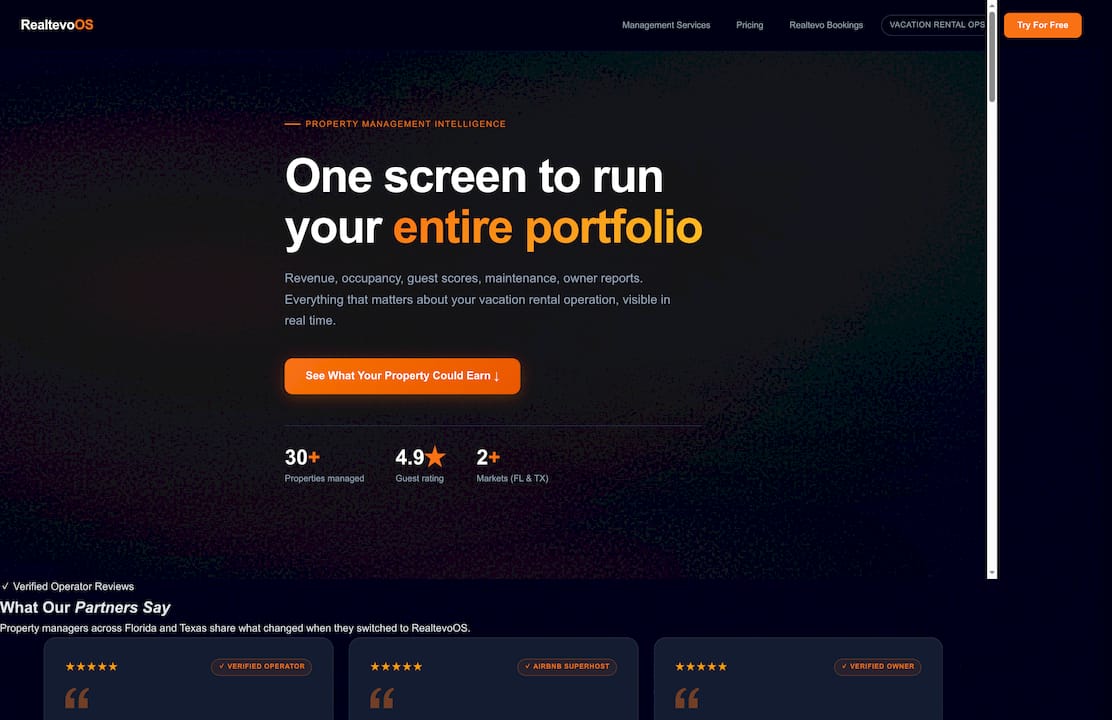
The platform consolidates your operational workflows into a single dashboard, pulling real-time data from Airbnb and Vrbo to support smarter pricing and reporting decisions. Automated guest communications, property management reporting, and performance tracking are built in, so you spend less time on manual tasks and more time on decisions that grow revenue. Property managers using Realtevoos report saving several hours each week while maintaining higher guest satisfaction scores. If you are ready to manage your portfolio like a revenue-focused operation, explore Realtevoos and see what unified management looks like in practice.
FAQ
What is the fastest way to increase vacation rental revenue?
Dynamic pricing with properly set floor and ceiling guardrails produces the fastest measurable revenue gains, with studies showing up to 36% more revenue compared to static pricing. Pair it with Instant Book and professional photos for compounding results.
How do I calculate a floor price for my rental?
Your floor price should cover your per-night cleaning cost (divided by stay length), platform fees, supply costs, and a minimum profit margin. Any rate below this number means you are paying to host a guest.
Why does my Airbnb listing rank low despite good reviews?
Conversion rate is Airbnb’s primary ranking factor, not review score. If your pricing is more than 15% above comparable listings or your cover photo is weak, your conversion rate drops and your ranking follows.
Should I use variable or flat cleaning fees?
Variable cleaning fees outperform flat fees in almost every market. A flat fee that covers your costs on a three-night stay will look excessive on a one-night stay and underpriced on a seven-night stay. Tie your fee to stay length and season.
How many hours does self-managing a vacation rental actually take?
Self-managing requires 15 to 25 hours per week during peak season. Automation tools and platforms like Realtevoos reduce this significantly, making it practical to manage multiple properties without proportional increases in labor.