Industry Terminology in Vacation Rentals: A Manager's Guide
Master industry terminology in vacation rentals to enhance communication and boost profits. Discover essential terms for success in this guide!

Industry Terminology in Vacation Rentals: A Manager’s Guide
Industry terminology in vacation rentals is the specialized vocabulary property owners and managers must command to operate efficiently, price competitively, and communicate without confusion across teams, guests, and platforms. Terms like ADR, RevPAR, cancellation policy, and PMS are not just jargon. They are the shared language that determines whether your operation runs at a profit or bleeds revenue through misaligned decisions. Platforms like Airbnb and Vrbo, tools like PriceLabs, and systems like property management software all use this vocabulary as a baseline. If your team does not speak it fluently, you are already at a disadvantage.
What is industry terminology in vacation rentals?
The formal term for this body of knowledge is property management vocabulary, though the vacation rental industry borrows heavily from hospitality, real estate, and technology sectors. Understanding it is not optional for serious operators. It shapes how you set prices, write listing descriptions, enforce guest policies, and interpret performance data. A manager who confuses RevPAR with ADR will draw the wrong conclusions from their own numbers. A host who cannot define maximum occupancy in their rental agreement invites disputes and potential liability.
The short-term rental (STR) industry has grown into a multi-billion dollar market, and with that growth has come a more rigorous professional standard. Operators who treat terminology as background noise consistently underperform those who build their workflows around precise definitions. This guide covers the terms that matter most, organized by the area of your business they affect.
What are the key financial metrics every operator should know?
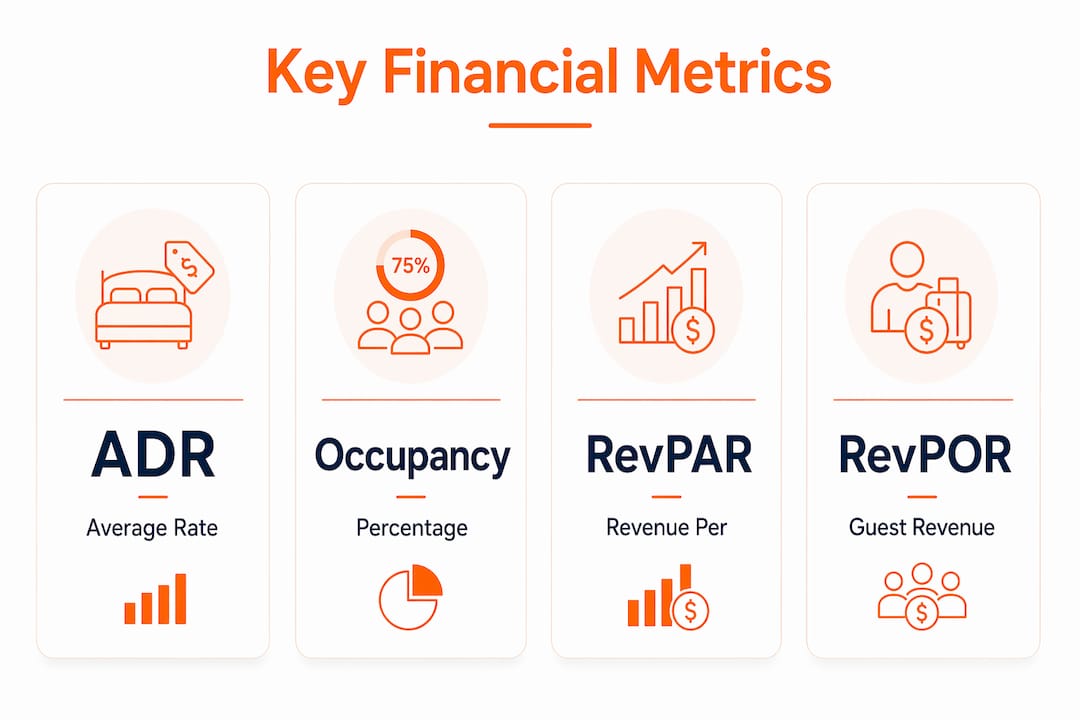
Financial performance in vacation rentals is measured through a set of KPIs borrowed from the hotel industry and adapted for short-term rental contexts. ADR, RevPAR, and occupancy rate are the three most cited metrics, but each tells only part of the story. Relying on any single number leads to flawed pricing decisions.

| Metric | Formula | What it tells you |
|---|---|---|
| ADR (Average Daily Rate) | Total room revenue / nights sold | Average revenue per booked night |
| Occupancy Rate | Nights booked / nights available × 100 | Percentage of available nights filled |
| RevPAR (Revenue per Available Room) | ADR × Occupancy Rate | Revenue efficiency across all available nights |
| TRevPAR (Total Revenue per Available Room) | Total revenue / available room nights | Full revenue picture including fees and add-ons |
| RevPOR (Revenue per Occupied Room) | Total revenue / occupied room nights | Spending behavior of guests who actually stay |
ADR alone is a misleading metric. A property with a $400 ADR but 40% occupancy earns far less than one with a $250 ADR and 80% occupancy. Combining metrics like RevPAR gives you a complete picture of revenue efficiency, not just the rate you charged on nights someone booked. GOPPAR (Gross Operating Profit per Available Room) goes one step further by factoring in operating costs, making it the most accurate measure of true profitability.
Emerging guest-centric metrics like RevPOR reveal how much revenue each occupied night actually generates, including cleaning fees, amenity charges, and upsells. This matters because two properties with identical RevPAR can have very different profitability profiles depending on their fee structures. Tracking RevPOR alongside RevPAR gives you the full picture that data-driven property management requires.
Pro Tip: Never evaluate a pricing change using ADR alone. Calculate the RevPAR impact before and after to confirm whether the adjustment actually improved revenue efficiency across your available inventory.
How do booking policies and guest management terms affect your operation?
Booking policy vocabulary is where property management meets legal exposure. Every term in your rental agreement carries financial and operational weight, and guests who misunderstand these terms become disputes waiting to happen.
Cancellation policy defines the conditions under which a guest receives a refund. For example, Sandollar Sity Vacation Rentals specifies a $50 cancellation fee for cancellations outside 30 days and no refund for cancellations inside 30 days. That structure protects revenue while giving guests a clear window for decision-making. Your policy should state the exact dollar amounts, time windows, and refund methods in plain language.
Holdovers refer to guests who remain in the property past their checkout time without prior written approval. Vivid Telluride’s terms of service make guests financially responsible for holdover fees, which protects the operator from lost revenue when a new guest is arriving the same day. Maximum occupancy sets the legal and safety limit on how many people can occupy the property at once, and the same terms require prior approval for any guest count that reaches that limit, with penalties for unreported violations.
Common additional fees you need to define clearly in every listing and agreement include:
- Cleaning fee: A flat or variable charge covering post-stay cleaning. Seasonal adjustment of cleaning fees prevents high off-season charges from discouraging bookings and hurting search visibility.
- Booking fee: A platform or management charge applied at the time of reservation, separate from the nightly rate.
- Amenity fee: A recurring or one-time charge for access to specific property features like a pool, hot tub, or gym.
- Pet fee: A charge for guests bringing animals, often combined with a refundable pet deposit.
- Security deposit: A refundable amount held to cover potential damages, distinct from non-refundable fees.
Enforcement terms matter just as much as the fees themselves. Penalties for unreported pets, unauthorized smoking, or exceeding maximum occupancy must be stated with specific dollar amounts. Vague language like “additional charges may apply” is unenforceable and invites disputes.
Pro Tip: Send guests a pre-arrival message that restates your three most important policies in plain language. Guests who confirm they have read the rules before arrival generate significantly fewer disputes at checkout.
Vacation rental vs. short-term rental vs. Airbnb: what is the difference?
These three terms are used interchangeably in casual conversation, but they carry distinct meanings depending on context. Vacation rental and short-term rental often describe the same property, but the preferred term shifts based on whether you are marketing to guests, filing taxes, or responding to a zoning inquiry.
| Term | Primary context | Typical usage |
|---|---|---|
| Vacation rental | Guest marketing | Listing descriptions, property websites, guest-facing communication |
| Short-term rental (STR) | Legal and regulatory | Zoning applications, tax filings, municipal permits, insurance policies |
| Airbnb | Platform-specific | Refers to properties listed on Airbnb specifically, not the property type |
Using the wrong term in the wrong context creates real problems. A city ordinance that restricts “short-term rentals” applies to your property whether you call it a vacation rental or not. An insurance policy written for a “vacation rental” may not cover incidents that occur during a stay booked through a platform the insurer does not recognize. Tax authorities in many jurisdictions use “short-term rental” as the legal definition for properties rented for fewer than 30 consecutive days, which triggers specific reporting requirements.
For marketing purposes, “vacation rental” carries warmer connotations and performs better in guest-facing copy. For compliance and operations, “short-term rental” is the term that aligns with regulatory language. Knowing which term to use, and when, is a basic competency for any operator managing properties across multiple markets. The vacation rental marketing guide from Realtevoos covers how to position your listings using the right language for each channel.
What technology terms do property managers need to understand?
Technology vocabulary is now inseparable from property management vocabulary. Operators who do not understand the systems running their business cannot identify where revenue is leaking or where efficiency is breaking down.
A Property Management System (PMS) is the central system of record for your operation. It coordinates pricing, availability, reservations, and operational data across all your properties. A well-configured PMS prevents revenue leaks by maintaining a single source of truth that all team members reference. Without it, pricing decisions made by one team member can conflict with availability updates made by another.
Key technology terms every operator should know:
- Channel manager: Software that syncs your availability and pricing across multiple booking platforms (Airbnb, Vrbo, Booking.com) simultaneously, preventing double bookings.
- Dynamic pricing tool: A system like PriceLabs that adjusts nightly rates automatically based on demand signals, local events, and competitor pricing.
- Dashboard: A visual interface that aggregates KPIs, booking data, and operational metrics into a single view for faster decision-making.
- API (Application Programming Interface): The technical connection that allows your PMS to communicate with channel managers, pricing tools, and guest communication platforms.
- Booking engine: A direct reservation system embedded in your own website, allowing guests to book without paying platform fees.
88% of listings have quality issues that negatively affect search ranking and force revenue managers to reduce prices to maintain visibility. This statistic points directly to the cost of ignoring listing optimization as a technical discipline. Strong listing descriptions, accurate amenity tagging, and high-resolution photos are not marketing extras. They are revenue protection. Realtevoos’s property management reporting tools help operators track these quality signals alongside financial KPIs in one place.
Operational terminology becomes actionable only when your entire team references the same data source. A revenue manager using one dashboard and an operations manager using another will eventually make conflicting decisions that cost you bookings or damage guest relationships.
Key takeaways
Mastering vacation rental terminology is the single most direct path to reducing revenue leaks, resolving guest disputes faster, and making pricing decisions grounded in real data rather than intuition.
| Point | Details |
|---|---|
| Use multiple financial metrics | ADR alone misleads; combine with RevPAR and occupancy rate for accurate revenue analysis. |
| Define policies with specifics | State exact dollar amounts and time windows in cancellation and fee policies to prevent disputes. |
| Match terminology to context | Use “vacation rental” for marketing and “short-term rental” for legal and regulatory communication. |
| Centralize your data in a PMS | A single system of record prevents conflicting decisions between revenue and operations teams. |
| Treat listing quality as revenue | Poor listing content forces price reductions; accurate descriptions protect your ranking and rate. |
Why terminology mastery is the foundation, not the finish line
I have worked with property managers who could quote their ADR to the decimal but had no idea what their RevPAR was. They were proud of their nightly rate and confused about why their revenue was flat. That gap between knowing one number and understanding the system of numbers is exactly where most operators get stuck.
The terminology problem is rarely about intelligence. It is about onboarding. Most property owners learn this business by doing it, which means they pick up terms inconsistently, often from platform help pages or other owners who are also learning on the fly. The result is a team where “occupancy rate” means different things to different people, and where a conversation about pricing turns into a miscommunication about which metric you are even optimizing for.
What I have found works is treating terminology education as a recurring practice, not a one-time orientation. When you bring on a new team member, walk them through your KPI definitions with actual examples from your own properties. When you adopt a new tool like PriceLabs or a new channel manager, spend time on the vocabulary that tool introduces before you configure it. The operators who scale successfully are not necessarily the ones with the most properties. They are the ones whose teams speak the same language.
The uncomfortable truth is that revenue management gaps between teams are almost always a communication problem before they are a strategy problem. Fix the language, and the strategy becomes much easier to execute.
— Jose
How Realtevoos helps you put this vocabulary to work

Realtevoos is built for property managers who want their terminology and their data in the same place. The platform consolidates KPIs like ADR, RevPAR, and occupancy rate into a single operator command center, pulling real-time data from Airbnb, Vrbo, and your PMS so your entire team references the same numbers. Automated reporting eliminates the manual work of compiling performance data, and AI-driven alerts flag revenue leaks before they compound. If you are managing multiple properties and want your operations vocabulary to match your operational reality, Realtevoos gives you the infrastructure to make that happen.
FAQ
What does ADR mean in vacation rentals?
ADR stands for Average Daily Rate and is calculated by dividing total room revenue by the number of nights sold. It measures the average revenue earned per booked night, but should always be read alongside occupancy rate and RevPAR for accurate performance analysis.
What is the difference between a vacation rental and a short-term rental?
“Vacation rental” is the preferred term in guest-facing marketing, while “short-term rental” is the standard term in legal, regulatory, and tax contexts. Both typically refer to the same type of property rented for fewer than 30 consecutive days.
What is a PMS in property management?
A Property Management System (PMS) is the central software platform that coordinates bookings, pricing, availability, and operational data across your properties. It serves as the system of record that prevents conflicting decisions between team members and reduces revenue leaks.
Why do cancellation policies need specific dollar amounts?
Vague cancellation language is difficult to enforce and frequently leads to guest disputes. Policies that state exact fees and refund windows, such as a $50 fee outside 30 days and no refund inside 30 days, give both parties clear expectations and reduce the likelihood of chargebacks or complaints.
What is RevPAR and why does it matter more than ADR?
RevPAR (Revenue per Available Room) multiplies ADR by occupancy rate, giving you a revenue efficiency score across all available nights, not just booked ones. A high ADR with low occupancy produces a low RevPAR, which is why RevPAR is the more reliable indicator of overall pricing strategy performance.
Recommended
- Predictive Maintenance for Vacation Rentals Explained — Realtevo Blog
- Enterprise property management: Data-driven success for vacation rentals — Realtevo Blog
- Vacation Rental Marketing List: Your 2026 Growth Guide — Realtevo Blog
- Property Management Reporting Examples for Vacation Rentals — Realtevo Blog