The Multi-Location Vendor Management Guide That Actually Scales
Unlock efficient multi-location vendor management with our scalable guide. Centralize contracts, enhance compliance, and drive performance today!

The Multi-Location Vendor Management Guide That Actually Scales
The right answer to multi-location vendor management is a hybrid model: centralize contracts, catalogs, and reporting, but let each site execute purchases within guardrails you build into the buying process itself. That means vendor tiering, guided buying with centralized catalogs, and performance scorecards working together instead of as separate initiatives.
Three levers do most of the work:
- Vendor tiering so oversight effort matches actual business risk, not squeaky wheels
- Guided buying and centralized catalogs that make the compliant vendor the easy choice, not a policy that someone has to remember
- Performance scorecards reviewed on a fixed cadence, not whenever something breaks
Your first move this week: run a vendor visibility audit across every site, list every active supplier relationship, and assign a named owner to each. You cannot govern what you cannot see.
Key Takeaways
Multi-location vendor management works when centralized contracts and catalogs pair with decentralized, embedded purchasing controls that make compliance the default, not an afterthought.
| Point | Details |
|---|---|
| Run a visibility audit first | Map every active vendor relationship across sites before designing any new process. |
| Tier vendors into four groups | Match oversight effort to business impact, switching cost, and supply complexity. |
| Embed guidance in workflows | Use guided buying and centralized catalogs so the compliant vendor is the default choice. |
| Structure onboarding to 90 days | Assign owners, document SLAs, and baseline scorecards within a fixed window. |
| Centralize visibility with RealtevoOS | RealtevoOS gives multi-property operators one dashboard for vendor and operational coordination. |
Table of Contents
- Why Multi-Location Vendor Management Breaks Down at Scale
- What Are the Hidden Costs of Running Too Many Vendors?
- How Do You Build a Vendor Tiering Framework?
- How Do You Embed Vendor Guidance Into Purchasing Workflows?
- What Does a 90-Day Vendor Onboarding Playbook Look Like?
- How Do You Scale Vendor Governance Across More Sites?
- How Do You Manage Vendor Risk Across Multiple Locations?
- RealtevoOS and What Applied Vendor Governance Looks Like
- Your 90 to 180 Day Vendor Management Rollout
- What Leadership Buy-In Actually Requires
- See the Hybrid Model Running in One Dashboard
- Sources
Why Multi-Location Vendor Management Breaks Down at Scale
Vendor management typically falls apart the same way at every growing company: facilities buys HVAC service in one region while operations signs a separate contract for the same trade two zip codes over, and nobody at headquarters knows both exist. That duplication is shadow spend, and it compounds fast once you cross ten or fifteen sites.
The visibility gap is what actually costs you money. When purchasing happens outside sanctioned channels, you lose the negotiated leverage that comes from consolidated volume, and finance loses the ability to forecast spend accurately. ProcureDesk and Amazon Business both identify shadow spend and fragmented buying channels as the top failure modes in multi-site procurement.
The pattern repeats across categories:
- Facilities signs local vendors for repairs while corporate holds a national contract for the same service
- Site managers use personal relationships instead of the approved supplier list
- Emergency purchases skip the approval workflow entirely and never get reconciled
What Are the Hidden Costs of Running Too Many Vendors?
Multi-vendor sprawl carries costs that never show up on an invoice. Management overhead climbs as your team juggles dozens of contracts, contact points, and renewal dates instead of a handful. Invoice handling multiplies, reconciliation errors creep in, and emergency freight charges pile up when nobody remembers which supplier already has a standing agreement nearby.
Hidden cost categories worth tracking:
- Administrative overhead from managing duplicate contracts and contacts
- Downtime costs when an underperforming vendor causes delays
- Invoice processing and reconciliation labor across mismatched systems
- Emergency freight or rush fees from reactive, unplanned purchases
Consolidation lowers total cost of ownership when you find real overlap, specs are stable, and switching costs are manageable. Redundancy stays strategic when a category is genuinely high-risk, single-source failure would halt operations, or specs vary too much by site to standardize safely.
How Do You Build a Vendor Tiering Framework?
A four-tier segmentation model is the backbone of effective vendor oversight, and it is the single fastest way to stop treating every supplier the same. Strategic vendors (a limited number by spend and operational dependency) get quarterly business reviews, named executive sponsors, and joint planning sessions. Preferred vendors get regular check-ins and scorecards but lighter governance. Transactional and commodity vendors run on catalog rules and periodic spot audits, not standing meetings.
Assign one accountable owner per vendor, regardless of tier. That person signs off on renewals, escalations, and performance conversations, so no vendor relationship becomes an orphan when a site manager changes roles.
Tier assignment should weigh three factors:
- Business impact if the vendor fails to deliver
- Switching cost and how long a transition would realistically take
- Supply complexity, including how many sites depend on the same source
Segmentation, scorecards, and contract lifecycle management are consistently cited as the foundation procurement teams build everything else on top of.
Pro Tip: Cap strategic tier membership at 15 vendors, even if your instinct says more deserve it. Once a tier balloons, the quarterly review cadence collapses under its own weight and nobody gets real attention.
How Do You Embed Vendor Guidance Into Purchasing Workflows?
Guided buying means site employees only see approved vendors when they open a catalog. It is the difference between publishing a policy and making the policy the path of least resistance. When the compliant option is also the fastest one, adoption stops being a training problem.

Embedding vendor guidance directly into the purchasing workflow turns vendor management from a retrospective audit exercise into something enforced at the moment of purchase, and that shift is what actually reduces shadow spend.
Build the workflow around three components:
- Approval workflows tied to purchase size, with dynamic thresholds that route larger buys to a category manager automatically
- Site-specific budgets that flex for local conditions without opening the door to off-catalog buying
- Anomaly detection that flags a purchase pattern breaking from a site’s normal history
Analytics should surface compliance rate by site, off-catalog spend trends, and vendor concentration by category, so you catch drift before it becomes a habit.
Pro Tip: Review your top five off-catalog purchase categories monthly for the first two quarters after rollout. That is where you will find both your biggest leakage and your best case for expanding the approved catalog.
What Does a 90-Day Vendor Onboarding Playbook Look Like?
A structured onboarding period prevents the slow drift into undocumented, ad hoc vendor relationships that plague multi-site operations later. A defined 60 to 90 day onboarding window with named owners and documented service level agreements reduces time to value and cuts remediation costs down the line.
- Days 1 to 30: Kickoff call, SLA documentation, and system access setup with the vendor owner assigned
- Days 31 to 60: Site-level training, catalog activation, and a first performance baseline captured
- Days 61 to 90: First formal scorecard review and adjustment of thresholds or terms as needed
Scorecards should track four dimensions consistently:
- Delivery reliability (on-time rate)
- Quality (defect or rework rate)
- Responsiveness (average resolution time)
- Commercial compliance (invoice accuracy, contract adherence)
Share scorecards with vendors before the review meeting, not during it. That single habit preserves trust and speeds up remediation when performance slips.
How Do You Scale Vendor Governance Across More Sites?
Scaling vendor governance across dozens of sites works best as a three-phase rollout rather than a single company-wide mandate.
- Standardize. Consolidate vendor catalogs and master contracts into one system of record before you touch workflow automation. You cannot orchestrate what is not standardized first.
- Orchestrate. Pilot approval workflows and exception handling in your highest-leakage categories, then expand once the pilot proves out. A three-phase methodology built around standardizing catalogs first is what makes this work across portfolios of 20 or more locations.
- Automate. Layer in continuous leakage detection and anomaly monitoring so drift gets caught automatically instead of during an annual audit.
Pilot in categories with high purchase frequency and known leakage first. That is where the ROI shows up fastest, and it builds the internal case for a broader rollout.
How Do You Manage Vendor Risk Across Multiple Locations?
A vendor risk register turns vague worry into a scored, reviewable list. Score each vendor relationship on impact times likelihood, then review the register quarterly alongside your strategic tier meetings.
Mitigation playbook essentials:
- Dual-source critical categories where a single vendor failure would stop operations
- Diversify geographically so one regional disruption doesn’t take down every site at once
- Keep contingency contracts on standby for your highest-impact single-source relationships
Escalate immediately, outside the normal review cadence, whenever a vendor touches sensitive data processing, carries cybersecurity exposure, or represents true single-source criticality with no fallback. Waiting for the next quarterly review on those categories is how a manageable risk becomes an operational crisis.
RealtevoOS and What Applied Vendor Governance Looks Like
The hybrid model described throughout this guide, centralized governance with decentralized execution, is not theoretical. It’s the same architecture RealtevoOS applies to vacation rental operations, where property managers coordinate cleaning crews, maintenance vendors, and service providers across dozens of properties from one dashboard instead of a spreadsheet per site.
Multi-location vendor oversight fails less often from bad vendors and more often from the absence of a single place where every site’s supplier data actually lives. Centralized visibility is what turns vendor management from firefighting into a repeatable process.
Jose Villeda’s guides on centralizing rental data across properties and multi-market portfolio management walk through applied versions of the tiering and dashboard concepts covered here.
Your 90 to 180 Day Vendor Management Rollout
- Days 0 to 30: Complete the vendor inventory, assign named owners to every relationship, and finish the visibility audit
- Days 30 to 90: Launch a pilot catalog in your highest-leakage category, formalize the onboarding playbook, and establish scorecard baselines
- Days 90 to 180: Expand workflow orchestration company-wide, roll out compliance analytics, and lock in your full governance cadence
Pro Tip: Resist the urge to roll out every tier and every workflow control at once. A single well-run pilot category builds more internal buy-in than a company-wide mandate that half the sites quietly ignore.
What Leadership Buy-In Actually Requires
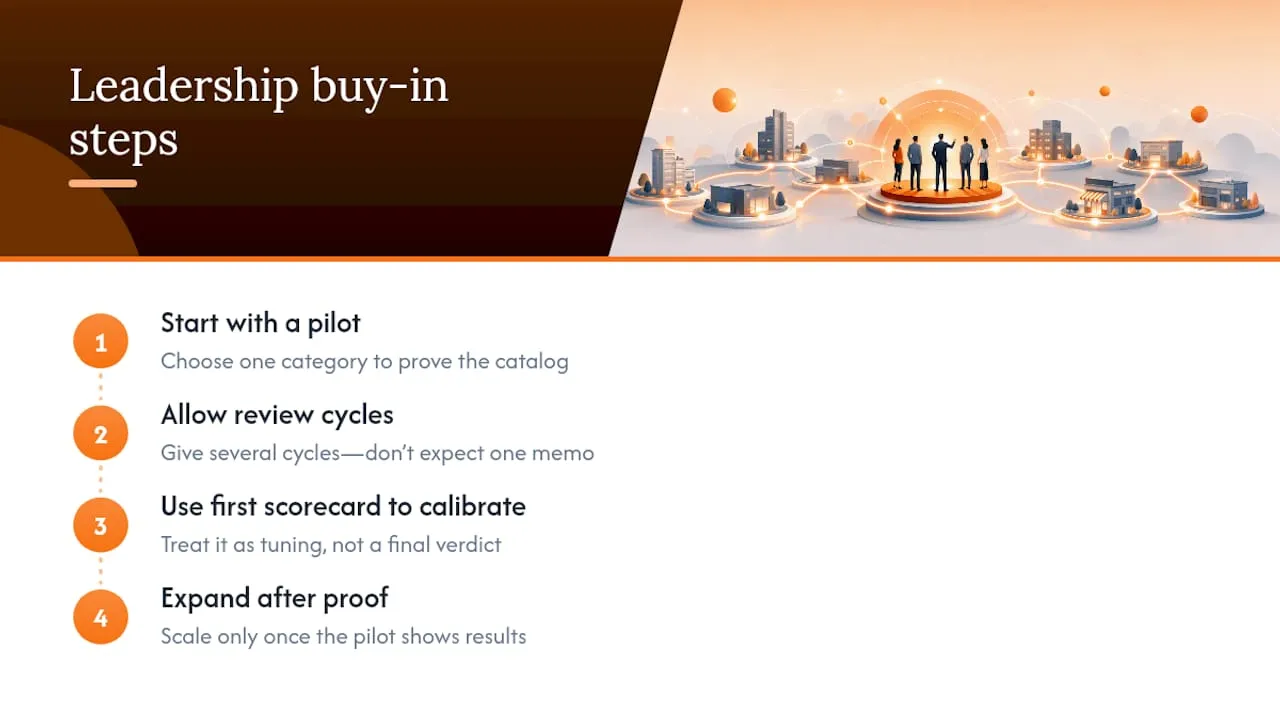
Rolling out a hybrid vendor model fails more often from impatience than bad design. Site leaders need to see the catalog work before they trust it, and that takes several review cycles, not one memo. Give the pilot category room to prove itself before expanding, and treat the first scorecard cycle as a calibration exercise, not a verdict.
See the Hybrid Model Running in One Dashboard
Reading the framework is one thing. Running vendor tiers, approval workflows, and scorecards across a real portfolio without a dozen spreadsheets is another. RealtevoOS gives multi-property operators the centralized command center this guide describes: one dashboard pulling live data from Airbnb, Vrbo, and your PMS, with automation handling the guest and vendor coordination work your team currently does by hand.

Property managers using RealtevoOS report saving several hours a week that used to go into manual reporting and vendor follow-ups, freeing that time for the strategic reviews this guide recommends. If you manage vendors and operations across multiple properties, look at the RealtevoOS Command Center and request a demo to see how your own vendor data would look centralized in one view.
Sources
- Rethinking vendor management in a decentralized world — Amazon Business
- Multi-Location Procurement: How to Manage 20+ Locations - ProcureDesk
- 10 Vendor Management Best Practices for 2026 — BusinessModelAnalyst