Types of Maintenance Workflows for Vacation Rental Managers
Discover the types of maintenance workflows for vacation rental managers. Learn to optimize strategies and improve guest satisfaction!

Types of Maintenance Workflows for Vacation Rental Managers
Multi-property vacation rental managers rely on five primary maintenance workflow types: preventive, corrective, predictive (condition-based), emergency, and inspection. Each maps to a specific trigger, cost profile, and guest-impact level. The smartest operators don’t pick one and commit to it across every asset. They use a hybrid approach, assigning workflow type by asset criticality, governed by a seven-stage lifecycle that keeps every job accountable from intake to closure.
The core principle: Match the workflow to the asset, not the other way around. High-criticality systems like HVAC and water heaters warrant predictive and preventive strategies. Low-criticality items like cabinet knobs can run to failure. That distinction drives your budget, your technician’s time, and ultimately your guest reviews.
Realtevoos consolidates all five workflow types into a single platform, automating triage, mobile capture, and owner reporting so nothing falls through the cracks across your portfolio.
Table of Contents
- What are the five types of maintenance workflows?
- How the seven-stage lifecycle governs every work order
- How to assign the right workflow by asset criticality
- What to capture and which tool features actually matter
- Which KPIs tell you whether your workflows are actually working
- How to roll out standardized workflows across your portfolio
- Key Takeaways
- The workflow gap most managers don’t see until it’s too late
- Realtevoos brings all five workflow types into one command center
- Useful sources
What are the five types of maintenance workflows?
Understanding the five work-order types is the first step toward building a maintenance program that actually scales. Here’s how each one applies to vacation rental operations.
| Workflow Type | Trigger | Vacation Rental Example | Cost Profile |
|---|---|---|---|
| Preventive (PM) | Calendar or usage schedule | HVAC seasonal tune-up, smoke detector battery swap | Low per event; predictable |
| Corrective | Discovered defect, non-urgent | Loose cabinet hinge, scuffed baseboard | Moderate; planned timing |
| Predictive (PdM) | Condition data or sensor alert | Water heater showing abnormal temp readings | Higher upfront; saves long-term |
| Emergency | Immediate guest or safety impact | Burst pipe, failed door lock at check-in | 2–5× more expensive than planned work |
| Inspection | Scheduled audit or turnover trigger | Post-checkout walkthrough, seasonal safety check | Low; prevents higher-cost surprises |
Preventive maintenance runs on a fixed schedule regardless of equipment condition. Think HVAC filter changes every 90 days or annual pool safety inspections. It’s predictable and budget-friendly.
Corrective maintenance addresses known defects that aren’t urgent enough to interrupt a guest stay. A cracked tile or a sticky sliding door gets logged, planned, and scheduled between bookings.
Predictive maintenance is condition-triggered. A smart thermostat flagging unusual cycling behavior or a water sensor detecting micro-leaks initiates a work order before failure occurs. Learn more about condition-based approaches specific to rentals.
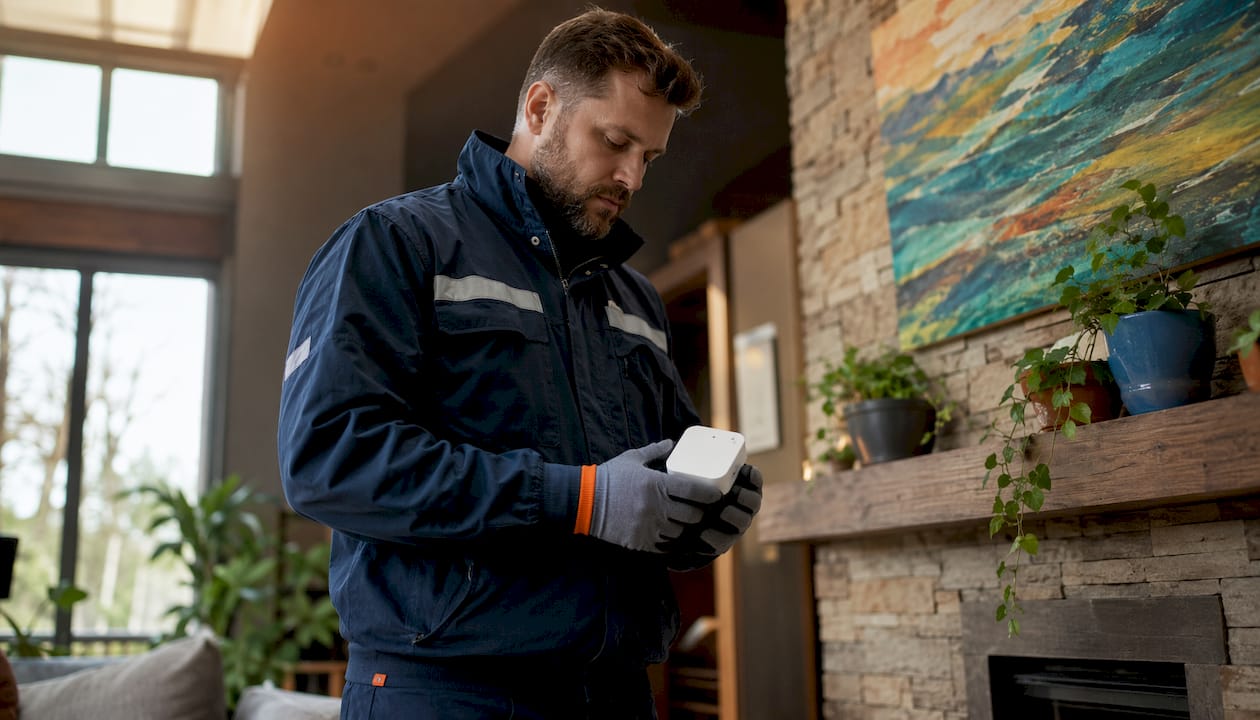
Emergency maintenance is the workflow you want to minimize. It’s reactive, disruptive to guests, and according to industry guidance, reactive repairs cost two to five times more than the same job done on a planned basis.
Inspection workflows are the unsung heroes of multi-property operations. A structured post-checkout walkthrough catches corrective items before they become emergencies.
How the seven-stage lifecycle governs every work order
A seven-stage maintenance lifecycle gives every work order a defined path from request to closure. Without it, jobs stall in the undefined middle ground between “someone mentioned it” and “it got fixed.”
- Work identification (intake): Guest submits a request, a sensor fires an alert, or a cleaner flags an issue during turnover. Every source feeds one intake queue.
- Prioritization (triage): Assign urgency: emergency, urgent, high, routine, or low. Base it on guest impact and asset criticality, not request order.
- Planning (labor and parts): Identify the technician skill required, confirm parts availability, and estimate time. Jobs without parts staged in advance stall at execution.
- Scheduling: Slot the job between bookings or during low-occupancy windows. For multi-property portfolios, batch same-trade work by geography to cut drive time.
- Execution: Technician completes the work following the assigned procedure. This stage is where point-of-work documentation happens, not after the shift ends.
- Completion and documentation (verification): Capture photos, parts used, time spent, and a completion timestamp. A supervisor or automated rule closes the work order only when all fields are confirmed.
- Reporting and analysis: Roll individual work orders into portfolio-level KPIs. This stage feeds your budget decisions and next quarter’s PM schedule.
On-site crew checklist for stages 5–6:
- Photo of the issue before work begins
- Photo of completed repair
- Parts used and quantities
- Actual labor time vs. estimated
- Any follow-up items discovered
Pro Tip: Require technicians to submit photos and close work orders from their phones before leaving the property. A work order closed in the field has complete data; one closed from memory two days later rarely does.
How to assign the right workflow by asset criticality
No single strategy fits every asset. Reliability-Centered Maintenance (RCM) is the framework that makes the hybrid approach systematic. RCM requires analyzing each asset’s failure modes and the consequences of those failures, then selecting the maintenance strategy that best manages that risk at the lowest cost.
For vacation rental portfolios, a simplified RCM lens produces a three-tier asset map:
| Asset | Criticality | Recommended Strategy | Rationale |
|---|---|---|---|
| HVAC system | High | PdM + PM | Guest comfort; failure triggers emergency + refund |
| Water heater | High | PM + planned corrective | Failure causes immediate guest displacement |
| Smart locks / door hardware | High | PM + inspection | Security and access; failure blocks check-in |
| Dishwasher / washer-dryer | Medium | PM + planned corrective | Inconvenient but not a safety issue |
| Pool / hot tub systems | High | PM + inspection | Safety and liability; regulatory compliance |
| Cosmetic items (paint, décor) | Low | Run-to-failure | No guest safety impact; low replacement cost |
RCM in practice: Condition-based and RCM approaches lower long-term costs versus pure reactive programs, according to industry guidance. For vacation rentals, that means spending more on HVAC monitoring and less on replacing cabinet knobs on a schedule.
The hybrid model lets you concentrate predictive and preventive resources on assets that directly affect guest safety and satisfaction, while letting low-criticality items run until they actually need attention.
What to capture and which tool features actually matter
Real-time, point-of-work documentation separates high-performing multi-property operations from those perpetually chasing incomplete records. Capturing data after the fact introduces errors, gaps, and the kind of budget surprises that erode owner trust.
Minimum data fields at intake:
- Asset ID or location tag
- Issue description and photo
- Reporter name and timestamp
- Urgency classification
Minimum data fields at completion:
- Technician name and actual labor time
- Parts used and cost
- Before/after photos
- Guest impact (yes/no, and nature)
- Follow-up items flagged
Tool features your platform must have:
- Mobile work order creation and closure
- Automated triage and routing rules
- Parts inventory integration
- Owner-facing report generation
- PMS integration (Airbnb, Vrbo, Guesty, Hostaway)
Property condition also feeds guest perception. Listing photo quality and visual presentation are often the first signal guests use to judge whether a property is well-maintained, making cosmetic inspection workflows worth including in your program.
Pro Tip: Set a platform rule that any work order older than 48 hours without a status update triggers an automatic alert to the property manager. Stalled jobs are the leading cause of guest-facing failures.
Which KPIs tell you whether your workflows are actually working
Tracking the right metrics turns your maintenance program from a cost center into a decision-making asset. Here are the KPIs that matter most for multi-property managers.
| KPI | Formula / Definition | Target |
|---|---|---|
| Planned Maintenance % (PMP) | Planned hours ÷ total maintenance hours | 85 % ou plus (SMRP, référence de classe mondiale) |
| % Emergency work | Emergency hours ÷ total maintenance hours | Inférieur à 15 % |
| Mean Time to Respond (MTTR) | Avg. time from intake to technician dispatch | Varies by urgency tier |
| Cost per property (monthly) | Total maintenance spend ÷ active properties | Benchmark against prior periods |
| Backlog age | Avg. age of open work orders | Under 7 days for routine items |
A PMP of 85% or higher means the vast majority of your technician hours go toward planned, scheduled work rather than firefighting. Tracking portfolio-level maintenance data monthly lets you spot properties trending toward reactive mode before guests feel it.
A minimal weekly report covers: new work orders opened, closed, and overdue. A monthly report adds cost per property, PMP, and emergency work percentage. That’s enough to make confident budget and staffing decisions.
How to roll out standardized workflows across your portfolio
Piloting with 10–15% of your portfolio using standardized templates and mobile capture produces reliable KPI baselines before full-scale rollout.
- Inventory and classify assets across all properties. Tag every asset with a criticality tier and assign a default workflow type.
- Define lifecycle templates and data fields. Build one template per workflow type with required intake and completion fields locked.
- Select pilot properties (10–15% of portfolio). Choose a mix of property types and locations that represent your full range.
- Train staff and run the pilot. Walk technicians through mobile capture, work order closure, and escalation rules. Run for four to six weeks.
- Measure KPIs and adjust. Check PMP, emergency work percentage, and backlog age. Identify where jobs stall and fix the template or routing rule.
- Scale across the portfolio. Roll out property by property, using pilot data to set realistic benchmarks and communicate expectations to owners.
Common rollout pitfalls:
- Skipping asset classification and assigning every job the same priority
- Letting technicians close work orders without required photos
- Failing to communicate the new process to owners before launch
Automate maintenance request intake from the start so no request enters the system outside the defined workflow.
Key Takeaways
A hybrid, asset-criticality-driven maintenance program governed by a seven-stage lifecycle is the most cost-effective approach for multi-property vacation rental managers.
| Point | Details |
|---|---|
| Five workflow types | Preventive, corrective, predictive, emergency, and inspection each serve a distinct trigger and cost profile. |
| Seven-stage lifecycle | Every work order follows intake, triage, planning, scheduling, execution, documentation, and reporting. |
| Hybrid by criticality | Apply PdM and PM to high-criticality assets; run low-criticality items to failure to protect budget. |
| PMP benchmark | Visez au moins 85 % de Planned Maintenance Percentage, selon les références de l’industrie, pour maintenir une faible part d’heures d’urgence. |
| Realtevoos | Consolidates all five workflow types, automated triage, mobile capture, and owner reporting in one platform. |
The workflow gap most managers don’t see until it’s too late
Most multi-property managers I talk to have a maintenance system. What they don’t have is a maintenance workflow. Those are different things. A system stores work orders. A workflow governs how every job moves from intake to closure, who owns each stage, and what data gets captured along the way.
The operators who scale past 20 properties without hiring a full-time maintenance coordinator are almost always the ones who standardized the lifecycle first, then automated the repetitive parts. They didn’t start with the fanciest tool. They started with a clear template for each workflow type and a rule that no work order closes without a photo.
The hybrid, asset-criticality approach isn’t just a cost-saving tactic. It’s a trust-building mechanism with owners. When you can show an owner a monthly report that breaks down planned versus reactive spend, with photos and timestamps attached to every job, you stop having the “why did this cost so much?” conversation. The data speaks before you have to.
Realtevoos brings all five workflow types into one command center
Managing five workflow types across a growing portfolio without a unified platform means fragmented data, missed work orders, and owner reports assembled by hand. Realtevoos solves exactly that.

The platform maps the full seven-stage lifecycle into automated workflows: intake from any source (guest, cleaner, sensor), AI-driven triage, mobile capture for technicians, parts tracking, and owner-ready reports generated automatically. Property managers using Realtevoos report saving several hours each week on manual reporting alone.
What that means for your operation:
- Fewer emergency work orders as PM schedules run automatically
- Every work order closed with photos, timestamps, and cost data attached
- Owner reports delivered without manual assembly
- Full PMS integration with Airbnb, Vrbo, Guesty, and Hostaway
See how the Realtevoos Command Center handles your entire maintenance operation, from first request to owner report, and start your free trial today.
Useful sources
| Source | Why it’s relevant |
|---|---|
| Operations & Maintenance Best Practices (FEMP/EERE) | Federal guidance on maintenance strategy cost profiles and hybrid approaches |
| Equipment Maintenance Workflow (SM Global) | Defines the seven-stage maintenance lifecycle and pilot rollout guidance |
| Work Orders Overview (MapTrack) | Canonical source for the five primary work-order types |
| Best Maintenance Strategy (Eptura) | Explains hybrid and asset-specific strategy selection |
| Maintenance Work Order Process (Upkeep) | Covers point-of-work documentation, cost of reactive work, and lifecycle steps |
| Proven Maintenance Strategies (Samotics) | RCM framework and failure-mode analysis for strategic planning |
| Equipment Maintenance Types (eWorkOrders) | SMRP Planned Maintenance Percentage benchmark (~85%+) |
| Maintenance Work Order Process (Glitter.io) | Workflow vs. work order distinction; lifecycle governance rationale |