Dynamic Pricing in Rentals: A Property Manager's Guide
Discover what dynamic pricing in rentals is and how it boosts revenue. Learn to stay competitive in the evolving rental market.

Dynamic Pricing in Rentals: A Property Manager’s Guide
Dynamic pricing in rentals is the practice of automatically adjusting nightly rates in real time using market data, demand signals, and algorithms to maximize both revenue and occupancy. Unlike static pricing, which locks a property into a single rate regardless of conditions, dynamic rental pricing responds to what the market is actually doing on any given night. Property managers who adopt this approach consistently outperform those who set rates once and forget them. The gap between static and dynamic pricing widens every year as booking platforms grow more competitive and traveler behavior becomes harder to predict manually.
What is dynamic pricing in rentals and how does it work?
Dynamic pricing algorithms adjust rental rates in real time by processing multiple data inputs simultaneously: market demand signals, competitor rates within a defined radius, seasonality patterns, day-of-week tiers, and booking lead time. The algorithm multiplies a base price by a demand factor and keeps the result within a minimum and maximum range you set. That range is the key control mechanism. You define the floor and ceiling; the algorithm works within those bounds.
The specific inputs matter more than most property managers realize. Local event calendars, competitor occupancy, and lead time all feed into the rate calculation alongside broader seasonality data. A three-bedroom property near a convention center in october will price very differently than the same property in a slow january week, even if both fall within the same “shoulder season” category on a static pricing calendar.
Here is what a typical dynamic pricing model processes for each night on your calendar:
- Demand signals: Search volume trends, booking pace, and platform-level occupancy data for your market
- Competitor rates: Live pricing from comparable properties within a set geographic radius
- Seasonality and day of week: Historical booking patterns adjusted for current-year trends
- Lead time: How far in advance the night is being priced, with rates typically rising as the date approaches and inventory tightens
- Local events: Concerts, festivals, sporting events, and conferences that spike short-term demand
Static pricing ignores all of these variables. It treats a Saturday night in july the same as a Tuesday in february. Dynamic pricing treats every night as a separate pricing decision backed by live data.
Pro Tip: Set your minimum price based on your actual cost floor, not your gut feeling about what the property is worth. If your break-even nightly rate is $95, set your minimum at $100. Never let an algorithm price you below profitability.

What are the benefits of dynamic pricing for rental properties?
The revenue case for dynamic rental pricing is well documented. Dynamic pricing increases annual short-term rental revenue by 10–40% compared to static pricing. That range reflects the difference between properties in highly seasonal markets and those in more stable urban markets. The mechanism is straightforward: rates rise during high-demand periods to capture premium revenue, and rates drop strategically during slow periods to fill nights that would otherwise sit vacant.
The occupancy benefit is often underappreciated. Many property managers focus on average daily rate (ADR) and miss the RevPAR picture. RevPAR, or revenue per available room, accounts for both rate and occupancy together. A property priced too high during a slow week earns nothing. A property priced slightly below market during that same week earns something. Dynamic pricing finds that balance automatically.
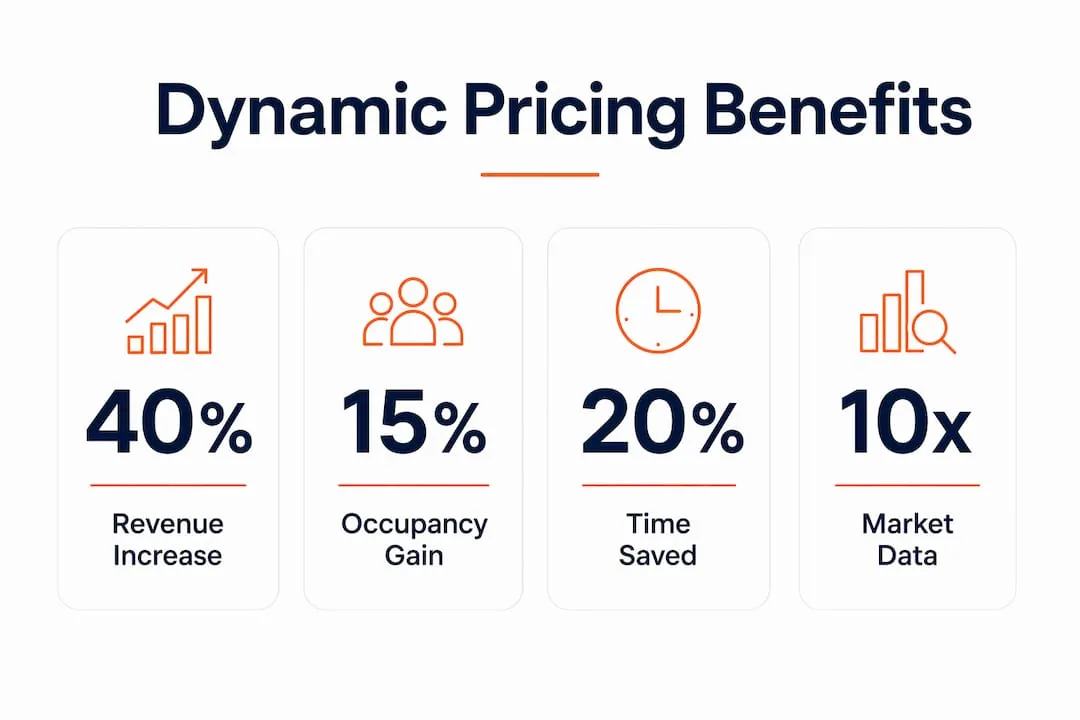
The operational benefits compound over time. Dynamic pricing algorithms can update rates multiple times per day, reacting to market shifts faster than any manual process. A property manager handling ten or more listings cannot realistically monitor competitor rates daily across every market. Automation closes that gap without adding headcount.
The core benefits break down into three categories:
- Revenue protection: Rates rise automatically during local events, holidays, and high-demand weekends without requiring you to monitor every market signal
- Occupancy protection: Strategic price reductions during low-demand periods fill gaps that static pricing leaves vacant, protecting your annual revenue floor
- Time savings: Automated repricing removes the daily or weekly manual pricing task from your workflow, freeing time for guest experience and property operations
For property managers running rental occupancy optimization across multiple listings, the time savings alone justify the tool cost within the first month.
What are common misconceptions and risks of dynamic pricing?
The biggest misconception about dynamic pricing is that it means surge pricing. Dynamic pricing is not just surge pricing. It strategically lowers rates during low demand to keep units occupied and protect annual margins. The downward adjustment is just as important as the upward one. A tool that only raises prices is not a dynamic pricing model. It is a revenue management tool with one hand tied behind its back.
A second common mistake is treating dynamic pricing as a set-and-forget system without proper configuration. The algorithm works within the bounds you set. If those bounds are wrong, the output is wrong. Property managers who set a minimum price too low will find their algorithm filling slow weeks at rates that barely cover cleaning costs. Those who set a maximum too high will miss bookings during moderate-demand periods.
A third risk involves tool selection. Platform-native dynamic pricing tools often under-earn because they optimize for platform booking volume rather than individual host profit margin. A booking platform wants your calendar full. You want your calendar profitable. Those goals overlap but do not always align. Third-party tools give you more granular control over base rates, rules, and market comparisons.
Here is a practical checklist for avoiding the most common dynamic pricing mistakes:
- Set a true minimum price. Calculate your actual cost per night including cleaning, utilities, platform fees, and mortgage allocation. Your minimum must exceed this number.
- Review your bounds monthly. Market conditions shift. A minimum set in january may be too low by june in a seasonal market.
- Do not skip the manual review phase. Spend time understanding your market before handing full control to an algorithm.
- Choose tools built for hosts, not platforms. Prioritize tools that let you set base rates and rules independently of platform defaults.
- Monitor RevPAR, not just ADR. A rising ADR with falling occupancy is a warning sign that your pricing ceiling is too aggressive.
Pro Tip: Before enabling full automation, run your chosen tool in “proposal mode” for 30 days. Review every suggested rate change before it goes live. This builds pricing intuition you cannot get from reading documentation.
How can rental property owners implement dynamic pricing effectively?
The most reliable path to effective dynamic pricing starts with a manual workflow. A weekly 15–20 minute review of competitor rates and occupancy builds the market intuition that makes automated tools more effective. Property managers who skip this phase often misconfigure their tools because they do not understand what normal looks like in their market. That manual phase typically improves revenue 8–12% over static pricing on its own, before any automation is added.
Once you understand your market, the implementation steps follow a clear sequence.
Start by setting your base price. This is the anchor the algorithm uses to calculate demand-adjusted rates. Set it at a realistic midpoint for your property, not your aspirational peak rate. Then define your minimum and maximum. The minimum protects profitability. The maximum prevents the algorithm from pricing you out of bookings during moderate-demand periods.
Next, layer in event-based rules. Most third-party tools allow you to flag specific dates for manual overrides or elevated minimums. Local festivals, major sporting events, and holiday weekends warrant manual attention even within an automated system. Local event calendars and demand patterns are inputs the best tools process automatically, but you should verify the tool is capturing your specific market’s events.
The distinction between fully automated and proposal-based tools matters for property managers who are new to dynamic pricing:
| Feature | Fully automated tools | Proposal-based tools |
|---|---|---|
| Rate updates | Applied automatically, multiple times daily | Suggested for manager review before applying |
| Best for | Experienced managers with calibrated settings | Managers building pricing intuition |
| Speed of response | Fastest reaction to market shifts | Slower but allows human judgment |
| Risk level | Higher if bounds are misconfigured | Lower due to manual review step |
For managers running vacation rental revenue strategies across multiple properties, fully automated tools with well-configured bounds are the practical choice. Proposal-based tools work well for single-property owners or those new to algorithmic pricing.
Ongoing monitoring is not optional. Check your RevPAR weekly, compare it to the prior month and prior year, and adjust your base price or bounds if performance drifts. Dynamic pricing is not a one-time setup. It is a system that requires periodic calibration to stay aligned with your market.
Key Takeaways
Dynamic pricing in rentals is the single most effective revenue tool available to property managers, delivering 10–40% annual revenue gains over static pricing when properly configured and monitored.
| Point | Details |
|---|---|
| Core definition | Dynamic pricing adjusts nightly rates automatically using demand, seasonality, and competitor data. |
| Revenue impact | Properly configured dynamic pricing increases annual rental revenue by 10–40% over static rates. |
| Owner control | Algorithms work within minimum and maximum price bounds that you set, protecting profitability. |
| Tool selection | Third-party tools outperform platform-native tools by optimizing for host profit, not booking volume. |
| Implementation path | Start with a weekly manual review workflow before enabling full automation to build market intuition. |
Why dynamic pricing rewards patience more than speed
Most property managers I talk to want to flip the switch on dynamic pricing and watch revenue climb immediately. That is not how it works, and the managers who treat it that way are the ones who end up frustrated six months later with misconfigured tools and erratic rates.
The real value of dynamic pricing is not in the daily price fluctuations. Dynamic pricing software functions as a system for consistent rate optimization with guardrails, not as a tool for constant price flickering. The managers who get the most out of it are the ones who invest time upfront in understanding their market, setting realistic bounds, and reviewing performance data regularly.
The other thing most articles miss: dynamic pricing is most valuable during your worst weeks, not your best ones. The primary value lies in protecting margins during low-demand periods by adjusting prices downward to avoid vacancies. Your peak weekends will fill regardless of your pricing strategy. The algorithm earns its keep by filling your slow Tuesdays in november at a rate that still makes sense for your business.
If you manage more than three properties, the scalability argument becomes impossible to ignore. Manual pricing across ten listings in different markets is not a pricing strategy. It is a guessing game with a spreadsheet. Dynamic pricing gives you a consistent, data-driven framework that scales with your portfolio without scaling your workload.
— Jose
Realtevoos: built for property managers who take pricing seriously
Property managers who want dynamic pricing to work need more than a pricing tool. They need a platform that connects pricing decisions to the full operational picture.

Realtevoos is built specifically for vacation rental operators managing multiple properties. The platform integrates real-time data from Airbnb and Vrbo into a single dashboard, giving you occupancy trends, booking pace, and revenue metrics in one place. That data context makes dynamic pricing decisions sharper. When you can see that a property’s occupancy is trailing its market by 15 points, you know your pricing bounds need adjustment. Realtevoos surfaces those signals automatically, so you act on data rather than instinct. Property managers using Realtevoos report saving several hours each week on manual reporting and communications. Explore the Realtevoos command center to see how it fits your portfolio.
FAQ
What is dynamic pricing in short-term rentals?
Dynamic pricing in short-term rentals is an automated system that adjusts nightly rates in real time based on demand, seasonality, competitor pricing, and booking lead time. The goal is to maximize revenue and occupancy by pricing each night at its true market value.
How much can dynamic pricing increase rental revenue?
Dynamic pricing increases annual rental revenue by 10–40% compared to static pricing. The exact gain depends on market seasonality, property type, and how well the tool is configured.
Does dynamic pricing mean my rates will always be high?
No. Dynamic pricing lowers rates during low-demand periods to fill vacant nights and protect annual revenue. The downward adjustment is a core function, not a side effect, of a properly configured dynamic pricing model.
Can I control the minimum and maximum prices the algorithm sets?
Yes. Dynamic pricing tools work within minimum and maximum price bounds that you define. The algorithm adjusts rates within those limits, so your profitability floor and booking ceiling are always protected.
Should I use a platform-native or third-party dynamic pricing tool?
Third-party tools give you more control over base rates and profit-focused rules. Platform-native tools optimize for booking volume, not individual host revenue, which can cost you margin over time. For serious property managers, a dedicated third-party tool is the better choice.