What Is Smart Rental Pricing? A 2026 Guide
Discover what smart rental pricing is and how it boosts your revenue. Learn to unlock dynamic pricing strategies for vacation rentals.

What Is Smart Rental Pricing? A 2026 Guide
Smart rental pricing is an automated method that uses algorithms to adjust vacation rental rates in real time based on demand, seasonality, local events, and market competition. The industry term for this approach is dynamic pricing, and understanding the difference between platform-default tools and professional-grade systems is what separates average operators from top earners. Property owners and managers who rely on gut instinct or static rates consistently leave revenue on the table. This guide explains how smart pricing works, where built-in tools fall short, and what expert operators do differently.
What is smart rental pricing and how does it work?
Smart rental pricing is defined as algorithmic dynamic pricing that continuously recalculates the optimal nightly rate for a vacation rental property. The algorithm pulls from multiple data inputs: booking pace, local event calendars, competitor rates, seasonal demand curves, and historical occupancy patterns. Each input carries a weight, and the system recalculates a recommended rate whenever the data shifts.
The core mechanics involve two guardrails every property owner must set: a price floor and a price ceiling. The floor protects against underpricing during slow periods. The ceiling captures maximum revenue during peak demand. Between those two boundaries, the algorithm applies demand multipliers. A music festival in your market might trigger a 2x multiplier on a Friday night. A rainy Tuesday in the off-season might push rates toward the floor.

Pricing updates happen on two timelines. Built-in platform tools typically reprice once per day. Professional third-party dynamic pricing engines reprice multiple times per day, capturing intraday demand shifts that platform tools miss entirely. That frequency difference is one of the most underappreciated factors in rental price optimization.
Pro Tip: Set your price floor based on your actual cost per night, including cleaning fees, mortgage allocation, and platform fees. Never let an algorithm price below your break-even point.
What are the advantages and limitations of platform-native smart pricing tools?
Platform-native smart pricing tools offer one clear advantage: they cost nothing and require minimal setup. For a first-time host with a single property, that convenience has real value. The tool connects directly to the platform’s booking data and starts adjusting rates automatically within minutes of activation.
The limitations, however, are structural and significant. Platform incentives prioritize booking volume over host revenue. The platform earns a percentage of every booking, so its algorithm is calibrated to maximize the number of bookings, not the revenue per booking. Those two goals frequently conflict.
The revenue cost of that conflict is measurable. Airbnb’s Smart Pricing tool underprices by 15–30% during high-demand dates compared to optimized manual or third-party pricing strategies. That gap compounds across a full calendar year into thousands of dollars of lost revenue.
Three structural limitations explain why platform tools underperform:
- Minimum price anchoring. Smart Pricing frequently selects rates at the low end of the host’s set bounds, creating a persistent downward bias in nightly rates.
- Limited data granularity. Platform tools draw primarily from their own booking data. They lack visibility into competitor rates on other platforms, local event signals, or lead-time patterns across the broader market.
- Low transparency. The algorithm operates as a black box. Hosts cannot see why a specific rate was chosen, which makes it nearly impossible to identify and correct underpricing patterns.
Setting a low base rate compounds all three problems. A low base rate anchors the algorithm and handicaps its ability to price aggressively during peak demand, even when market conditions justify much higher rates.
How do third-party dynamic pricing tools enhance rental revenue?
Third-party dynamic pricing engines solve the core problems that platform tools cannot. They pull real-time data from multiple sources simultaneously: competitor rates across platforms, local event databases, regional booking lead times, and property-specific historical performance. That broader data set produces more accurate rate recommendations.
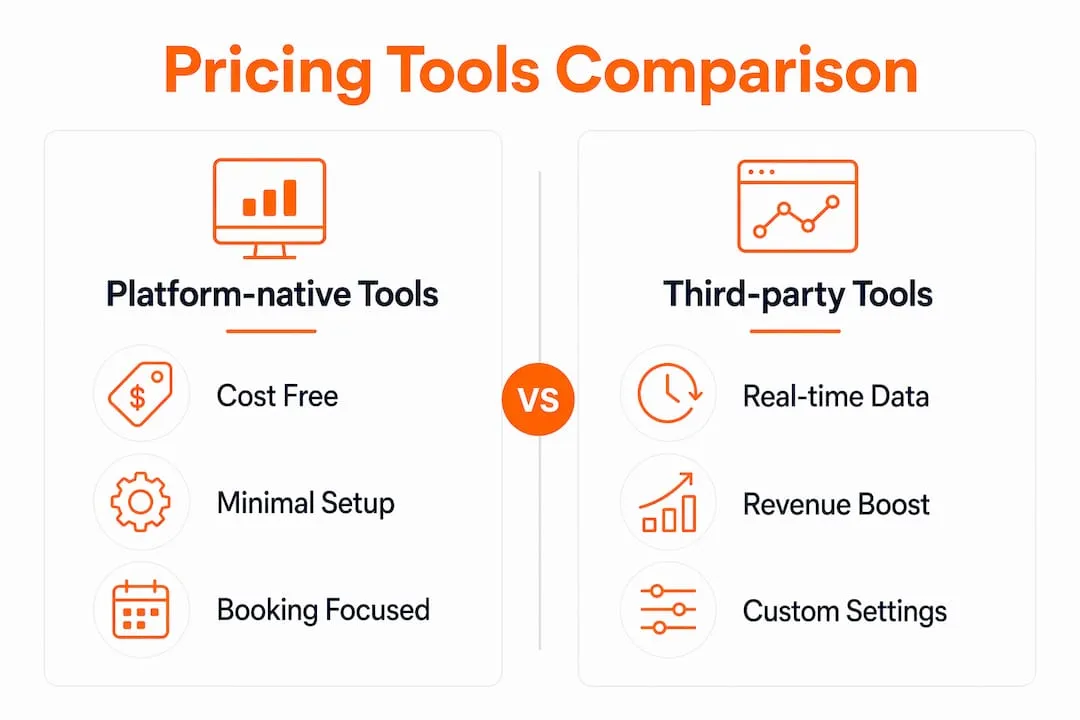
The revenue impact is substantial. Third-party tools generate 10–40% higher annual rental revenue compared to static or platform-default pricing. That range reflects the difference between properties that simply activate a tool and properties that configure it properly with custom guardrails and active oversight.
The feature set of professional pricing engines differs from platform tools in four meaningful ways:
| Feature category | Platform-native tools | Third-party pricing engines |
|---|---|---|
| Repricing frequency | Once daily | Multiple times per day |
| Data sources | Platform booking data only | Multi-platform, events, competitors |
| Custom guardrails | Basic min/max only | Reaction logic, discount rules, overrides |
| Revenue optimization goal | Booking volume | Host revenue per available night |
Property managers running multiple properties benefit most from third-party tools. The ability to set property-specific reaction logic, apply bulk rule changes, and review performance across a portfolio makes these tools a practical necessity at scale. For a deeper look at how these engines integrate with broader operations, the property manager’s guide to dynamic pricing covers the technical setup in detail.
Pro Tip: When evaluating a third-party pricing engine, ask specifically how it handles local events. Tools that integrate live event data from sources like local tourism boards or ticketing platforms will outperform those relying on historical patterns alone.
What strategies do expert operators use for smart rental pricing?
Top-tier property managers treat pricing as an ongoing operating process, not a one-time configuration. Top 1% rental operators use continuous market monitoring, defined reaction logic, and strict price guardrails to outperform generic pricing tools by 15–25%. The gap between them and average operators is not the tool they use. It is how actively they manage it.
The strategies that separate expert operators from the rest fall into five categories:
- Continuous competitor tracking. Monitor comparable properties in your market at least weekly. Rate changes by competitors signal demand shifts you should respond to immediately.
- Defined reaction logic. Decide in advance how your pricing responds to specific triggers. A local concert, a holiday weekend, or a last-minute booking window each warrant a different pricing response.
- Strict price boundaries. Set minimum and maximum rates that reflect your actual cost structure and your market’s ceiling. Review these boundaries quarterly, not annually.
- Manual overrides for peak periods. Effective revenue management combines partial automation with manual overrides during peak demand and local events. Never let an algorithm handle your highest-revenue nights without human review.
- Lead-time discounting rules. Define at what point before arrival you will discount an unfilled night, and by how much. This prevents last-minute panic pricing that erodes your average daily rate.
Data-driven pricing transforms rate-setting from intuition into a structured system built on competitor tracking, margin analysis, and defined rules. That structure is what makes pricing decisions repeatable and measurable across a growing portfolio. Property managers looking to build this system from the ground up will find the vacation rental revenue tips resource a practical starting point.
The most common mistake among property owners who adopt smart pricing for the first time is treating it as a set-and-forget solution. Dynamic pricing requires active management. The market changes, your competitors change, and local demand patterns shift. Your pricing system must change with them. Operators who check their pricing performance monthly will consistently outperform those who check it quarterly.
Key Takeaways
Smart rental pricing delivers the highest returns when property owners combine automated algorithms with active oversight, custom guardrails, and property-specific data rather than relying on platform defaults alone.
| Point | Details |
|---|---|
| Platform tools prioritize volume | Built-in tools optimize for booking count, not host revenue, causing consistent underpricing. |
| Third-party tools earn more | Professional pricing engines generate 10–40% more annual revenue than platform-default pricing. |
| Base rate anchoring is a trap | A low base rate handicaps any algorithm, suppressing rates even during peak demand periods. |
| Active management is required | Dynamic pricing is not a set-and-forget tool. Weekly oversight separates top earners from average ones. |
| Guardrails protect your margins | Setting firm price floors and ceilings based on real costs prevents the algorithm from pricing below break-even. |
Why I think most hosts are solving the wrong pricing problem
Most property owners I talk to frame their pricing challenge as a technology problem. They want to know which tool to use. The real problem is almost always a strategy problem. They have not defined what a good outcome looks like for their specific property, in their specific market, at their specific cost structure.
Platform smart pricing tools are not bad products. They are products built for a different goal than the one most hosts actually have. Once you understand that the platform’s incentive is booking volume and yours is profit per night, the tool’s behavior stops being frustrating and starts making sense. You stop blaming the algorithm and start building around its limitations.
The hosts I have seen generate the most consistent revenue growth are not the ones using the most sophisticated tools. They are the ones who review their pricing data every week, adjust their guardrails every quarter, and manually override their algorithm for every major local event on the calendar. They treat pricing as a discipline, not a feature. The AI-driven approaches available today make that discipline easier to maintain, but they do not replace it. The operators who combine good tools with active management are the ones who pull away from the competition every year.
— Jose Villeda
Realtevoos: a command center built for serious rental operators
Property managers who want to move beyond platform defaults need a system that connects pricing intelligence with full operational visibility. Realtevoos is built specifically for that purpose.
Realtevoos integrates real-time data from Airbnb, Vrbo, and other platforms into a single dashboard, giving property managers the market signals they need to make confident pricing decisions. The platform’s AI-driven automation handles routine reporting and guest communications, freeing up the hours that most managers spend on manual tasks each week. For operators managing multiple properties, Realtevoos scales without adding operational complexity. Property managers at vacation rental services who have adopted centralized platforms report measurable gains in both revenue and guest satisfaction. See what Realtevoos can do for your portfolio at realtevoos.com.
FAQ
What is smart rental pricing in simple terms?
Smart rental pricing is an automated system that adjusts your vacation rental’s nightly rate based on demand, seasonality, and market competition. The goal is to charge the highest rate the market will support on any given night.
How is smart pricing different from dynamic pricing?
Smart pricing is the term platforms like Airbnb use for their built-in automated rate tool. Dynamic pricing is the broader industry term for any algorithm-driven rate adjustment system, including more advanced third-party engines.
Does Airbnb’s Smart Pricing maximize host revenue?
Airbnb’s Smart Pricing prioritizes booking volume over host revenue, and it underprices by 15–30% during high-demand periods. Most professional operators use third-party tools or manual overrides to capture peak-demand revenue.
How often should I review my rental pricing strategy?
Review your price guardrails and competitor rates at least weekly. Conduct a full strategy review quarterly to adjust your minimum and maximum rates based on updated cost structures and market conditions.
Can I use smart pricing on multiple properties at once?
Third-party dynamic pricing engines and platforms like Realtevoos support multi-property pricing management, allowing you to set property-specific rules and review portfolio-wide performance from a single dashboard.