Winning Vacation Rental Competitive Market Entry in 90 Days
Achieve successful vacation rental market entry in just 90 days by optimizing operations, automating processes, and strategically vetting your market.

Winning Vacation Rental Competitive Market Entry in 90 Days
You win vacation rental competitive market entry by proving operational density before you chase scale, automating pricing and messaging from day one, and running a 90-day pilot that converts owners with clean, transparent P&Ls. Skip any of those three, and you’ll bleed margin to a market you don’t actually understand yet.
Here’s what to do in the next 48 to 72 hours:
- Pull occupancy, ADR, and comp-set data for your target submarket.
- Call three local vendors (cleaning, maintenance, locksmith) to gauge response times.
- Draft your owner pitch with a specific revenue-lift number.
- Confirm PMS and channel manager setup can go live within two weeks.
Pro Tip: *Track one number this week: your projected ADR delta versus the submarket average.
Key Takeaways
Winning vacation rental competitive market entry requires proving density in one submarket, automating pricing and messaging immediately, and running a transparent 90-day owner pilot before expanding further.
| Point | Details |
|---|---|
| Vet fast, decide faster | Collect occupancy, ADR, comp set, and vendor density data within 48 to 72 hours before committing. |
| Protect owner economics | Keep commission around a quarter and cap introductory discounts at a moderate percentage for the first couple of months. |
| Automate before you hire | Messaging and pricing automation can cut active management time by 60 to 70% per unit. |
| Build trust through reporting | A transparent owner dashboard benchmarked against the submarket reduces churn more than acquisition spend. |
| Pilot before you scale | RealtevoOS lets you run 3 to 5 pilot doors for 90 days to validate pricing and owner reporting before expanding. |
Table of Contents
- Vacation Rental Market Entry Strategy: Vetting a Market in 48 to 72 Hours
- How Do You Acquire Owners in a New Market?
- What Pricing Rules Protect Owner Returns While Winning Bookings?
- Operational SOPs That Prevent Churn as You Scale
- What Tech Stack Do You Need Before Launch?
- KPIs and Reporting That Build Owner Trust
- Your 90-Day Launch Plan for a New Market
- Run Your Pilot Doors on RealtevoOS
- Frequently Asked Questions
- Sources
Vacation Rental Market Entry Strategy: Vetting a Market in 48 to 72 Hours
Speed matters here, but sloppy speed kills margin later. You need ten data points, not fifty, and you need them fast enough to make a go or no-go call before a competitor locks up the good owners.
Collect these before you commit:
- Occupancy rate and ADR trends over the past 12 months
- Seasonality curve (peak, shoulder, off-season spread)
- Average booking window (how far out guests book)
- Channel mix (Airbnb share vs. Vrbo vs. direct)
- Comp set ADR and occupancy for 10 to 15 similar listings
- Permit caps or short-term rental license limits
- Dominant guest segment (families, business travelers, groups)
- Average length of stay
- Local events calendar that drives demand spikes
- Vendor density (cleaners, handymen, locksmiths available)
Pull this from OTA listing pages, county assessor records, Google Trends, and short-term rental data services. A market with occupancy above 60% and ADR growth outpacing regional inflation is worth a closer look. Flat or declining ADR alongside rising new-listing counts is your warning sign; that’s a market saturating faster than it’s growing.
Pro Tip: Walk a 10 to 15 minute radius around your target submarket and map every service vendor you’d need. If cleaners and handymen are already stretched thin across three other management companies, your turnover times will suffer the moment you add doors.
Multi-market operators often learn this the hard way. Going wide before you have density in one submarket tends to dilute both marketing and operations, which is exactly why a tight, defensible submarket beats a scattered footprint every time.
How Do You Acquire Owners in a New Market?
Referrals convert best and cost the least, but they only work once you have a handful of local listings performing well. Agent partnerships scale faster but require real relationship investment, and cold direct outreach to recent buyers or self-managing owners is your most expensive channel. Blended owner acquisition cost commonly runs $1,400 to $8,400, with a long payback period, so protect retention hard once an owner signs.
Your pitch should hit three points: revenue lift versus self-management, full transparency on fees and performance, and a clear risk-mitigation story (insurance, damage protocols, local vendor network). Vague promises about “more bookings” don’t convert; a specific ADR comparison against their current listing does.
Once an owner says yes, move fast on onboarding:
- Sign the contract and confirm fee structure within 48 hours.
- Schedule professional photos within the first week.
- Install smart locks and confirm WiFi speed meets your standard.
- Load pricing rules and minimum-stay settings into your PMS.
- Connect the listing to Airbnb, Vrbo, and direct booking channels.
- Confirm cleaning and maintenance vendor coverage for the unit.
- Send the owner a sample statement template before the first booking.
Choose your contract architecture based on the owner’s appetite for control. Full-service management typically charges around a quarter of booking revenue; a hybrid model works for owners who want to handle their own maintenance; a la carte fee-for-service fits self-managers who just need distribution and pricing help.
What Pricing Rules Protect Owner Returns While Winning Bookings?
Your base ADR should track the comp set you built during vetting, adjusted with minimum-stay rules on weekends and gap-night discounts for single-night holes in the calendar. Length-of-stay discounts (5 to 10% for a week or more) fill shoulder season without discounting your peak nights, and a last-minute pricing ladder captures demand inside a 3 to 7 day booking window without cratering ADR further out.
Run the breakeven math before you commit to a submarket:
| Cost or Lift Factor | Typical Range |
|---|---|
| Management commission | around a quarter of booking revenue |
| Cleaning fee pass-through | Set at cost plus small margin |
| Dynamic pricing ADR lift | Varies by market and season |
| Blended owner acquisition cost | $1,400–$8,400 |
Day-one pricing checklist:
- Set minimum stays for weekends and holiday periods.
- Build a gap-night rule to auto-discount orphaned single nights.
- Load a last-minute ladder for the final week before check-in.
- Cap introductory discounts at a moderate percentage for the first couple of months.
Introductory discounts help you climb search rank on Airbnb and Vrbo fast, but never discount so deep that the owner’s net payout looks worse than self-managing. That’s the fastest way to lose a signed owner in month two.
Operational SOPs That Prevent Churn as You Scale
Every new market exposes weak SOPs faster than your home market did, because you don’t have the local trust network to paper over mistakes yet. Build these before you onboard your fifth property, not after a bad review forces the issue.
Your turnover checklist needs photo-verified cleaning checks at every changeover, a maintenance triage workflow that separates “fix today” from “schedule this week,” and a documented damage process owners can see in real time. Photo-verified checkout checklists paired with a documented damage-waiver product remove the largest churn vectors tied to cleanliness disputes and owner mistrust.
Staffing follows volume, not the other way around:
- One operations coordinator per roughly 15 to 20 properties
- One owner-success contact once you pass 10 to 15 doors
- One maintenance tech (or trusted vendor) on-call per submarket
- A rotating on-call schedule covering guest issues after hours
New property onboarding should include standardized hardware. Using the same smart-lock brand and WiFi setup across every unit cuts support calls dramatically, because your team troubleshoots one system instead of ten.
Pro Tip: The single control that prevents the most churn is photo-verified turns tied directly to a documented damage workflow. Owners forgive a lot when they can see exactly what happened between one guest leaving and the next one checking in.
For a deeper walk-through of turnover coordination, see this operational efficiency guide.

What Tech Stack Do You Need Before Launch?
Your minimum stack is a PMS with a built-in channel manager, a dynamic pricing engine, messaging automation, a turnover ops tool, and payment plus document handling for contracts. Automating messaging and pricing early can cut active management time by roughly 60 to 70% per unit, which is the difference between adding your next ten doors smoothly or drowning in manual work.
Sequence your integrations: calendar sync first (this alone prevents double bookings), pricing engine second, messaging automation third, then connect owner reporting directly to your PMS. Evaluate any new tool on API availability, owner-reporting depth, reliability at real scale, and monthly cost as a percentage of revenue, generally 3 to 6% is a reasonable ceiling.
Delay niche integrations (loyalty programs, advanced upsell tools) until after day 30. Retrofitting core systems while managing live bookings is far riskier than adding polish once your foundation holds.
KPIs and Reporting That Build Owner Trust
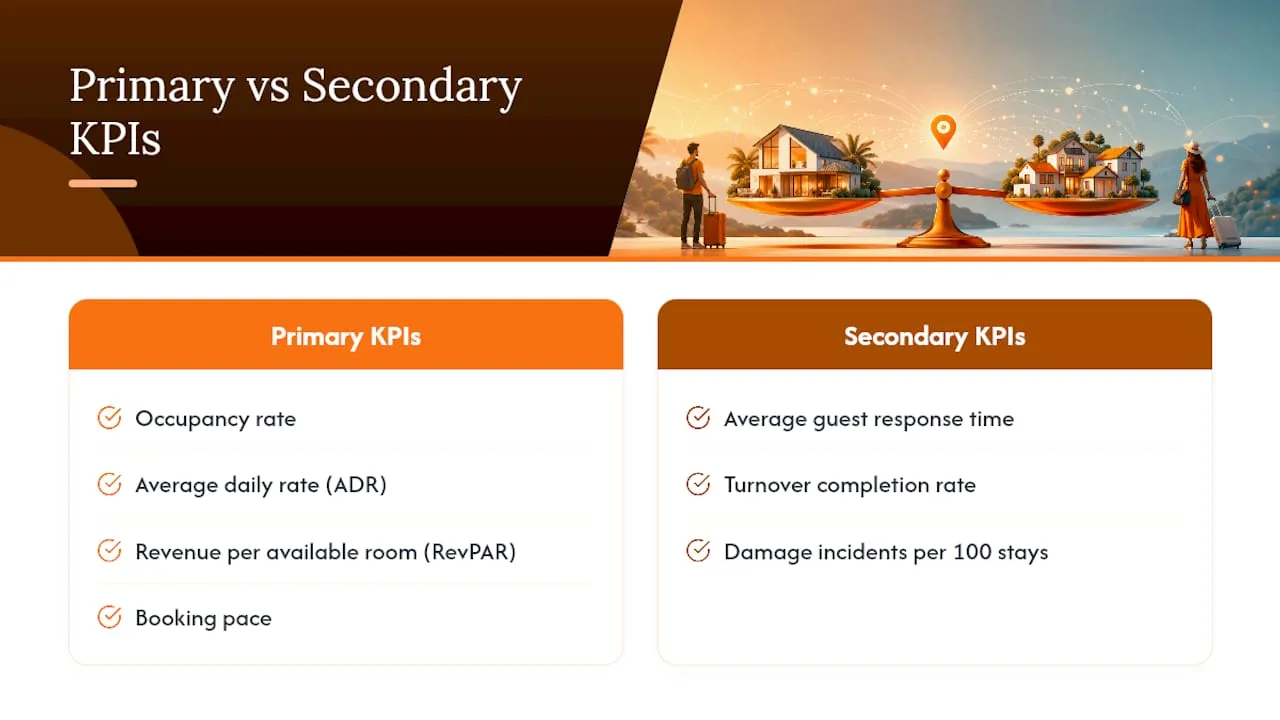
Track occupancy, ADR, RevPAR, booking pace, cancellation rate, owner net payout, and owner churn rate as your primary dashboard from day one. Watch average guest response time, turnover completion rate, and damage incidents per 100 stays as secondary signals that predict problems before they show up in revenue.
Run a daily ops dashboard, a weekly internal review, a monthly owner statement, and a quarterly business review with your pilot owners. Owner retention responds more to a transparent dashboard benchmarked against the submarket than to any amount of extra acquisition spend, so lead your owner reports with comparison data, not just raw numbers.
Your 90-Day Launch Plan for a New Market
- Days 0-30 (Foundation): Complete business formation and insurance, stand up your PMS and channel manager, and configure dynamic pricing before a single listing goes live.
- Days 31-60 (First Doors): Onboard your first 3 to 5 pilot properties, confirm vendor coverage, and launch owner reporting.
- Days 61-90 (Operational Cadence): Review KPIs weekly, refine pricing rules based on real booking data, and prepare your owner acquisition pitch for the next wave.
Budget bullets to set expectations:
- One-time setup (legal, insurance, initial photography): varies by market
- Monthly tech stack at small scale: roughly $400 to $600 for 10 to 15 properties
- Onboarding labor: heaviest in days 31 to 60, tapering after
Hand your pilot owner a launch packet: signed contract, photo schedule, pricing rule summary, and a sample statement so they know exactly what month one looks like.
Three Lessons from Scaling Portfolios
Density beats geography. A tight submarket with real vendor relationships outperforms a scattered footprint every time. Automate pricing and messaging before you hire more people, not after you’re overwhelmed. The most common mistake I see is chasing a second market before the first one is actually profitable.
Run Your Pilot Doors on RealtevoOS
The playbook above only works if the operational grind doesn’t eat your team alive during the first 90 days, and that’s exactly where most manual operators stall out. RealtevoOS is the alternative to juggling spreadsheets, disconnected PMS tabs, and manual owner emails when you’re trying to launch in a new market fast.

RealtevoOS ties directly into the moves this article recommends:
- Automated guest messaging that handles the volume spike a new market launch creates
- Dynamic pricing synced with real-time Airbnb and Vrbo data, so your ADR adjusts without manual review
- An owner dashboard that shows the exact transparency this article says reduces churn
- Onboarding templates that turn your 7 to 14 day sequence into a repeatable checklist instead of a scramble
Run your first pilot on RealtevoOS with 3 to 5 doors for 90 days. Use that window to validate your pricing rules and prove your owner reporting cadence before you scale further. Check out the command center dashboard to see how the setup maps onto the exact 90-day plan above.
Frequently Asked Questions
What does vacation rental competitive market entry actually require on day one?
It requires a validated submarket with attractive occupancy and ADR data, a PMS and channel manager already configured, and at least one signed pilot owner ready to onboard within the first two weeks.
How many properties should I target before calling a market entry successful?
Most defensible playbooks point to 30 to 60 doors in a single submarket before you consider expanding further, since that density supports staffing an owner-success role without overspending.
Is a vacation rental market saturation strategy different from entering a fresh market?
Yes. A saturated market demands sharper differentiation, tighter pricing, and faster owner conversion, while a fresh or underserved market rewards early density and vendor relationship building over aggressive discounting.
How long does it take to break even after entering a new market?
Breakeven timing depends on your onboarding pace and owner acquisition cost, which commonly ranges from $1,400 to $8,400 per owner. Faster onboarding and strong retention shorten that window considerably.
Do I need a revenue management tool immediately, or can dynamic pricing rules alone work?
Simple dynamic pricing rules work fine under 20 properties. Once you pass that range, a dedicated revenue management tool becomes worth the added cost.
Sources
- GTM Playbook for Vacation Rental Property Managers in 2027
- How do you build the GTM playbook for a vacation rental property…
- How Property Managers scale from 50 to 500 listings
- Complete Guide to Scaling from 3 to 25 STR Properties in 2026 | STRStack
- Podcast: Multiple Vacation Rental Markets? It’s Super Hard: And Here’s Why… • BuildUp Bookings