Vacation Rental Fire Safety Checklist for Property Managers
A vacation rental fire safety checklist for property managers: smoke and CO alarm placement, testing, extinguishers, escape plans and prevention rules.
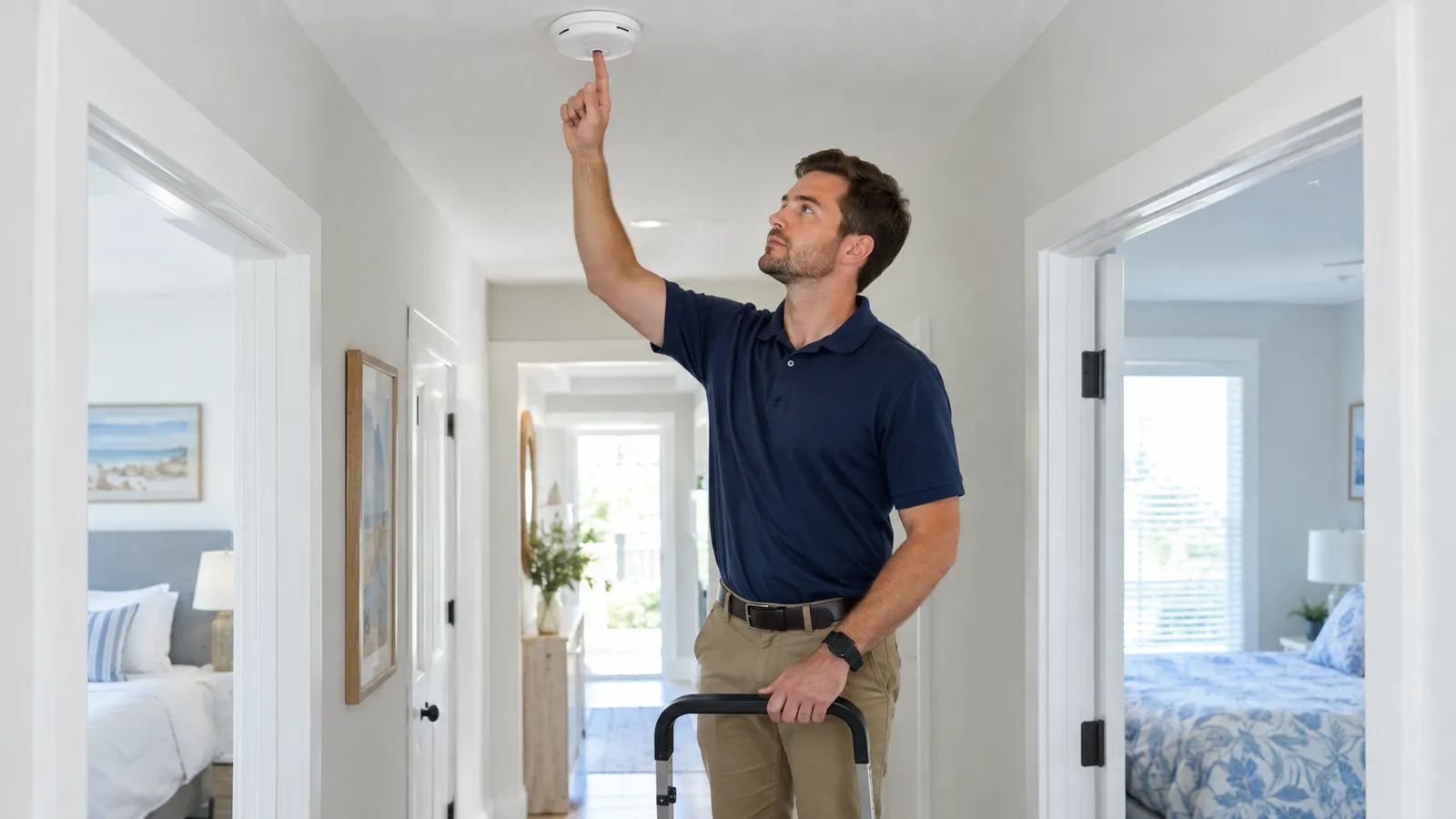
Vacation rental fire safety comes down to working, interconnected smoke and CO alarms, a visible extinguisher, clear escape routes, prevention rules for cooking and heating, and a documented inspection schedule. Because guests don't know the home, everything has to be obvious to a stranger arriving at night.
Key Takeaways
Fire safety in a rental works when equipment, inspections and guest instructions are documented and checked on a schedule, not installed once and forgotten.
| Point | Details |
|---|---|
| Alarms everywhere people sleep | Smoke alarms in every bedroom, outside sleeping areas and on every level, per USFA. |
| Test monthly, replace at 10 years | Log monthly tests and track each alarm's manufacture date. |
| Add CO protection | CO alarms on each level outside sleeping areas where fuel-burning appliances exist. |
| Target cooking and heating | The two leading causes of home fires; set clear guest rules and annual inspections. |
| Make escape obvious | Post a floor plan with two ways out of each sleeping room and mirror it in the guidebook. |
Table of Contents
- Why Is Fire Safety Different in a Vacation Rental?
- Where Should Smoke Alarms Go in a Vacation Rental?
- How Often Should You Test and Replace Smoke Alarms?
- Do Vacation Rentals Need Carbon Monoxide Alarms?
- What Fire Safety Equipment Should Every Rental Have?
- How Do You Prevent Cooking and Heating Fires?
- How Should Guests Learn the Escape Plan?
- Vacation Rental Fire Safety Checklist
- What Operators Get Wrong About Vacation Rental Fire Safety
- How RealtevoOS Handles Fire Safety Operations
- Frequently Asked Questions About Vacation Rental Fire Safety
- Sources
Why Is Fire Safety Different in a Vacation Rental?
Fire safety is different in a vacation rental because the people sleeping there don't know the home: they don't know where the exits are, how the stove behaves or where the extinguisher hangs.
- Guests are unfamiliar with the layout — a family arriving late at night may never notice the second exit from a bedroom unless you point it out.
- Time is short — the Red Cross notes that if a fire starts in a home, you may have as little as two minutes to escape (American Red Cross — Home Fire Safety). Ready.gov adds that in less than 30 seconds a small flame can turn into a major fire (Ready.gov — Home Fires).
- Nobody lives there to notice problems — a chirping alarm, a frayed cord or a clogged dryer vent can go unnoticed for weeks between owner visits.
- Many hands touch the home — cleaners, maintenance techs, owners and guests all interact with equipment, so responsibility for checks has to be written down.
That is why fire safety in a rental belongs in your operating standard, with equipment, inspections, guest instructions and records, rather than in the owner's memory.
Where Should Smoke Alarms Go in a Vacation Rental?
Smoke alarms should be installed in every bedroom, outside each separate sleeping area and on every level of the home, including the basement.
That placement comes straight from the U.S. Fire Administration, which describes it as a precaution all homeowners and landlords need to take (USFA — Smoke Alarms). For rentals, a few details matter:
- Cover both fire types — USFA recommends that every place where people sleep have both ionization and photoelectric alarms, or dual-sensor alarms that contain both sensors.
- Interconnect them — USFA advises choosing interconnected alarms so that when one sounds, they all sound — important when guests sleep with bedroom doors closed.
- Check local rules — USFA notes that your city, county or state may require a specific type of alarm; confirm with the local fire marshal before you buy.
How Often Should You Test and Replace Smoke Alarms?
Test every smoke alarm monthly, replace 9-volt batteries at least once a year, and replace the alarm itself 10 years from its manufacture date.
- Monthly test — USFA says to test smoke alarms every month, whether they run on 9-volt batteries, 10-year lithium batteries or household wiring (USFA — Smoke Alarms).
- Battery changes — USFA recommends replacing 9-volt smoke alarm batteries at least once every year; Ready.gov suggests twice a year unless the alarm uses 10-year lithium batteries (Ready.gov — Home Fires).
- Unit replacement — alarms age out. USFA notes they need to be replaced 10 years from the manufacture date, so record that date for every unit.
- Never leave one disabled — Ready.gov warns never to disable a smoke alarm while cooking. In a rental, a guest who pulls a chirping alarm off the ceiling leaves the next guest unprotected — so make a missing or disabled alarm a same-day maintenance task.
Do Vacation Rentals Need Carbon Monoxide Alarms?
Any rental with fuel-burning appliances, a fireplace or an attached garage should have carbon monoxide alarms, placed on each level outside each sleeping area.
- Placement — the EPA page on carbon monoxide summarizes the Consumer Product Safety Commission recommendation that every home have CO alarms on each level outside each sleeping area (EPA — Carbon Monoxide's Impact on Indoor Air Quality).
- Annual appliance inspection — the same source urges an annual professional inspection of all fuel-burning appliances, including furnaces, stoves, fireplaces, clothes dryers, water heaters and space heaters.
Many jurisdictions also have their own CO alarm requirements for rentals, so confirm local code alongside these recommendations.
What Fire Safety Equipment Should Every Rental Have?
Every rental needs working smoke and CO alarms, a fire extinguisher in the kitchen, clear exits and posted emergency information that a stranger can understand at a glance.
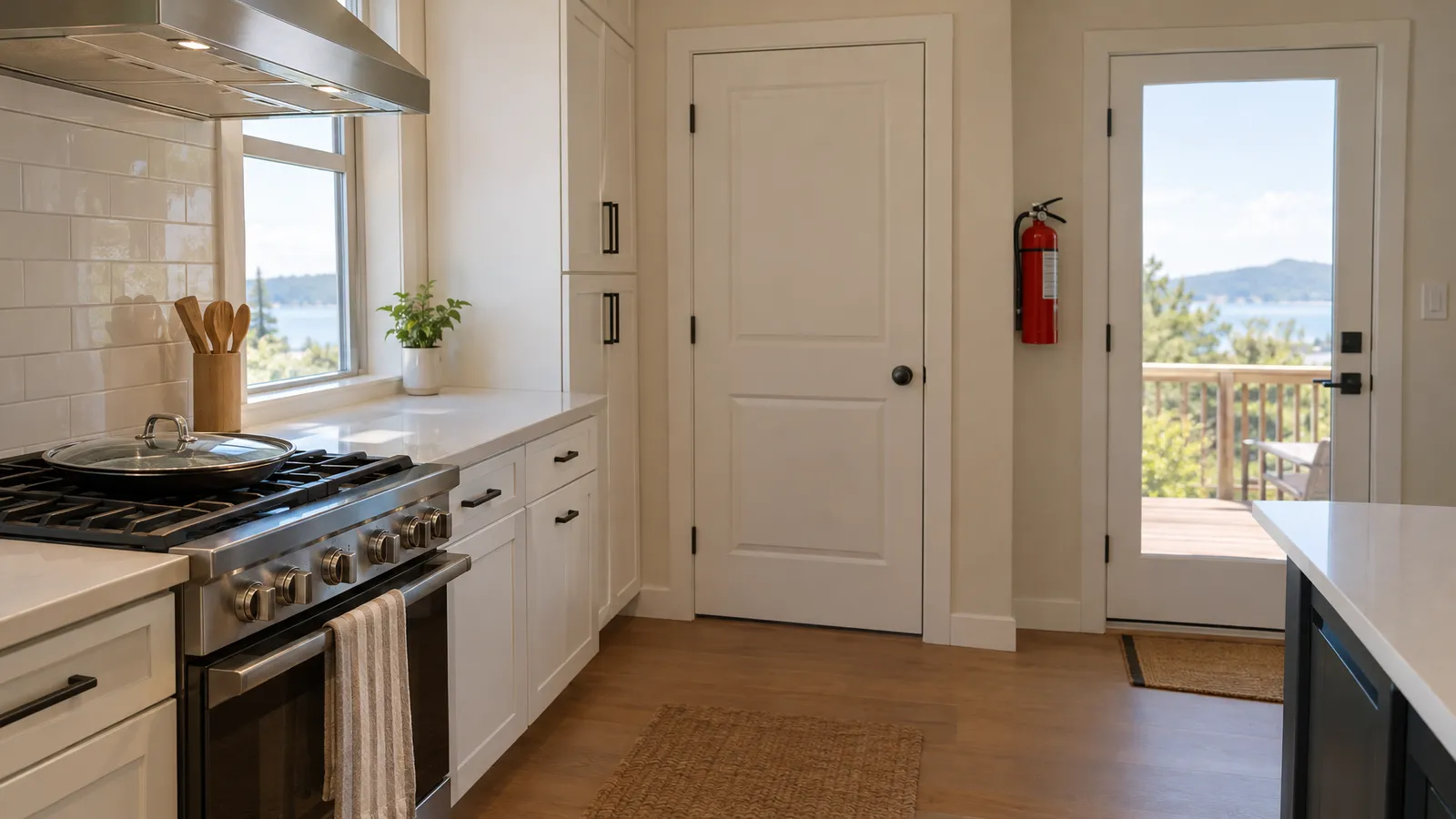
- Kitchen fire extinguisher — Ready.gov recommends keeping a fire extinguisher in the kitchen and contacting your local fire department for help with proper use and maintenance (Ready.gov — Home Fires). Mount it near an exit where guests can see it.
- Pan lid or baking sheet nearby — USFA advises keeping a lid or baking sheet nearby to cover a pan that catches fire (USFA — Cooking Fire Safety).
- Escape-ready windows — Ready.gov says to make sure windows are not stuck, screens can be removed quickly and security bars can be opened.
- Posted emergency card — the address, the local emergency number, the exits and the extinguisher location, written for someone who has never been in the home.
How Do You Prevent Cooking and Heating Fires?
Prevent most rental fires by targeting the two biggest home risks, cooking and heating, with clear guest instructions and annual equipment maintenance.
USFA calls cooking by far the leading cause of home fires and home fire injuries, and says heating fires remained the second leading cause of home fires in 2021 (USFA — Cooking Fire Safety; USFA — Heating Fire Safety).
- Stand by your pan — USFA's cooking message is simple: if you leave the kitchen, turn the burner off. Put it in the house manual near the stove instructions.
- Three feet of clearance — USFA says to keep anything that can burn at least 3 feet from heat sources, including fireplaces, wood stoves, radiators, space heaters and candles.
- Space heaters off when away — USFA advises turning space heaters off when leaving the room or going to bed. Many operators simply don't supply portable heaters.
- Annual chimney and heating service — have heating equipment and chimneys cleaned and inspected each year by a professional, per USFA.
- Grills away from the house — Ready.gov recommends positioning barbecue grills at least 10 feet from siding and deck railings, and out from under eaves and overhanging branches.
- Cords and appliances — Ready.gov says to replace worn, old or damaged appliance cords immediately and not to run cords under rugs or furniture.
Write these into your house rules so guests see them before they light a fireplace or fire up the grill.
How Should Guests Learn the Escape Plan?
Guests should get a short, visual escape plan in the home and in the digital guidebook, showing two ways out of every sleeping room and a meeting spot outside.
- Two ways out — Ready.gov advises finding two ways out of each room in case the primary way is blocked by fire or smoke (Ready.gov — Home Fires).
- Simple floor plan — post a floor plan on the back of each bedroom door or near the main entry, marking exits and the extinguisher. NFPA's escape planning resources are a useful model (NFPA — Escape Planning).
- Get out, stay out — the Red Cross's rule is to get out, stay out and call for help, and never go back inside for anything or anyone (American Red Cross — Home Fire Safety).
- Smoke basics — Ready.gov advises dropping to the floor and crawling low under smoke, and feeling a door before opening it; if it's hot, use the second way out.
Vacation Rental Fire Safety Checklist
Use this checklist when onboarding a property and as the basis for recurring inspections.
- Confirm local fire and CO alarm requirements with the fire marshal or permitting office.
- Install smoke alarms in every bedroom, outside each sleeping area and on every level.
- Use interconnected, dual-sensor (or both ionization and photoelectric) alarms where possible.
- Record the manufacture date of every alarm and schedule replacement at 10 years.
- Install CO alarms on each level outside each sleeping area if the home has fuel-burning appliances.
- Test every smoke and CO alarm monthly and log the result.
- Mount a fire extinguisher in the kitchen near an exit and have it checked per the manufacturer and local fire department guidance.
- Keep a pan lid or baking sheet by the stove.
- Confirm every bedroom window opens and screens or security bars release easily.
- Schedule annual professional inspection of chimneys, heating equipment and other fuel-burning appliances.
- Check grill placement, cords and dryer area during turnovers.
- Post an escape floor plan and emergency card, and mirror it in the digital guidebook.
- Add fire safety basics to the house rules and pre-arrival message.
Pair this with your broader vacation rental emergency response plan so the team knows what happens after an alarm or a call.
What Operators Get Wrong About Vacation Rental Fire Safety
Most gaps come from treating fire safety as a one-time install rather than a recurring, documented check.
- Installing once and forgetting — alarms installed at onboarding quietly pass their replacement date because nobody recorded when they were made.
- Testing only when something chirps — a monthly test is the standard USFA sets; waiting for a low-battery chirp means a guest is the one who finds the problem.
- Hiding the extinguisher — an extinguisher under the sink behind cleaning supplies is hard for a stranger to find in a hurry.
- Assuming guests know the exits — the second way out of a lower-level bedroom is obvious to the owner and invisible to a first-time guest.
- Skipping seasonal equipment — fireplaces, wood stoves and heaters come into use in cold months. Our winterization checklist is a good time to book the annual inspection.
How RealtevoOS Handles Fire Safety Operations
RealtevoOS doesn't install alarms or replace a fire inspection. It keeps the recurring work, records and guest communication around fire safety organized across your portfolio.
- Maintenance tracking — log alarm tests, replacement dates, extinguisher checks and chimney inspections per property so overdue items are visible.
- Crew coordination — add alarm tests and window checks to turnover tasks so cleaners and inspectors confirm them before the next arrival.
- AI that learns your SOPs — teach it each property's exits, extinguisher location and fireplace rules so answers to guests stay accurate.
- Unified guest inbox and 24/7 AI guest messaging — answer questions about a chirping alarm or how to use the fireplace at any hour, and route real issues to your team.
- Owner reports — show owners the safety maintenance completed on their property.
In a real emergency, guests should always call the local emergency number first. RealtevoOS helps make sure the preparation and follow-up actually happen.
Frequently Asked Questions About Vacation Rental Fire Safety
Where should smoke alarms be placed in a vacation rental?
The U.S. Fire Administration recommends smoke alarms in every bedroom, outside each separate sleeping area and on every level of the home, including the basement. Interconnected alarms are recommended so that when one sounds, they all sound.
How often should vacation rental smoke alarms be tested?
USFA recommends testing smoke alarms every month, replacing 9-volt batteries at least once a year and replacing each alarm 10 years from its manufacture date. Logging a monthly test during a turnover is a practical way to keep the cadence.
Does a vacation rental need a carbon monoxide alarm?
If the home has fuel-burning appliances, a fireplace or an attached garage, yes. The EPA summarizes the CPSC recommendation of CO alarms on each level outside each sleeping area, and many local codes require them in rentals.
Should a vacation rental have a fire extinguisher?
Yes. Ready.gov recommends keeping a fire extinguisher in the kitchen. Mount it where a guest can see it near an exit, and ask your local fire department about proper use and maintenance.
How do I tell guests about the fire escape plan?
Post a simple floor plan showing two ways out of every sleeping room, the extinguisher and a meeting spot, and repeat it in the digital guidebook. Reinforce the Red Cross rule: get out, stay out and call for help.