Vacation Rental House Rules Template: What to Include
Vacation rental house rules template: the rules to include, how to word them in plain language, and how to enforce them politely without conflict.
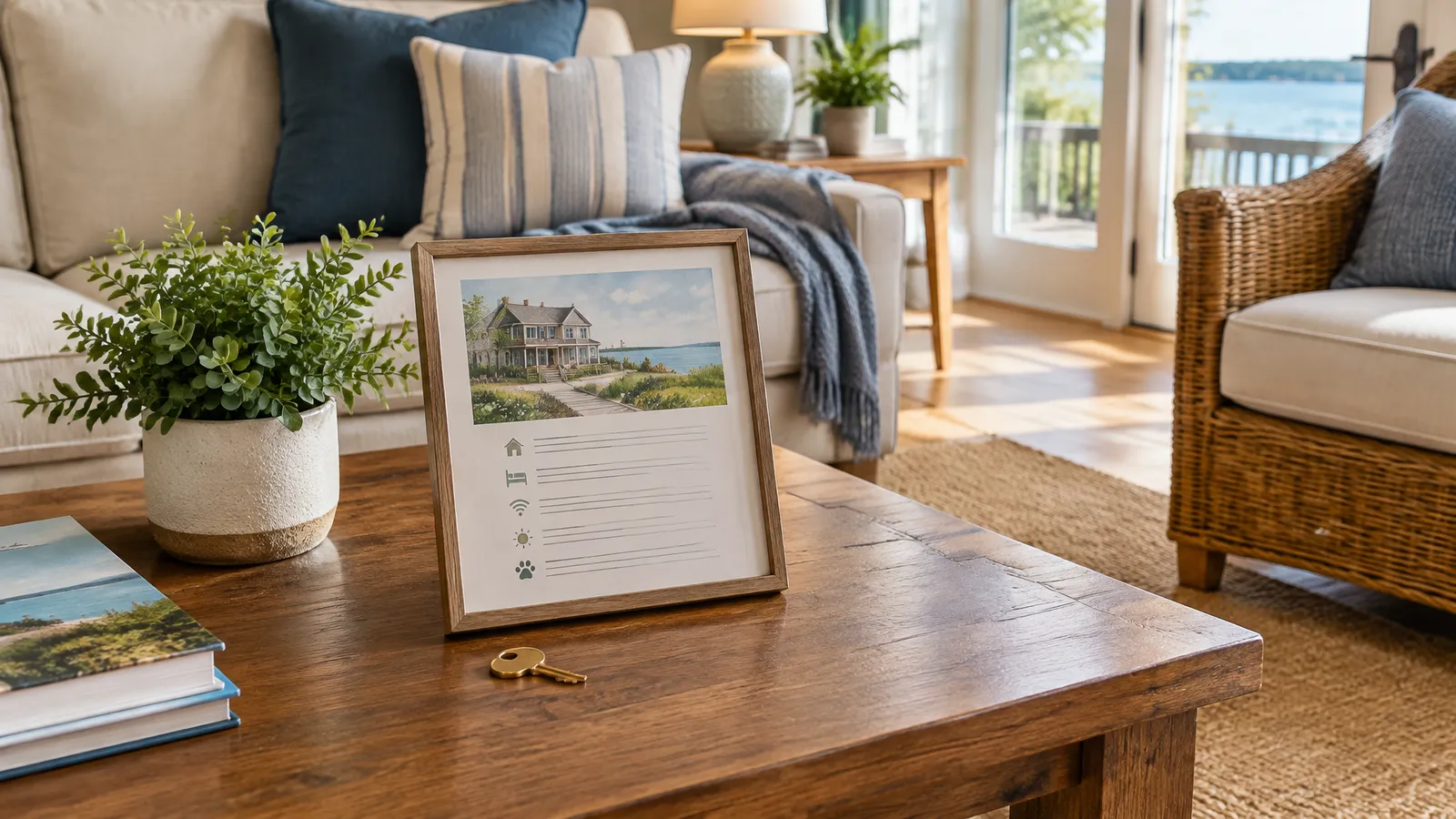
A vacation rental house rules template should cover occupancy, quiet hours, parties, smoking, pets, parking, safety and check-out, in short plain-language sentences. Shown in the listing, the arrival message and the property, clear rules prevent most disputes before they start.
Key Takeaways
Effective house rules are short, specific and visible, and they are enforced consistently and politely.
| Point | Details |
|---|---|
| Cover the core topics | Occupancy, noise, events, smoking, pets, parking, safety and check-out. |
| Write plainly | Short, specific, positive sentences that read well on a phone. |
| Match local rules | Align quiet hours, guest counts and fire safety with your permit and local law. |
| Treat assistance animals separately | Keep them apart from your pet policy and check your obligations. |
| Show rules three times | In the listing, the arrival message and at the property. |
Table of Contents
- What Should a Vacation Rental House Rules Template Include?
- Why Do House Rules Matter for Vacation Rentals?
- How Do You Write House Rules in Plain Language?
- How Should You Handle Quiet Hours and Noise?
- How Do You Set Rules for Parties, Events and Extra Guests?
- What Should Your Smoking, Candle and Grill Rules Say?
- How Do You Write a Pet Policy and Handle Assistance Animals?
- What Do Operators Get Wrong About House Rules?
- Where Should You Display Your House Rules?
- How Do You Enforce House Rules Without Being Confrontational?
- How RealtevoOS Helps You Keep House Rules Consistent
- Frequently Asked Questions About Vacation Rental House Rules
- Sources
What Should a Vacation Rental House Rules Template Include?
A good template covers the handful of topics that cause most disputes: who may stay, noise, parties, smoking, pets, parking, safety, trash and check-out. Everything else is a property-specific extra.
- Occupancy and visitors — the maximum number of guests, and whether day visitors are allowed.
- Quiet hours — the exact times, and what “quiet” means outdoors, such as on a deck or by a hot tub.
- Events and parties — a clear statement of whether gatherings are permitted and how to ask.
- Smoking and open flames — where, if anywhere, they are allowed.
- Pets and animals — your pet policy, plus how you handle assistance animals.
- Parking and neighbors — number of vehicles, where to park, and respect for neighbors and shared spaces.
- Safety and damage — what to do in an emergency and how to report a broken item.
- Check-out expectations — time, trash, keys and any basic reset tasks.
Keep each rule to one or two lines. A short list that guests read beats a long one they skip.
Why Do House Rules Matter for Vacation Rentals?
House rules set expectations before a problem happens, give you something concrete to point to when one does, and protect relationships with neighbors and owners.
- Fewer disputes — guests who know the quiet hours in advance rarely argue about them afterward.
- Consistency across the team — everyone, from the manager to the cleaner, enforces the same standard.
- Neighbor and owner relations — well-run rules reduce complaints that can turn into compliance trouble; see our guide to rental compliance monitoring.
- Clearer conversations — a written rule lets you stay polite and factual instead of improvising.
How Do You Write House Rules in Plain Language?
Write rules as short, positive, specific sentences that a guest can follow without interpretation.
The federal plain language guidelines recommend short sentences, active voice and everyday words, and Nielsen Norman Group research on how people read on the web shows that people scan rather than read every word. Both apply to a house rules page read on a phone.
- Be specific — “Quiet hours are 10 PM to 8 AM” beats “Please be considerate.”
- Say what to do — “Please take trash to the bin at the side of the garage” beats “No trash left inside.”
- Explain the why when it helps — a one-clause reason, such as “the neighbors’ bedrooms face the patio,” increases compliance.
- Keep the tone of voice — warm and respectful; guests read tone as a signal of how you will treat them.
- Limit the list — if you have more than 10–12 rules, consider which ones truly matter.
How Should You Handle Quiet Hours and Noise?
State the hours, the areas covered and a simple contact path, and make sure your wording matches any local noise ordinance.
Many cities set their own noise limits and some short-term rental permits specify quiet hours, so check your local rules. For background on how noise is regulated in the United States, see the EPA’s Noise Control Act summary.
- Hours — pick start and end times and apply them to indoor and outdoor areas.
- Outdoor spaces — decks, patios and pools carry sound farther than guests expect.
- Escalation — explain that neighbors can contact you and that repeated issues may affect the stay.
- Device guidance — if you use noise monitors, disclose them according to your platform and local requirements.
How Do You Set Rules for Parties, Events and Extra Guests?
Say plainly whether parties and events are allowed, how many guests may stay overnight, and how many visitors may be present at once.
Use this short checklist when writing the section:
- Set a firm overnight occupancy number that matches your permit, insurance and the property’s sleeping capacity.
- Decide whether day visitors are permitted and the maximum number at any time.
- State your policy on events, including weddings and gatherings, and how to request approval if you ever allow them.
- Explain how you verify guest count, such as a registration step or exterior camera at entrances only, and disclose it.
- Outline the consequence of a violation in factual language, and make sure it matches your booking terms.
Rules about guest count should line up with what you advertise and with your local registration. Our short-term rental local law guide is a useful starting point.
What Should Your Smoking, Candle and Grill Rules Say?
Spell out where smoking, open flames and grills are allowed, and where they are not, because these rules relate directly to fire safety and indoor air quality.
- Smoking — the US EPA guidance on secondhand smoke and smoke-free homes explains why many homeowners choose smoke-free policies; state whether smoking is allowed indoors, outdoors only, or not at all.
- Candles and open flames — the NFPA candle safety guidance is a useful reference when deciding whether to allow candles inside the property.
- Grills — if the property has a grill, describe where to use it, and review the NFPA grilling safety tips before writing instructions.
- Fire pits and fireplaces — give operating instructions or state that they are decorative; local rules may restrict their use.
- Alarms — tell guests never to disable smoke or carbon monoxide alarms and where to find them.
How Do You Write a Pet Policy and Handle Assistance Animals?
Your pet policy should state whether pets are welcome, any limits, and what guests are responsible for, and it should be handled separately from requests involving assistance animals.
- Pet-friendly rules — number and size limits, whether pets may be left alone, furniture rules and clean-up expectations.
- No-pet properties — state this clearly in the listing and house rules to prevent surprises at the door.
- Assistance animals — laws differ by situation. The ADA service animal FAQs explain how service animals are defined for public accommodations, and the HUD guidance on assistance animals covers how the Fair Housing Act overview treats animals in housing. How these laws apply to a particular short-term rental can depend on the property and the jurisdiction, so check with a qualified professional before writing exceptions.
Avoid wording that treats a request for an assistance animal as a pet exception without first understanding your obligations.
What Do Operators Get Wrong About House Rules?
The biggest mistake is treating house rules as a legal shield rather than a communication tool.
- Too long — a page of fine print that no one reads, which makes enforcement harder.
- Too negative — a long string of “NO” statements that sets a hostile tone before arrival.
- Hidden placement — rules that appear only after booking, or buried below the fold in the listing.
- Mismatch with listing — contradicting the listing on guest count, pets or events.
- Unenforced rules — rules that the team does not follow up on teach guests that they are optional.
- One template for every property — a rule about the pool for a unit with no pool signals carelessness.
Where Should You Display Your House Rules?
Show rules in three places: the listing, the pre-arrival message and the property itself, with the same wording each time.
- In the listing — so guests agree to them before booking.
- In the arrival message — next to the entry steps; our check-in instructions guide shows where rules fit in the sequence.
- In the property — a short printed card or digital guidebook where guests will actually see it.
- In follow-up messages — if an issue arises, link back to the specific rule instead of rewriting it.
How Do You Enforce House Rules Without Being Confrontational?
Respond early, stay factual, quote the specific rule and offer a way to fix the problem.
- Check the facts first, such as a neighbor’s report or a message from the guest.
- Contact the guest promptly and politely, and refer to the exact rule.
- Offer a simple fix and a time frame.
- Document the exchange in the reservation record.
- Follow up after the stay if damage or a repeated violation needs attention, using your booking terms and platform policies.
Consistent tone matters. Our guest communication best practices go deeper on how to word these messages.
How RealtevoOS Helps You Keep House Rules Consistent
RealtevoOS is an AI-powered operating system for vacation rental operators, so your rules, guest messages and operations live in one place instead of scattered across channels.
- Unified guest inbox — guest conversations from your channels sit in a single inbox, so rule reminders and complaints are handled from one place.
- AI trained on your SOPs — you load your own house rules and procedures, and the assistant uses them when answering guest questions.
- Maintenance tracking and crew coordination — if a guest reports damage or a cleaner finds an issue, it can be routed to the right person.
You still decide what the rules are; the platform helps your team apply them the same way each time.
Frequently Asked Questions About Vacation Rental House Rules
How many house rules should a vacation rental have?
Aim for the handful that prevent real problems, usually around eight to twelve. Short, specific rules are easier for guests to follow and for your team to enforce.
Should house rules be in the listing or sent after booking?
Both. Put them in the listing so guests agree before booking, repeat them in the pre-arrival message, and keep a short copy at the property.
Can I ban parties in my vacation rental?
Yes, many operators do, and some local permits require it. State the policy clearly in the listing and house rules, along with your guest and visitor limits.
How should I handle an assistance animal request at a no-pet property?
Treat it separately from your pet policy. Rules vary by situation and jurisdiction, so understand your obligations before responding and consult a qualified professional if unsure.
What should I do when a guest breaks a house rule?
Contact them promptly, refer to the specific rule, offer a simple fix and document the conversation. Use your booking terms and platform policies for anything more serious.
Sources
- ADA.gov — Service animals FAQs
- HUD — Assistance animals
- HUD — Fair Housing Act overview
- NFPA — Candle safety
- NFPA — Grilling safety
- US EPA — Secondhand smoke and smoke-free homes
- US EPA — Summary of the Noise Control Act
- PlainLanguage.gov — Federal plain language guidelines
- Nielsen Norman Group — How users read on the web