Vacation Rental Power Outage Plan: A Property Manager's Guide
Build a vacation rental power outage plan: guest outage kits, messaging templates, generator and CO safety, food rules and a recovery checklist for your team.
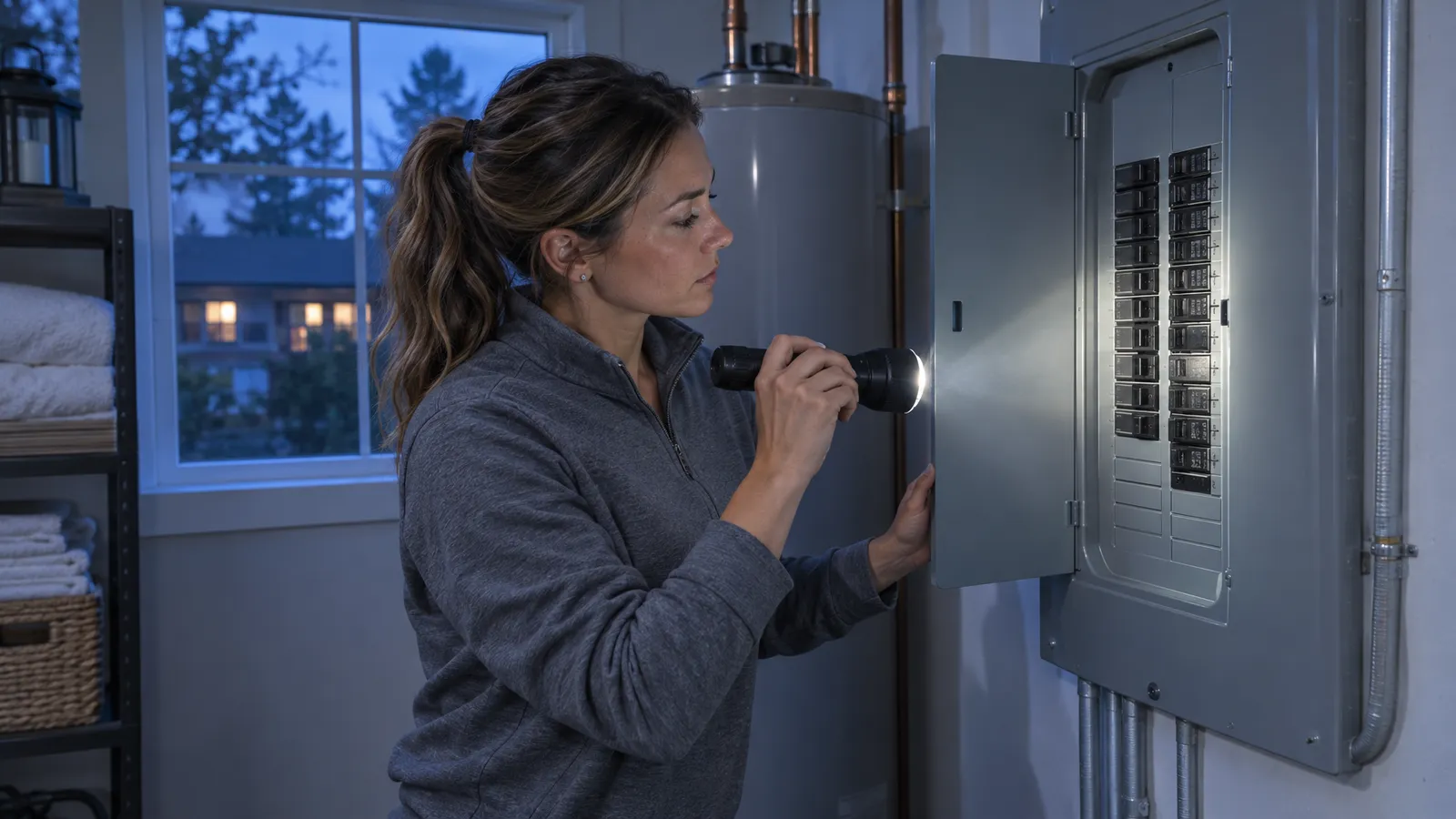
A vacation rental power outage plan tells your team and your guests exactly what to do when the lights go out: where the supplies are, how to stay safe, what happens to the food, and who checks the home when power returns. Because guests don't know the property, the plan has to work for a stranger standing in a dark kitchen.
Key Takeaways
An outage plan works when supplies, guest messages, safety rules and recovery checks are written down and assigned before the power fails.
| Point | Details |
|---|---|
| Prepare each property | Document the breaker panel, utility provider and power-dependent systems. |
| Stock a findable kit | Flashlights, power banks, a radio, water and thermometers, sized to occupancy. |
| Communicate early and often | Acknowledge fast, point to the kit and promise the next update. |
| Prevent CO and fire | Generators and grills outside, at least 20 feet from windows; flashlights, not candles. |
| Recover before the next guest | Check breakers, food, alarms and systems, restock the kit and log it. |
Table of Contents
- Why Does a Vacation Rental Need Its Own Power Outage Plan?
- What Supplies Should Every Rental Keep for Outages?
- How Should You Communicate With Guests During an Outage?
- How Do You Keep Guests Safe From Carbon Monoxide and Fire?
- Should Your Vacation Rental Have a Generator?
- When Should Food Be Thrown Out After an Outage?
- What Should the Team Check When Power Comes Back?
- Vacation Rental Power Outage Plan Checklist
- What Operators Get Wrong About Power Outages
- How RealtevoOS Handles Power Outage Operations
- Frequently Asked Questions About Vacation Rental Power Outages
- Sources
Why Does a Vacation Rental Need Its Own Power Outage Plan?
A vacation rental needs its own outage plan because the people inside don't know the home, don't own the supplies and can't make decisions about the property without you.
Ready.gov notes that extended outages can disrupt communications, water and transportation, close stores, gas stations and banks, spoil food and prevent the use of medical devices (Ready.gov — Power Outages). In a rental, every one of those effects lands on a guest who is far from home.
- Guests can't find anything — the breaker panel, the flashlights and the shutoffs are obvious to an owner and invisible to someone who arrived yesterday.
- Your team gets flooded with messages — one neighborhood outage can trigger messages from every guest in the area at the same time.
- Decisions need an owner — whether to relocate guests, discard food or call an electrician should follow a written policy, not a late-night guess.
What Supplies Should Every Rental Keep for Outages?
Keep a labeled outage kit with lighting, charging, a radio, water and basic food, stored where guests can find it in the dark.
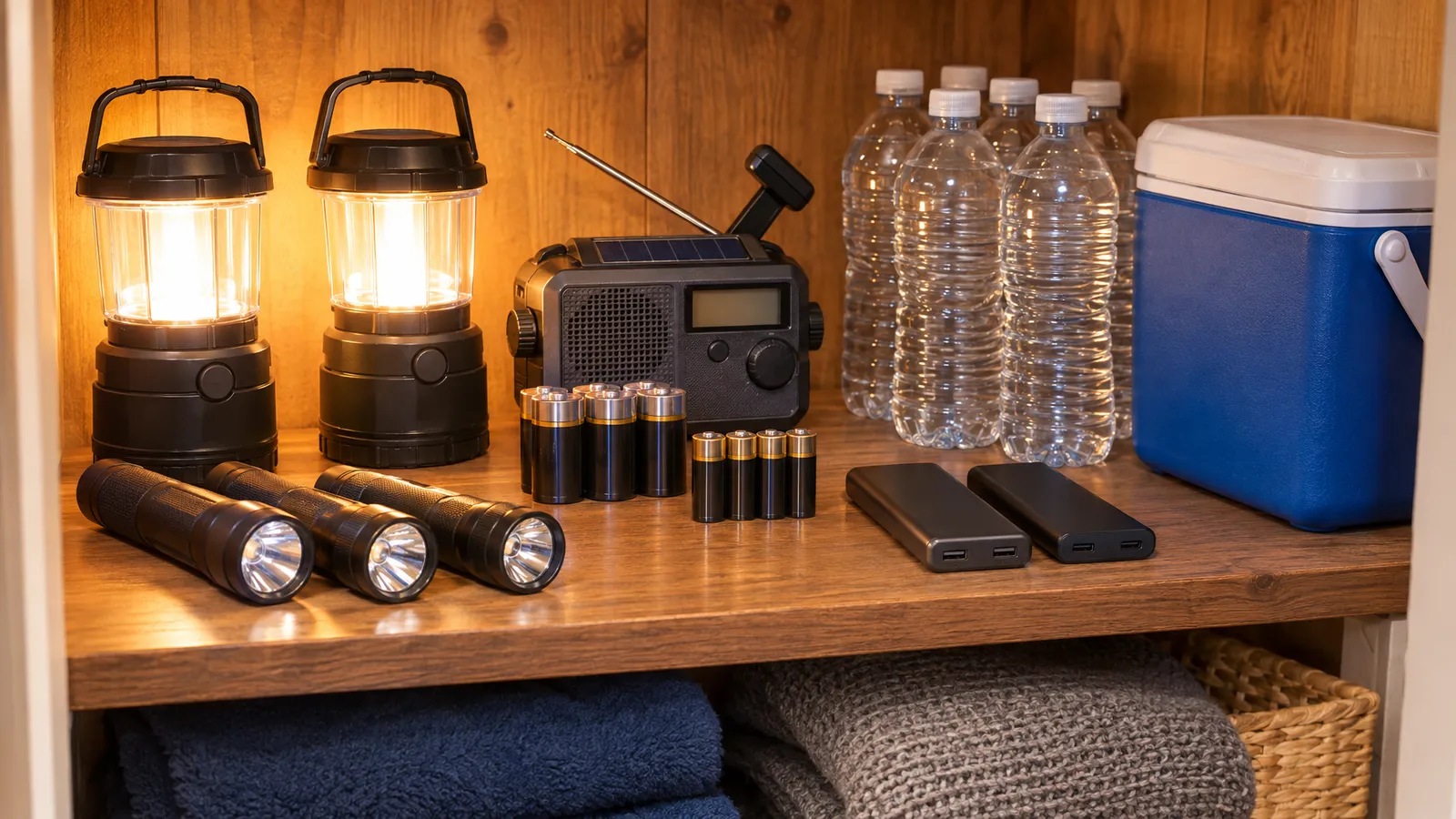
- Lighting — Ready.gov recommends having flashlights for every household member; in a rental, size it to the maximum occupancy (Ready.gov — Power Outages).
- Charging — Ready.gov suggests planning for batteries and alternative power such as a portable charger or power bank.
- Radio — Ready.gov's basic kit list includes a battery-powered or hand crank radio and a NOAA Weather Radio with tone alert (Ready.gov — Build a Kit).
- Water and food — Ready.gov's kit guidance calls for one gallon of water per person per day for several days and at least a several-day supply of non-perishable food.
- Cold storage helpers — the FDA recommends appliance thermometers in the refrigerator and freezer, and freezing containers of water for ice to keep food cold (FDA — Food and Water Safety During Power Outages).
- Flashlights, not candles — the Red Cross says to use flashlights, not candles, during an outage (American Red Cross — Power Outage Safety).
Mention the kit's location in your house manual and check it during turnovers.
How Should You Communicate With Guests During an Outage?
Message guests quickly, tell them what you know and what you're doing, and give them the next update time, even if nothing has changed.
- Acknowledge fast — confirm you know about the outage and are checking with the utility.
- Point to the kit — give the exact location of flashlights, lanterns and chargers.
- Share safety basics — no candles, no gas stove for heat, keep the fridge and freezer closed.
- Set the next update — say when you'll check in again and keep that promise.
- Offer options — if heat, cold or medical needs make the home unsafe, explain what relocation or support you can provide.
- Close the loop — send an all-clear when power returns.
The Red Cross encourages people to sign up for local alerts and to have communication devices that work without home power (American Red Cross — Power Outage Safety). Your team should be subscribed to utility and weather alerts for every market you operate in; the National Weather Service safety pages are a good starting point for storm preparedness.
How Do You Keep Guests Safe From Carbon Monoxide and Fire?
The biggest outage dangers are carbon monoxide from generators and grills used too close to the home, and fires from candles or improvised heating.
- Generators and grills stay outside — Ready.gov says generators, camp stoves and charcoal grills should always be used outdoors and at least 20 feet away from windows (Ready.gov — Power Outages).
- No gas stove or oven for heat — Ready.gov warns that using a gas stove or oven to heat a home increases the risk of carbon monoxide poisoning and fire.
- CO alarms with battery backup — Ready.gov advises carbon monoxide detectors with battery backup in central locations on every level; the EPA also summarizes CO alarm placement guidance (EPA — Carbon Monoxide's Impact on Indoor Air Quality).
- Fans and open windows aren't protection — the Red Cross notes that opening doors and windows or using fans will not prevent CO buildup in the home (American Red Cross — Generator Safety).
Our vacation rental fire safety checklist covers alarm placement and testing in more detail.
Should Your Vacation Rental Have a Generator?
A generator can keep critical systems running, but only if it is installed and operated safely; a portable unit left for guests to run themselves adds risk.
- Prefer a permanent setup — the Red Cross calls a permanently installed stationary generator the best option, and says a generator connected to house wiring needs a transfer switch installed by an electrician (American Red Cross — Generator Safety).
- Never backfeed — plugging a generator into a wall outlet, known as backfeeding, puts utility workers, neighbors and the household at risk of electrocution, according to the Red Cross.
- Size it honestly — the Red Cross notes some machines draw up to 3 times as much power when starting up, so add up loads and leave headroom.
- Fuel rules — turn the generator off and let it cool before refueling, and store fuel in an approved safety can outside living areas.
When Should Food Be Thrown Out After an Outage?
Keep refrigerator and freezer doors closed, and discard perishables that have been above 40°F for too long; when in doubt, throw it out.
- How long cold lasts — an unopened refrigerator keeps food cold for about 4 hours, and a full freezer holds its temperature for about 48 hours (24 hours if half full) if the door stays closed (FDA — Food and Water Safety During Power Outages).
- The discard rule — the FDA says to discard refrigerated perishable food such as meat, poultry, seafood, milk, eggs or leftovers that has been above 40°F for 4 hours or more.
- Refreezing — if a freezer thermometer reads 40°F or below, or food still contains ice crystals, it is safe to refreeze or cook, per the FDA.
- Medications — Ready.gov advises that if the power is out for more than a day, refrigerated medication should be discarded unless the label says otherwise, and a doctor or pharmacist should be consulted (Ready.gov — Power Outages).
For guests, the practical move is to replace spoiled groceries or offer a credit under a clear policy, rather than asking them to judge food safety themselves.
What Should the Team Check When Power Comes Back?
After power returns, inspect the home before the next arrival so a hidden problem doesn't become the next guest's complaint.
- Confirm power is restored to every circuit and that no breakers remain tripped. The Red Cross says to have an electrician inspect tripped breakers before turning them on (American Red Cross — Power Outage Safety).
- Check refrigerator and freezer temperatures and discard food per the FDA guidance above.
- Reset thermostats, water heaters, pool and spa equipment, smart locks, cameras and Wi-Fi.
- Test smoke and CO alarms and replace any batteries drained during the outage.
- Restock the outage kit: batteries, water, power banks charged.
- Look for water issues where pumps or heating stopped; in cold climates review your winterization checklist.
- Keep clear of fallen lines: the Red Cross advises staying at least 35 feet away from fallen power lines and anything they touch, and calling 911.
- Send the guest an all-clear and log the event, actions taken and any costs for the owner.
Vacation Rental Power Outage Plan Checklist
Use this checklist to build the plan once and review it before storm season. Treat it as one chapter of your broader vacation rental emergency response plan so roles and contact trees stay consistent.
- Document the breaker panel, shutoffs, utility provider and outage reporting method for each property.
- Note power-dependent systems: well pump, sump pump, electric heat, garage doors, smart locks.
- Stock an outage kit sized to maximum occupancy and record where it's stored.
- Install CO alarms with battery backup on every level and confirm smoke alarms have backup power.
- Decide your generator policy: none, staff-operated, or permanently installed with a transfer switch.
- Place appliance thermometers in every refrigerator and freezer.
- Write guest message templates for first notice, updates and all-clear.
- Set decision thresholds for food replacement, relocation and technician dispatch.
- Subscribe the team to utility and weather alerts for every market.
- Add outage instructions to the house manual and digital guidebook.
- Run the recovery checklist after every outage and log it for the owner.
What Operators Get Wrong About Power Outages
Most outage problems come from assuming the guest will figure it out, instead of preparing the property and the messages in advance.
- No kit, or a kit nobody can find — a drawer of dead flashlights in the garage doesn't help a guest in a dark bedroom.
- Leaving candles as the backup — they look cozy in listing photos, but the Red Cross specifically says to use flashlights, not candles.
- Going silent — guests forgive an outage much more readily than they forgive not hearing from you.
- Letting guests decide about food — without a policy, guests either eat food they shouldn't or throw out everything and expect a refund.
- Skipping the recovery check — tripped breakers, reset thermostats and drained alarm batteries are found by the next guest if nobody looks.
How RealtevoOS Handles Power Outage Operations
RealtevoOS can't restore power or replace your utility or electrician, but it keeps the communication, tasks and records around an outage organized across your portfolio.
- Unified guest inbox and 24/7 AI guest messaging — answer outage questions from every affected guest in one place, at any hour, and route real issues to your team.
- AI that learns your SOPs — teach it each property's kit location, breaker panel and outage rules so answers stay accurate.
- Maintenance tracking — log outage-related issues such as tripped breakers, alarm batteries or pump checks per property so nothing is left open.
- Crew coordination — add recovery checks and kit restocking to turnover tasks before the next arrival.
- Owner reports — show owners what happened, what the team did and what was maintained.
In any emergency, guests should call the local emergency number first. RealtevoOS helps make sure the preparation and follow-up actually happen.
Frequently Asked Questions About Vacation Rental Power Outages
What should a vacation rental power outage plan include?
A property profile (breaker panel, utility provider, power-dependent systems), an outage kit, guest message templates, carbon monoxide and generator safety rules, food and relocation decision thresholds, and a recovery checklist for when power returns.
How long does food stay safe in a rental during a power outage?
According to the FDA, an unopened refrigerator keeps food cold for about 4 hours and a full freezer holds its temperature for about 48 hours (24 hours if half full) if the doors stay closed. Discard refrigerated perishables that have been above 40°F for 4 hours or more.
Can guests use a generator at a vacation rental?
Only if your written policy allows it. Generators must run outdoors and at least 20 feet from windows, according to Ready.gov, and the Red Cross warns never to plug one into a wall outlet. Consider limiting operation to staff or using a permanently installed unit with a transfer switch.
What should be in a vacation rental outage kit?
Flashlights or lanterns for every guest, spare batteries, charged power banks, a battery or hand crank radio, water and non-perishable food, and appliance thermometers for the fridge and freezer. Ready.gov's kit checklist is a useful baseline.
Should I give guests candles for power outages?
No. The American Red Cross recommends using flashlights, not candles, during a power outage. Battery lanterns give guests light without adding a fire risk.