Why Adopt Enterprise Rental Solutions for Growth
Discover why adopt enterprise rental solutions is crucial for property managers. Save time and money while enhancing your rental operations.

Why Adopt Enterprise Rental Solutions for Growth
Enterprise rental solutions are integrated management platforms that consolidate bookings, operations, and asset utilization into a single system for vacation rental property managers. The case for adopting them is direct: property managers running portfolios across Airbnb and Vrbo without unified tools face double bookings, fragmented data, and manual reporting that consumes hours every week. Realtevoos was built specifically to solve these problems. Understanding why adopt enterprise rental solutions matters now, not later, because the cost of staying fragmented compounds as your portfolio grows.
Why adopt enterprise rental solutions: the core benefits
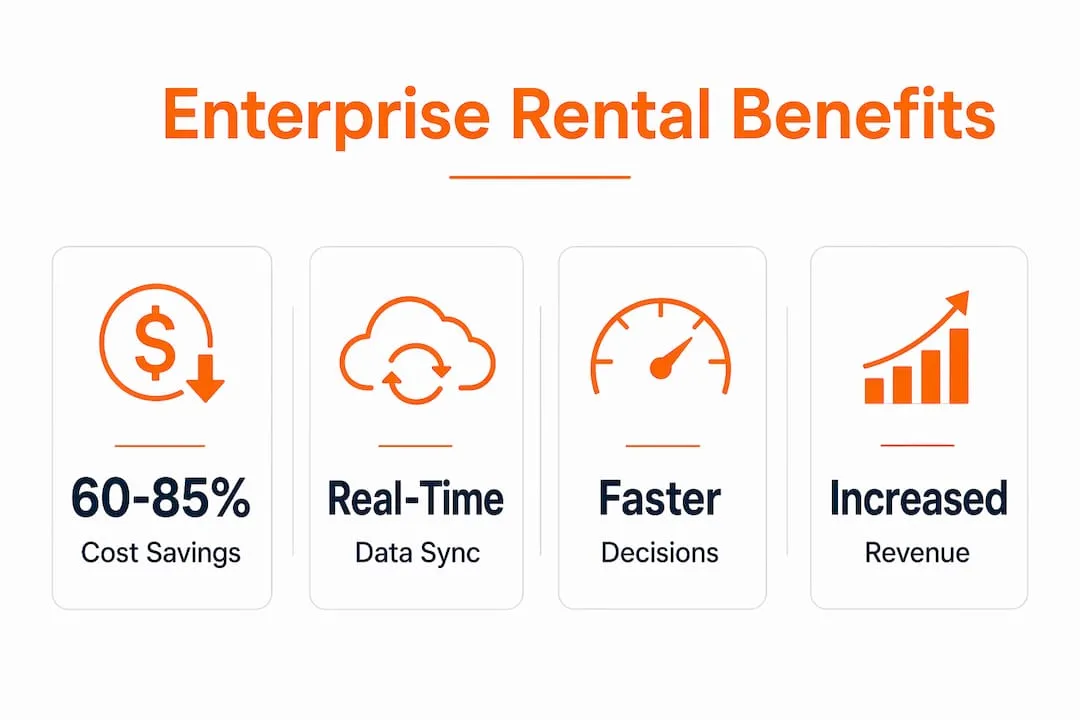
The financial case for enterprise rental management is stronger than most property managers realize. Organizations using flexible, enterprise-grade rental models save 60–85% on Year 1 occupancy costs compared to long-term leasing commitments. That figure reflects real cash freed up by paying only for capacity used, rather than locking into multi-year contracts that penalize you for changing conditions.
The operational benefits of adopting rental solutions go well beyond cost:
- Eliminated manual reconciliation. Unified platforms replace spreadsheets and disconnected tools, removing the daily grind of cross-checking booking data across multiple channels.
- Idle asset monetization. Centralized management enables property managers to rent unused assets to subcontractors, turning cost centers into revenue streams.
- Better vendor negotiations. Consolidated purchasing data gives you real leverage when negotiating with cleaning crews, maintenance vendors, and supply partners.
- Live inventory visibility. Real-time dashboards show occupancy, revenue, and availability across every property simultaneously, replacing guesswork with facts.
- AI-driven workflow automation. Platforms with built-in AI handle pricing adjustments, guest communications, and scheduling without manual input.
Pro Tip: When calculating the value of an enterprise rental platform, include option value: the ability to enter new markets in days or absorb demand spikes without restructuring. That flexibility has real financial worth that simple cost accounting misses.
The advantages of adopting rental solutions also include faster decision-making. Businesses that consolidate rental data into a single platform report significantly faster decisions and higher asset utilization than those using fragmented tools. Speed matters when a competitor can undercut your pricing or a guest complaint needs an immediate response.

How do enterprise rental solutions improve operational efficiency?
Managing a vacation rental portfolio across disconnected systems creates compounding problems. Bookings live in one tool, payments in another, maintenance schedules in a third. Every handoff between systems is a point where errors enter and time disappears.
Manual synchronization of rental bookings and operations leads directly to double bookings and data fragmentation, and the risk grows with every property you add. A portfolio of 20 units managed manually is manageable. At 100 units, it becomes a liability. The industry benchmark is clear: once portfolios exceed 100 units, moving to a unified platform is no longer optional.
A connected platform addresses this through a structured set of improvements:
- Single source of truth. All booking, availability, and guest data updates in real time across every channel, eliminating conflicting records.
- Automated guest communications. Check-in instructions, review requests, and maintenance alerts go out on schedule without staff intervention.
- Unified payment processing. Payments, refunds, and security deposits flow through one system, reducing reconciliation time to near zero.
- Compliance tracking. Local rental regulations, tax requirements, and licensing deadlines are tracked centrally rather than managed through separate reminders.
- Scheduling coordination. Cleaning crews, inspectors, and maintenance teams receive automated assignments tied directly to checkout times and booking changes.
Pro Tip: Before committing to any platform, map every manual task your team performs weekly. Assign a time cost to each one. That exercise almost always reveals that operational efficiency gains justify the platform investment within the first quarter.
Connected operating environments that unify booking layers with back-office operations reduce costly manual workarounds and improve data reliability across the board. The enterprise rental service advantage here is not just efficiency. It is the removal of the structural risk that fragmented systems create.
What strategic considerations matter when adopting rental management software?
Adoption is an operational transformation, not a software purchase. Property managers who treat it as a simple tool swap consistently underestimate the change involved and underdeliver on results.
The right framing is this: you are building a platform that your entire operation runs on. That means the sequence of what you connect matters as much as what you choose.
“Decision-makers increasingly view enterprise rental solutions as strategic tools enabling rapid market entry and workforce agility, not just cost-saving software. The option value of being able to scale without restructuring is the real competitive advantage.”
Key strategic factors to address before and during adoption:
- Audit your current stack. Identify every tool, spreadsheet, and manual process in use. Know what you are replacing and what you are keeping.
- Prioritize staged integration. A staged modernization approach connecting payments, compliance, and scheduling incrementally avoids the disruption of replacing everything at once.
- Use APIs to connect, not replace. Incremental integration using APIs is best practice for modernizing rental operations without business interruption.
- Set measurable milestones. Define what success looks like at 30, 60, and 90 days post-launch, including specific metrics like booking error rates and staff hours saved.
- Plan for demand volatility. Enterprise platforms allow entry into new markets in days and absorb workforce fluctuations without costly restructuring. Build that flexibility into your adoption plan from day one.
The pitfall most property managers hit is trying to run a full rip-and-replace migration during peak season. Phased rollouts, starting with the highest-friction workflows, consistently outperform big-bang migrations in both adoption speed and staff satisfaction.
How can enterprise rental solutions enhance guest experience and revenue?
Guest experience and revenue are directly connected to how well your operations run behind the scenes. A guest who receives a late check-in message, a wrong access code, or a maintenance delay does not leave a five-star review. Those failures almost always trace back to a broken operational workflow.
Enterprise rental platforms address this at the source. Centralized management enables contactless check-in workflows that reduce friction for guests and eliminate the need for staff to be physically present at every arrival. Automated communications keep guests informed at every stage without manual effort from your team.
| Operational area | Manual system result | Enterprise platform result |
|---|---|---|
| Booking confirmation | Delayed, error-prone | Instant, automated |
| Check-in instructions | Sent manually, inconsistently | Triggered automatically at booking |
| Maintenance scheduling | Reactive, often delayed | Proactive, tied to checkout data |
| Pricing adjustments | Weekly manual updates | Real-time, data-driven changes |
| Guest review requests | Forgotten or inconsistent | Automated post-checkout |
Revenue opportunities also expand with centralized management. Property managers using unified platforms can:
- Apply smart pricing algorithms that adjust rates based on demand, local events, and competitor availability in real time.
- Identify underperforming properties quickly through unified dashboards and act on that data within hours, not weeks.
- Rent idle assets to subcontractors or partner operators, creating income from capacity that would otherwise sit unused.
- Use lodging workflow data to identify bottlenecks in the guest experience and fix them before they affect reviews.
The cost-effectiveness of rental solutions shows up most clearly in revenue per available unit. When pricing, availability, and guest communications all run from one system, every unit performs closer to its ceiling.
Key Takeaways
Enterprise rental solutions deliver measurable cost savings, operational efficiency, and revenue growth when property managers adopt them as a platform transformation rather than a simple tool swap.
| Point | Details |
|---|---|
| Cost savings are significant | Enterprise rental models save 60–85% on Year 1 occupancy costs versus long-term leasing commitments. |
| Unified data prevents costly errors | Manual synchronization causes double bookings and fragmentation; a single source of truth eliminates both. |
| Staged adoption reduces risk | Connecting payments, compliance, and scheduling incrementally outperforms full system replacements. |
| Guest experience drives revenue | Automated check-in, pricing, and communications directly improve reviews and occupancy rates. |
| Option value is a real financial asset | The ability to enter new markets quickly and absorb demand spikes without restructuring has measurable worth. |
What I have learned after watching property managers adopt these platforms
Property managers who treat enterprise rental adoption as a cost-cutting exercise almost always leave the most valuable gains on the table. The real payoff is not the money saved in month one. It is the compounding advantage of having every part of your operation connected, visible, and responsive.
I have watched managers with 30-unit portfolios run circles around competitors managing 150 units, simply because their data was clean and their workflows were automated. The larger operators were drowning in manual reconciliation and reactive maintenance. The smaller, connected operators were making pricing decisions based on live data and responding to guest issues in minutes.
The uncomfortable truth about fragmented systems is that they feel manageable until they suddenly do not. The breaking point usually comes during peak season, when booking volume spikes and every manual process fails at once. By the time that happens, the cost of switching platforms is higher and the disruption is worse.
My strong recommendation: adopt before you feel the pain, not after. The AI-driven benefits of modern rental management platforms compound over time. The longer you wait, the more ground you give up to operators who started earlier.
The market in 2026 rewards speed and data quality. Manual operators are not just inefficient. They are structurally disadvantaged against anyone running a connected platform.
— Jose Villeda
Realtevoos: built for property managers who are ready to scale
Property managers who have read this far already know their current setup has limits. Realtevoos addresses those limits directly with its Command Center platform, an AI-powered system that consolidates bookings, operations, and guest communications across every property in your portfolio.
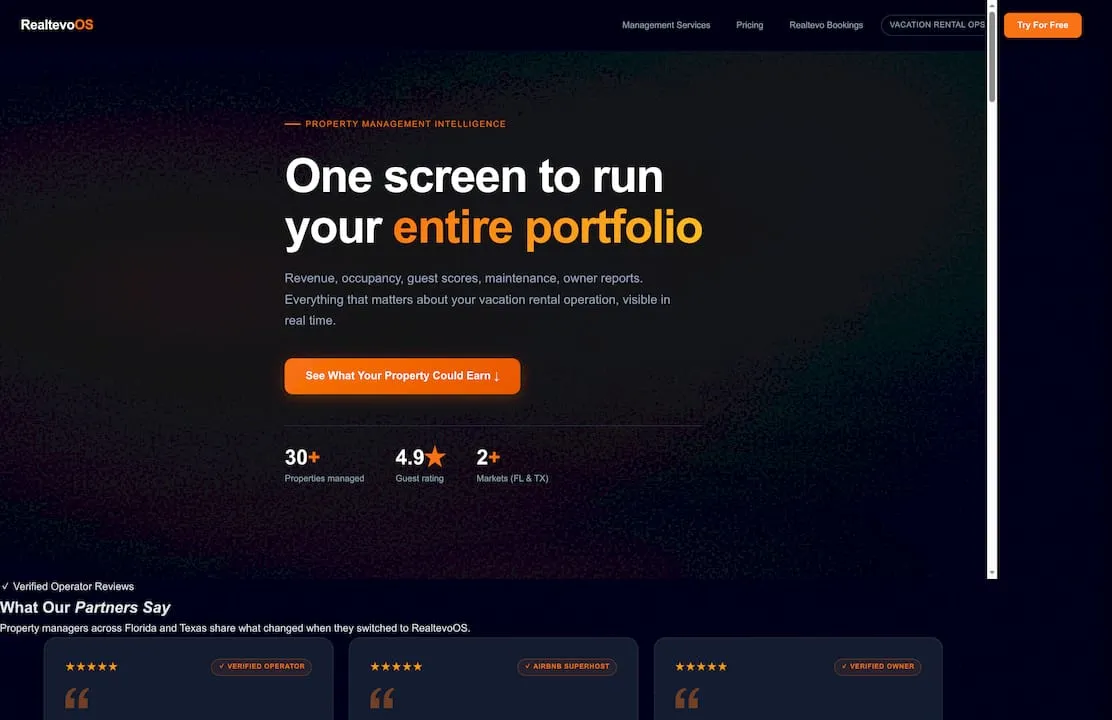
Realtevoos integrates real-time data from Airbnb and Vrbo into a single dashboard, automates guest communications, and gives property managers the live operational visibility that manual systems cannot provide. Property managers report saving several hours each week after switching. The platform is built to grow with your portfolio, so adding new properties does not mean adding new complexity. If you manage vacation rentals and want operations that run without constant intervention, explore Realtevoos and see what a connected platform actually looks like in practice.
FAQ
What are the main benefits of enterprise rental solutions?
Enterprise rental solutions reduce occupancy costs, eliminate manual data errors, and automate guest communications. They also enable real-time pricing adjustments and centralized management across multiple properties.
Is enterprise rental software worth it for small portfolios?
Enterprise rental platforms deliver measurable value even at smaller scales, but the return accelerates significantly once a portfolio exceeds 100 units. Staged adoption means you can start with the highest-friction workflows and expand from there.
How do enterprise rental solutions prevent double bookings?
Unified platforms synchronize booking and availability data in real time across all channels, removing the manual handoffs where double bookings occur. A single source of truth eliminates conflicting records at the source.
What is the best way to adopt an enterprise rental platform?
A staged modernization approach, connecting payments, compliance, and scheduling incrementally, reduces disruption and delivers faster results than replacing all systems at once. Starting during an off-peak period also reduces transition risk.
How do enterprise rental solutions improve guest satisfaction?
Automated check-in instructions, real-time maintenance scheduling, and consistent post-stay communications remove the friction points that generate negative reviews. Guests receive accurate, timely information without requiring manual staff effort at each step.