Role of Automation in Guest Experience: 2026 Guide
Discover the role of automation in guest experience. Transform touchpoints into reliable services while boosting team efficiency and guest loyalty.

Role of Automation in Guest Experience: 2026 Guide
Automation turns repetitive guest touchpoints into reliable, measurable service while freeing your team to deliver the high-impact human moments that build loyalty. For multi-property vacation rental managers, the role of automation in guest experience is no longer experimental. The AI Hospitality Alliance recommends treating AI as essential infrastructure, and the Mews Trend Report 2026 signals a clear shift from chatbots to agentic AI capable of autonomous coordination. The one-line recommendation: deploy an AI-powered operations platform like Realtevoos as your core infrastructure, pilot journey personalization and automated escalation first, then scale across your portfolio.
Table of Contents
- How does automation improve guest experience across your portfolio?
- What are the highest-impact automation use cases for vacation rentals?
- How do you roll out automation across a multi-property portfolio?
- How do you keep automation from replacing the human connection guests expect?
- What integrations does reliable portfolio-grade automation actually require?
- Where is guest-experience automation headed in the next 12–24 months?
- Realtevoos: built for portfolio-scale guest automation
- Key Takeaways
- The line most managers draw in the wrong place
- Why Realtevoos fits the multi-property manager coming from this article
How does automation improve guest experience across your portfolio?
Automation delivers five compounding benefits for property managers: speed, consistency, personalization at scale, proactive recovery, and revenue uplift. Each one maps to a KPI you can track from day one.
| Benefit | What Changes | KPI to Track |
|---|---|---|
| Speed | Instant responses to every inquiry, 24/7 | Average first-response time |
| Consistency | Identical SOPs executed across every property | Guest rating variance by property |
| Personalization | Context-aware messaging and upsell timing | Personalized upsell conversion rate |
| Proactive recovery | Sentiment detection flags issues before reviews | Resolution time; complaint rate |
| Revenue uplift | Dynamic pricing + ancillary recommendations | RevPAR; revenue per stay |
Personalization is where the compounding effect shows up most clearly. Recommendation engines can lift ancillary guest spending by roughly 7%, and when you pair that with smart rental pricing, the revenue and loyalty gains reinforce each other. Smart-room AI can also deliver 20–30% energy savings when paired with staff training and governance. Property managers using AI-driven platforms report saving several hours each week on manual communications alone, hours that shift to relationship-building and portfolio growth.
Stat: Recommendation engines can lift ancillary guest spending by ~7%, and smart-room AI can deliver 20–30% energy savings, according to the AI Hospitality Alliance.
What are the highest-impact automation use cases for vacation rentals?
The guest experience improvements managers feel fastest come from automating the transactional layer: the messages, codes, and confirmations guests need before they ever arrive.
- Pre-arrival onboarding: Trigger: booking confirmed → send a branded welcome guide 7 days out → send the door code 1 hour before arrival. This single sequence cuts check-in confusion and reduces inbound “where’s my code?” messages dramatically. See the full guest onboarding playbook for template language.
- Contactless check-in: Mobile and contactless check-in reduces wait times and measurably improves satisfaction scores when smart-lock delivery is reliable and timed correctly.
- Automated maintenance triage: When a guest reports an issue, automation logs the ticket, routes it to the right vendor, and sends the guest a confirmation with an ETA. Fewer negative reviews follow faster resolutions. The maintenance request automation guide covers vendor routing logic in detail.
- Housekeeping coordination: Checkout triggers a turnover task automatically, with property-specific checklists pushed to your cleaning team’s app. No manual dispatch, no missed turnovers.
- Upsells and local recommendations: Context-aware offers (a couple’s weekend → spa or dining suggestion; a family stay → activity guide) delivered in the pre-arrival window increase attachment rates without feeling pushy.
- Multilingual responses: AI handles translation automatically, with a fallback escalation rule that routes to a human agent when the system detects low-confidence language or emotional distress signals.
Pro Tip: Export your five best-performing guest reply messages from your inbox and use them to seed your AI’s knowledge base. Practitioners avoid the “generic bot” problem by encoding brand voice into style prompts, so every automated message sounds like your best agent, not a template.
How do you roll out automation across a multi-property portfolio?
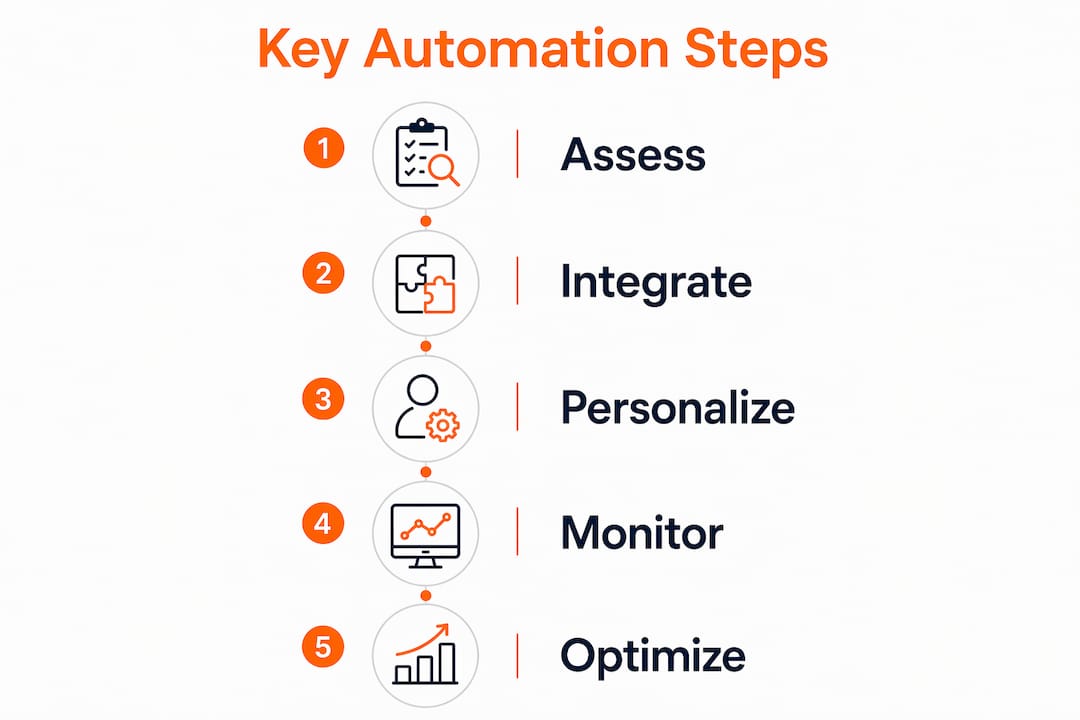
A staged rollout protects your guest ratings while you tune the system. Four phases, each with a clear exit criterion:
| Phase | Duration | Key Activities | Exit Criterion |
|---|---|---|---|
| Assess | several weeks | Audit PMS data, map current workflows, identify manual bottlenecks | Gaps documented; integration list confirmed |
| Pilot | several weeks | Deploy on 1 property; activate messaging, check-in, and maintenance automations | NPS stable or improved; response time down |
| Iterate | several weeks | Tune voice/prompts, refine escalation rules, adjust upsell timing | Escalation rate below threshold; guest rating holds |
| Scale | several weeks | Roll out across portfolio with staged property batches and staff training | All properties live; KPI dashboard active |
Cost drivers to budget for: PMS and channel manager integration complexity, smart-lock API setup, message volume tiers, and any custom workflow development. Onboarding services from your platform provider can compress the assess and pilot phases significantly. Track these KPIs throughout: NPS/guest rating, first-response time, resolution time, upsell conversion rate, and staff hours reclaimed per property per week. The scaling playbook for multi-property managers covers portfolio-level staging in detail.

How do you keep automation from replacing the human connection guests expect?
Over-automation is the most common adoption failure, and the primary barrier is organizational, not technical. The right model is staff-plus-technology: automate transactions, keep humans for emotional and complex interactions.
- Automate the transactional layer: Door codes, Wi-Fi passwords, check-in instructions, and FAQ responses are all safe to automate fully. Guests expect instant answers here.
- Configure escalation with context: When complaint language, frustration indicators, or emotionally charged phrasing appear, the system should route immediately to a human agent with the full conversation history attached. The guest never repeats themselves.
- Monitor red flags actively: Rising complaint sentiment, repeated escalations on the same topic, or a drop in loyalty scores all signal that an automation needs retuning, not more automation layered on top.
- Give staff oversight: Your team should see every active AI conversation and intervene with a single action. Successful managers treat AI as a colleague requiring oversight, not a replacement for judgment.
Pro Tip: Build a “human moments” list for each property type: the interactions where a personal call or handwritten note outperforms any automated message. Protect those moments deliberately, and your guest loyalty scores will reflect it.
Understanding the role of customer service as the emotional anchor of hospitality helps you draw the line correctly every time.
What integrations does reliable portfolio-grade automation actually require?
Automation is only as reliable as the integrations underneath it. Before you automate anything guest-facing, verify these systems are connected and tested:
- PMS (Guesty, Hostaway, or equivalent): Central ledger for bookings, guest data, and stay timelines. Every automation trigger originates here.
- Channel manager (Airbnb, Vrbo, and others): Real-time inventory sync prevents overbooking and keeps rates consistent across platforms.
- Smart locks: Secure, time-bound door-code delivery requires webhook support and a tested failover behavior. A missed code at 11 PM is a five-star review killer.
- Payment systems: Pre-authorization and damage deposit workflows need API-level integration to avoid manual reconciliation.
- Housekeeping and maintenance apps: Checkout triggers and issue tickets must flow automatically to your field teams with property-specific checklists.
- Owner portals and CRM: Automated owner reporting and owner relations workflows keep clients informed without manual report generation.
Realtevoos consolidates all of these into a single platform, with native integrations for Airbnb, Vrbo, Guesty, Hostaway, DocuSign, and common accounting tools. That consolidation matters because fragmented point solutions multiply your integration maintenance burden as you scale. AI in property management works best when the data layer is unified, not stitched together from five separate APIs.
Stat: Smart-room AI paired with staff training and governance can deliver 20–30% energy savings, per the AI Hospitality Alliance, making integrations a dual cost and sustainability lever.
Where is guest-experience automation headed in the next 12–24 months?
The Mews Trend Report 2026 identifies agentic AI as the next major frontier: systems that don’t just respond but take autonomous action, coordinating across departments without a human trigger. Early wins will appear in back-office coordination, guest messaging, and housekeeping workflows before agentic capabilities reach guest-facing interactions.
- Agentic AI in back-office first: Autonomous maintenance scheduling, owner report generation, and housekeeping dispatch are lower-risk starting points than guest-facing autonomous actions. Stage agentic features here before expanding.
- Converged conversational booking flows: Guests will book, modify, and request services through a single AI-powered conversation thread, with the PMS updated in real time.
- IoT and smart-room personalization: Connected rooms that adjust temperature, lighting, and entertainment preferences based on guest history will become a standard expectation, not a luxury differentiator.
- Futureproofing actions to take now: Invest in clean, unified guest data; prefer platforms with open APIs; build a semantic knowledge layer from your best guest interactions; and audit your escalation rules quarterly. See AI trends in property management for a deeper look at what’s coming.
Realtevoos: built for portfolio-scale guest automation
Realtevoos consolidates PMS and channel integrations, automated guest messaging, maintenance workflows, dynamic pricing, and real-time analytics into one command center built specifically for multi-property managers. Property managers report saving several hours each week on manual tasks, and the platform’s Airbnb, Vrbo, Guesty, and Hostaway integrations mean your automation stack stays synchronized across every booking source.
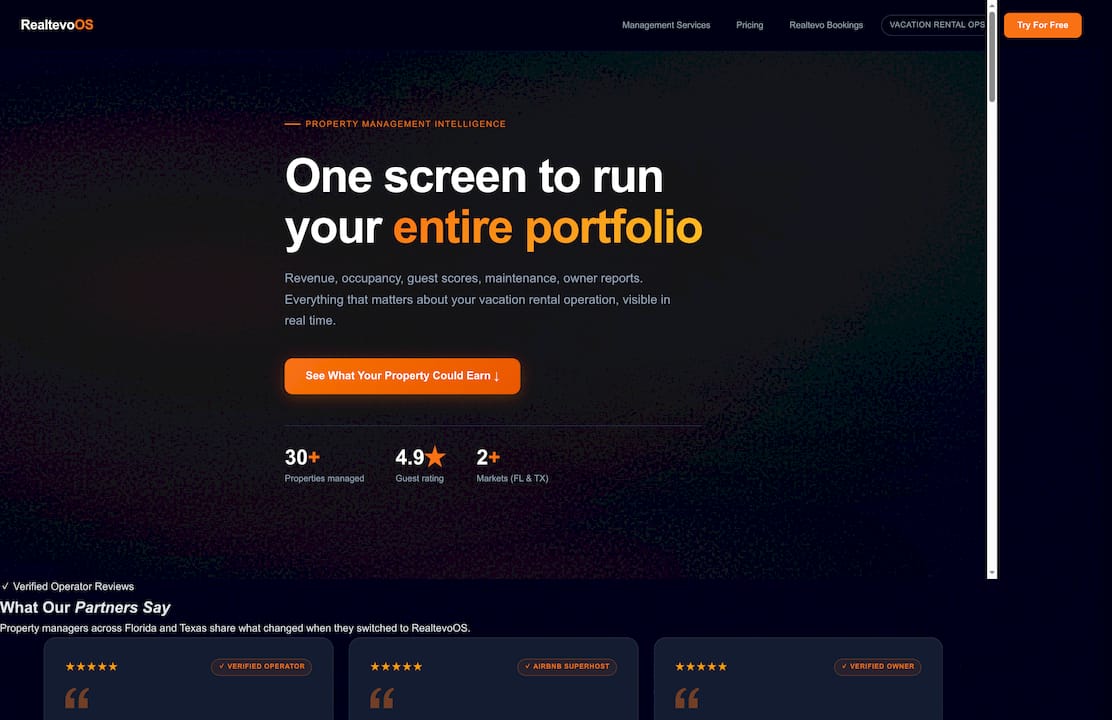
Pro Tip: Start your Realtevoos pilot on your three highest-volume properties. You’ll hit statistical significance on your KPIs faster, and the time savings will be visible within the first two weeks.
Stat: Property managers using Realtevoos report saving several hours each week on manual communications and reporting tasks.
Ready to see it in action? Explore the command center or start your free trial to put portfolio-scale automation to work for your properties today.
Key Takeaways
Automation makes guest touchpoints faster, more consistent, and personal at scale, but only when built on unified integrations, clear escalation rules, and a staff-plus-technology model.
| Point | Details |
|---|---|
| Automation as infrastructure | Treat AI-driven automation as core operations infrastructure, not an experiment, to see compounding ROI. |
| Pilot before scaling | Run a 4–8 week pilot on 1–3 properties before rolling out portfolio-wide; use NPS and response time as exit criteria. |
| Transactional layer first | Automate door codes, check-in instructions, and maintenance triage before tackling complex guest interactions. |
| Escalation rules protect loyalty | Configure automatic handoffs to human staff with full conversation context to prevent guest frustration. |
| Realtevoos for portfolio managers | Realtevoos consolidates PMS, channel, messaging, and maintenance automations in one platform for multi-property scale. |
The line most managers draw in the wrong place
The conventional wisdom says “automate the routine, keep humans for the personal.” That’s correct but incomplete. The mistake most managers make is treating “personal” as synonymous with “complex.” A guest asking for a late checkout is simple. But if they’ve messaged three times in two hours, that pattern is an emotional signal, and no automation should be handling message four.
The real line isn’t about task complexity. It’s about emotional temperature. Your automation stack should be reading sentiment continuously, not just routing by topic. When frustration appears, the system hands off. When the interaction is calm and transactional, it handles it completely. That distinction, built into your escalation rules from day one, is what separates a portfolio that earns consistent five-star reviews from one that generates polite three-star feedback about the “efficient but impersonal” experience.
The other underrated move: workflow templates built from your team’s actual best replies, not generic AI defaults. Your brand voice is an asset. Feed it into the system deliberately.
Why Realtevoos fits the multi-property manager coming from this article
You’ve just mapped out what portfolio-scale automation requires: unified integrations, sentiment-aware escalation, multilingual messaging, and a KPI dashboard that tells you what’s working. Realtevoos delivers all of that without the integration overhead of assembling five separate tools. One subscription covers guest messaging automation, dynamic pricing, maintenance triage, housekeeping coordination, owner reporting, and DocuSign document handling, all connected to Airbnb, Vrbo, Guesty, and Hostaway out of the box.
The concrete advantage for managers coming from this article: you skip the integration build phase entirely. Your pilot can start on real properties within days, not weeks. See everything the command center does and request a demo to get your portfolio live.